Everything about
PMI ACP Exam Content Outline

Complete guide to the 7 domains, 120+ tasks, and comprehensive syllabus for PMI Agile Certified Practitioner certification.


Table of Contents
Share This Article
Do you know that the Agile Certified Practitioner is PMI's fastest-growing certification? Agile is the way to go as more businesses seek proven methods to deliver incremental value faster and with greater customer satisfaction.
Agile Certified Practitioner by PMI is one of the leading agile certifications in the industry. It's prepared in collaboration with practitioners, who are integral to establishing those standards. The PMI-ACP certification and exam prepare you for the challenges of changing needs of the dynamic world by giving you the best practice using agile way.
We frequently hear that a PMI-ACP exam simulator is the best tool for helping candidates pass the test because it allows you to concentrate on developing your skills across a variety of pertinent agile topics. It is the ideal addition to your PMI-ACP course.
What Is the format of the PMI-ACP® Exam?
The PMI-ACP exam is a three-hour computer-based exam consisting of 120 multiple-choice questions. The pmi acp exam content outline domains are mapped to the questions.
Twenty of the questions do not count toward your overall score.You must be aware of the breakdown of the exam's questions. You can concentrate on the things that will help you get the best possible grades. You won't know which questions are for your grade and which are for the pre-test, so answer every question as if it matters, because it does! If you still need help understanding the concept, take a look at these PMI-ACP tips and tricks to ace the exam
Syllabus for the PMI-ACP® Exam
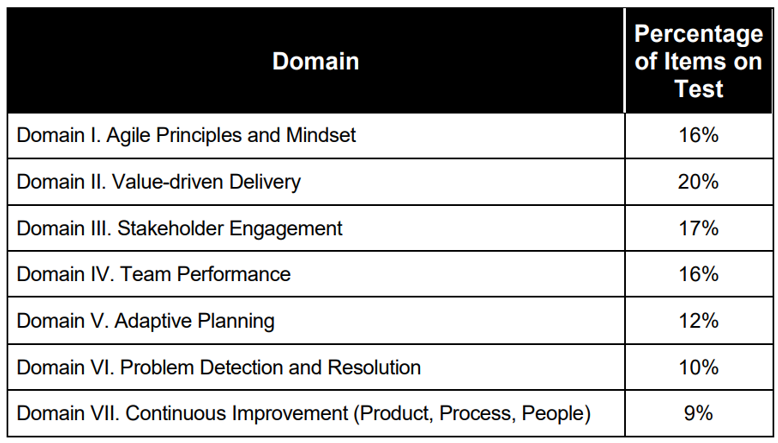
Reference - PMI ACP exam content outline
Domain I: Agile Mindset and Principles
The first pmi acp exam content outline domain is concerned with developing and fostering agile principles and the mindset required to work in an agile environment.
It all comes down to advocating for agile principles and assisting the team in using appropriate methods with a shared understanding. This domain seeks to investigate and assess your ability to demonstrate a facilitative, collaborative, and servant leadership style at work.
The following are important behaviors to consider as you prepare for your examination:
- Enhancing the visibility of actual project progress through the use of transparent and trusted information radiators for status sharing.
- Influencing processes and behaviors to encourage change at all organizational levels to improve efficiency.
- Using common terminology and ensuring that everyone in your organization understands what agile terms mean.
- Allowing team members to try out new techniques and methods of working, and then learning from their mistakes.
- Promoting self-organization and giving the team the authority to act.
There are 9 tasks in this domain:
- Promote the use of agile principles by demonstrating them, talking about them, and sharing agile values to create a common mindset within the team as well as between the customer and the team
- Assist in ensuring that everyone is aware of the agile practices and terminology, as well as the agile values and principles, in order to collaborate effectively.
- Support systemic or organizational change by educating the organizing and influencing people, processes, and behaviors to increase the organization's effectiveness and efficiency.
- To increase transparency and trust, practice visualization by keeping highly visible information radiators that display actual progress and team performance.
- Allowing everyone to experiment and make mistakes will help to create a safe and trustworthy team environment where everyone can learn from their mistakes and continually improve their working methods.
- Improve creativity by experimenting with novel methods and thought processes in order to identify more practical and successful working methods.
- To reduce the risks associated with knowledge silos and bottlenecks, encourage team members to share knowledge by collaborating and working together
- By creating a safe and respectful environment where new ideas can be tried in order to make improvements and encourage self-organization and empowerment, you can encourage emergent leadership within the team
- Employ servant leadership by assisting and motivating others in their endeavors so that they can deliver their best work and keep getting better.
Domain II: Value-driven Delivery
You should prioritize value for two reasons:
- Customers can start benefiting and profiting from the features that are most important to them long before the project is completed
- Stakeholders will be satisfied sooner, resulting in buy-in and engagement throughout the project lifecycle
The tasks for this domain is divided in sections:
Define Positive Value
- To maximize the value of deliverables to stakeholders while reducing non-value added work, identify units that can be produced incrementally while defining them
- To deliver value, clarify requirements by building consensus on the acceptance criteria for features on a just-in-time basis.
- To maximize value delivery, the team process should be chosen and customized based on the project, organizational, and team experience.
Avoid Potential Downsides
- Plan for small releasable increments by grouping requirements into minimally viable products/minimally marketable features to enable the early delivery and recognition of value.
- To identify risks early on and with the least expense possible, reduce increment size and increase review frequency with the appropriate stakeholders.
- Review increments frequently to confirm and improve business value, and ask users and customers for feedback.
Prioritization
- Work with stakeholders to prioritize the units of work in order to maximize the value of the deliverables.
- Prioritize and maintain internal quality when performing routine reviews and maintenance of the work products to lower the overall cost of incremental development.
- Maintain a constant awareness of it and attention to the environmental, operational, and infrastructure factors to raise the caliber and worth of the deliverables.
Incremental Development
- Conduct operational reviews and/or regular checkpoints with stakeholders to get feedback and make corrections to the work that is already being done and the work that is planned.
- To maximize the overall value proposition over time, balance the creation of deliverable units and risk reduction initiatives by adding both value-producing and risk-reducing work to the backlog
- For the purpose of maximizing value, rearrange requirements from time to time to take into account changes in the stakeholder community and the environment.
- Reduce the likelihood of failure by gathering and ranking pertinent non-functional requirements (such as operations and security) based on the environment in which the solution will be used.
- Conduct regular reviews of work products through inspections, reviews, and/or testing to find and include improvements in the overall process, product, and service.
Domain III: Stakeholder Engagement
The stakeholder engagement domain is concerned with how you collaborate with others throughout the project.
Two of the four Agile Manifesto values reflect stakeholder involvement in agile approaches. They are as follows:
- Customer involvement in contract negotiations
- Responding to change by following a strategy
This domain's key activities include:
- Iteration planning meetings
- Iteration reviews
- Retrospectives
- Day-to-day project status sharing via information radiators that are visible to all.
The tasks also includes:
- To make sure the team is aware of the interests, needs, and expectations of stakeholders, identify and involve effective and empowered business stakeholders through periodic reviews.
- Establish cooperative behaviors among team members by encouraging group decision-making and conflict resolution in order to increase decision-quality and shorten the decision-making process.
- Encouraging awareness among stakeholders, success criteria, deliverables, and acceptable trade-offs can be established and maintained, aligning expectations and fostering trust.
- You'll use all of these and more as you work with stakeholders daily, so they're important concepts to grasp for both your job and your PMI-ACP exam prep.
- Interpersonal skills are also important: conflict resolution, cultural awareness, negotiation, and sociopolitical awareness will help you build stronger working relationships with your team members and the larger stakeholder community for your project.
- Continually evaluating project and organizational changes will help you maintain proper stakeholder involvement by ensuring that new stakeholders are appropriately engaged.
- Create a high level vision and supporting objectives for the various project increments (products, deliverables, releases, iterations) in order to align stakeholders' expectations and foster trust.
- Transparency regarding work status should be provided by communicating team progress, work quality, risks, and obstacles in order to assist the key stakeholders in making wise decisions.
- Continually evaluating project and organizational changes will help you maintain proper stakeholder involvement by ensuring that new stakeholders are appropriately engaged.
Domain IV: Team Performance
We've seen a significant shift in the way the Project Management Institute – and all project management thought leadership – thinks about teams and stakeholders in recent years. The project manager's leadership role is recognized and expected, which is a good thing!
Agile projects benefit includes leadership skills, and there is also an emphasis on collaboration, cooperation, and facilitation. Human resource management is related to team performance. It covers the duties of selecting and leading your team to successful project outcomes
The tasks includes:
- To reduce team size and bottlenecks, encourage team members to become generalizing specialists, and to build a high-performing cross-functional team.
- In order to quickly create business value, assist in building a team with the interpersonal and technical skills required to meet all known project objectives
- Share the project vision with the team to help the team understand how its objectives fit into the project's overall goals, and take part in coordinating project and team goals
- Develop ground rules and internal procedures with the other team members to promote team coherence and strengthen team members' dedication to common goals
- Continuously identify team and individual motivators and demotivators to maintain high team morale and productive team members throughout the project
- Reduce misunderstandings and rework by fostering close communication within the team and with the proper external stakeholders through co-location or the use of collaboration tools
- To create a predictable outcome and maximise the value provided, reduce distractions.
- Share the project vision with the team to help the team understand how its objectives fit into the project's overall goals, and take part in coordinating project and team goals.
- To help team members better understand their capacity and produce more accurate forecasts, encourage the team to track and measure actual performance in previous iterations or releases
Consider the following tools and techniques for this domain:
- Communication and facilitation.
- Individuals are being cross-trained and up-skilled so that they can contribute in broad generalist roles.
- Tracking velocity to better understand the team's ability to complete work.
- Tasks involving forecasting and estimating
Domain V: Adaptive Planning
The domain of Adaptive Planning encompasses three major areas:
- Adaptation
- Levels of planning
- Agile estimation and sizing
Adaptation
Adaptation refers to the ability to respond to changes in needs and expectations over time. Your actions are based on retrospectives, to provide the most value possible.
Planning levels
Planning occurs on multiple levels, such as strategy at the company level, project selection based on strategy at the portfolio level, and proper project management at the project level. The outcomes of planning should be visible to encourage stakeholders to participate in and support the work.
Agile estimation and sizing
Agile sizing and estimation refers to the process of planning and estimating work. Techniques such as progressive elaboration to determine task size will aid in managing the team's velocity and keeping the project moving forward.
When planning the project, it is also critical to consider maintenance and operations work, and capacity planning becomes an important tool for the team.
The tasks includes:
- In order to increase commitment level and decrease uncertainty, make planning activities visible and transparent by promoting participation of important stakeholders and publishing planning results.
- In order to maximize the amount of business value delivered, review and modify the project plan to reflect modifications to the requirements, schedule, budget, and shifting priorities based on team learning, delivery experience, stakeholder feedback, and defects.
- To manage the project, modify the scope, schedule, and cost range estimates to account for the most recent knowledge of the work required to complete the project.
- Rolling wave planning and progressive elaboration are used to create plans at various levels (strategic, release, iteration, daily), balancing outcomes' predictability with the capacity to take advantage of opportunities.
- Set and manage stakeholder expectations as the project progresses by committing to ever-more-detailed deliverables to ensure that everyone is on the same page about what is expected.
- To maximise value, adjust the cadence and planning process based on the findings of periodic retrospectives about the qualities and/or the size, complexity, and/or importance of the project deliverables.
- To estimate the likely project size independent of team velocity and outside variables, size items using progressive elaboration techniques.
- To create or update the range estimate, adjust capacity by taking maintenance, operations, and other factors into account.
- To establish a starting point for managing the project, create initial scope, schedule, and cost range estimates that reflect the current high level understanding of the effort required to deliver the project.
- Utilize data from changing project size, resource capacity, and velocity metrics to continuously assess the estimated completion time.
The following are important skills to consider as part of this domain:
- Facilitation abilities
- The ability to analyze and decompose data while maintaining a constant focus on delivering value
- Leadership mentoring and coaching
Domain VI: Detection and Resolution of Problems
A large portion of the effort in an agile project revolves around establishing a sustainable working 'flow' as a team, which is what the sixth domain addresses.
The tasks includes:
- To uncover issues and roadblocks that are holding the team back or preventing it from delivering value, foster an open and safe environment by promoting dialogue and experimentation.
- Maintain a list of threats and issues that is visible, watched, and prioritized to increase accountability, spur action, and monitor ownership and resolution progress.
- Maintaining a threat list and incorporating activities into the backlog of work will help you transparently communicate the status of threats and issues.
- To maximize the value delivered, make sure issues are resolved by the appropriate team members and/or reset expectations in light of issues that cannot be resolved.
- Maintaining a threat list and incorporating activities into the backlog of work will help you transparently communicate the status of threats and issues.
Practitioners' primary tools and techniques include:
- Metrics such as the defect rate
- A risk-adjusted backlog
- Analysis of Variance
- Root cause investigation
- Techniques for problem-solving
This domain overlaps with the next one because the natural outcome of problem-solving is to implement the improvement activity.
Domain VII: Continuous Improvement (Product, Process, People)
This domain is concerned with tailoring and improving processes and work environments to increase team efficiency. It is the least tested area of the syllabus in the exam, but it is still important.
The tasks includes:
- To ensure team effectiveness within established organizational guidelines and norms, customize and adapt the project process by periodically reviewing and integrating team practices, organizational culture, and delivery goals.
- To build a more effective team of generalizing specialists, foster a culture of lifelong learning by giving people the chance to advance their skills.
- To prevent the recurrence of identified problems and enhance organizational effectiveness, create systemic improvements by disseminating knowledge and practices across projects and organizational boundaries.
- To increase the product's value, solicit customer feedback through frequent demonstrations and incremental delivery of the product.
- To build a more effective team of generalising specialists, foster a culture of lifelong learning by giving people the chance to advance their skills.
- Increase individual and team effectiveness by performing a value stream analysis, challenging existing process components, and eliminating waste.
This domain's key activities and tools include:
- Product evaluations and demonstrations
- Root cause analysis can be accomplished using tools such as the 5 Whys and fishbone diagrams.
- Learnings and feedback mechanisms
- Analysis of value streams for knowledge sharing
- All of these things help the team understand the work they're doing and how they're doing it so that feedback can be used to improve.
Which tools are covered by the PMI-ACP Syllabus?
The PMI-ACP syllabus includes a variety of tools and technologies that you must learn about in addition to the required modules if you want to earn the certification. Among the tools you will learn about are the following:
- Agile Analysis and Design
- Agile Estimation
- Metrics
- Communication
- Process Improvement
- Product Quality
- Planning and Monitoring
- Risk Management
- Value-based prioritization
Knowledge and Skills
- Agile values and principles
- Agile frameworks and terminology
- Agile methods and approaches
- Assessing and incorporating community and stakeholder values
- Stakeholder management
- Communication management
- Facilitation methods
- Knowledge sharing/written communication
- Leadership Building agile teams
- Team motivation
- Physical and virtual co-location
- Global, cultural, and team diversity
- Training, coaching, and mentoring
- Developmental mastery models (for example, Tuckman, Dreyfus, Shu Ha Ri)
- Self-assessment tools and techniques
- Participatory decision models (for example, convergent, shared collaboration)
- Principles of systems thinking (for example, complex adaptive, chaos)
- Problem solving Prioritization Incremental delivery Agile discovery
- Agile sizing and estimation
- Value based analysis and decomposition
- Process analysis Continuous improvement
- Agile hybrid models
- Managing with agile KPIs
- Agile project chartering
- Agile contracting
- Agile project accounting principles
- Regulatory compliance
- PMI's Code of Ethics and Professional Conduct
Some of them are explained below:
PMI's Code of Ethics and Professional Conduct
The PMI's code of ethics and professional conduct describes the expectations from the practitioners in the global project management community. It also articulates the ideal and the behaviors that are mandatory in the professional and volunteer roles.
Incremental delivery
Incremental delivery is building the products in a way that they could be easily deployed at the end of one or more iterations. It provides early feedback to the project that helps in improving the development of the rest of the project.
Agile Leadership
It has to embrace the agile principle of being flexible and adaptable and also motivates others to follow it. The attributes of an agile leader has to demonstrate model desired behavior, he should create and communicate vision, enable others to act etc.
Stakeholder's Management
Effective management of stakeholders can be the most important determinants of project success and it requires effective communication.
Team motivation
An agile leader needs to motivate the team. There are various theories which a leader should follow in order to motivate the team.
Conclusion
The pmi acp exam content outline, which is available on the PMI website, contains a review of the entire syllabus. You can always check the PMI ACP boot camps on EduHubSpot to ace your exam and get a complete idea of the exam content.
The PMI-ACP exam outline is broad because it requires practitioners to demonstrate their ability to work with a variety of tools and techniques. Agile practices are diverse, and you must have a toolbox of options from which to select the appropriate tools at the appropriate time in your project. Earning your certification will demonstrate to employers that you have the skills to assist them in delivering projects in a versatile manner.
Explore Our Latest
Insights

Stay updated with our recent blog posts.
Explore Our
Course Gallery

Discover a diverse range of courses designed to elevate your skills and knowledge.

