Integrating Agile and Predictive
Planning Methods Through the CAPM Framework

Learn how CAPM certification bridges agile and predictive project management methodologies. Understand when to use each approach and how to integrate them effectively.


Table of Contents
Share This Article
Introduction
The ever-evolving business landscape witnesses project managers are no longer confined to a single way of working. Some projects demand detailed and upfront planning, while others thrive in flexible and fast-moving environments. So how do professionals prepare to lead in both worlds?
Enter the Certified Associate in Project Management (CAPM®) - a globally recognized credential designed to bridge the gap between traditional and modern project methodologies. CAPM equips you with the tools to succeed
This blog will cover the understanding of agile vs predictive in CAPM and how this dual competency prepares you for real-world project challenges.
Understanding Agile vs Predictive in CAPM
The debate around agile vs predictive in CAPM is not about which is better but about knowing when and how to use each method. The CAPM curriculum has evolved over time to include both agile and traditional methodologies. This holistic approach allows candidates to be versatile project practitioners who can switch between approaches based on the project requirements.
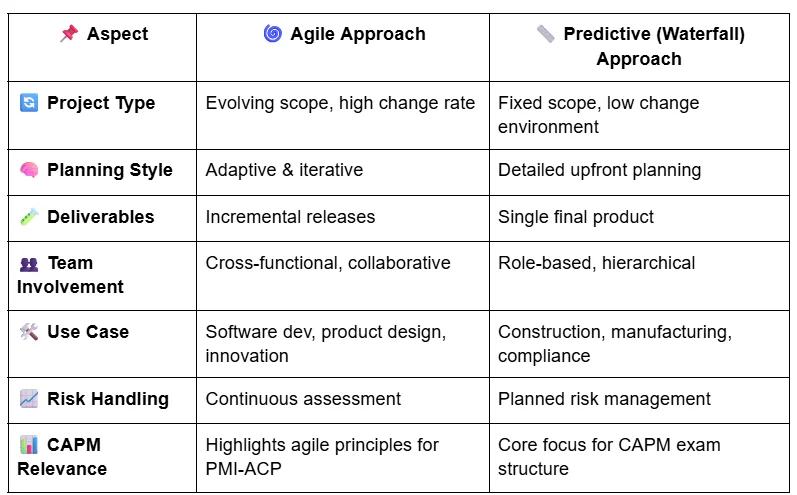
Predictive Planning - often referred to as the waterfall project model relies on a sequence of phases, which includes initiation, planning, execution, monitoring and closure. This method is most suitable for projects that have clearly defined deliverables and scope.
Agile Project Management - emphasizes flexibility, stakeholder cooperation, and rapid delivery via iterative cycle. This is ideal for projects whose requirements will change or evolve.
CAPM is a bridge between these two worlds. It ensures that professionals adapt to the context, rather than being strictly bound by a particular methodology.
Knowing CAPM as a Gateway to Adaptive Project Management
The CAPM certification is more than just an entry-level certification. It is a comprehensive framework-based approach that provides the foundation for adaptive Project Management. The 2023 CAPM includes topics like:
- Agile frameworks and principles (Scrum, Kanban).
- Hybrid methods
- Business Analysis
- Predictive planning tools for projects (e.g. Work Breakdown Structure).
This expansion reflects a shift in the industry towards flexibility and responsiveness. It gives learners the required tools to select the best strategy based on the project environment.
Understanding agile vs predictive in CAPM helps professionals assess project complexity and risks. The managers must focus on selecting a method (or combination) that aligns better with the success.
Agile vs Predictive in CAPM Use Cases
Predictive Planning Use Case: Infrastructure Development
Imagine a large-scale bridge construction project. From the beginning, scope, timetable, and materials have been well-defined. Here, predictive planning shines. CAPM helps professionals create detailed project charters and WBS documents. It teaches them how to allocate resources efficiently. This structuring is important because risks are known and changes can be costly.
Agile Use Case: Software Product Development
A software development team creating a mobile app, operates in an environment that is constantly changing. Iterations and changing stakeholder needs are important. CAPM prepares the candidates to conduct daily stand-ups and manage product backlogs. Agile empowers developers to embrace change and deliver working software rapidly and frequently.
Hybrid Use Case: Marketing Campaigns
Hybrid work models are required for many projects. Like, launching a new product with both agile and predictive tasks. CAPM shows how to combine traditional project planning and iterative cycles. Agile sprints are great for creative work but the larger scope is managed with predictive tools.
Process Comparison: Agile vs Predictive in CAPM
| Project Phase | Predictive Planning | Agile Methodology |
|---|---|---|
| Scope Definition | Fixed upfront through a detailed charter | Evolving scope with feedback-driven backlog refinement |
| Planning | Comprehensive planning at the start | Rolling wave planning with short iterations |
| Execution | Sequential tasks based on WBS | Time-boxed sprints with daily stand-ups |
| Monitoring & Control | Earned Value Analysis, baselines | Burn-down charts, velocity tracking |
| Closure | One-time project delivery | Continuous delivery with final product release |
CAPM does not force learners to choose one over the other. Instead, it highlights when each is most appropriate, giving practitioners the flexibility to pivot as project dynamics shift.
For a deeper understanding of how PMI supports both predictive and adaptive approaches, the PMBOK® Guide (7th Edition) along with the Agile Practice Guide offers authoritative insights. These resources provide detailed comparisons, hybrid use cases, and guidance on applying agile principles within the traditional project management structure.
Mapping Work Breakdown Structure to Agile Iterations
One of the most interesting integrations in agile vs predictive in CAPM is the mapping of a Work Breakdown Structure (WBS) - a traditional tool into agile workflows.
In predictive planning, the WBS decomposes the total scope into manageable deliverables and tasks. In agile, while the terminology changes (e.g., epics, user stories), the logic is similar.
Opt for Standardize Documentation
Use standard guidelines and templates for purchasing to assure uniformity in the RFQs - Request for Quotes, vendor evaluations and contracts.
Here's a way to bridge the gap:
-
WBS Element: Website Interface Design
→ Agile Equivalent: Epic: "Design User Interface"
→ Iteration Deliverables: Sprint 1: Homepage Mockup; Sprint 2: Contact Form -
WBS Element: User Authentication Module
→ Agile Equivalent: Epic: "Secure Login System"
→ Iteration Deliverables: Sprint 1: User Registration; Sprint 2: Password Reset Flow
This translation shows how agile and predictive methods can coexist. CAPM helps learners structure work predictively and then break it into iterative cycles for agile execution.
Benefits of Integrating Agile and Predictive Through CAPM
Gives Broader Career Opportunities
As industries adopt hybrid project environments, employers seek professionals skilled in both agile and predictive methods. CAPM certification equips individuals with the versatility to manage diverse project types, increasing job prospects across sectors like IT, construction, finance, and healthcare.
Helps With Improved Risk Management
CAPM teaches professionals to assess and respond to both known and emerging risks. By integrating predictive tools for detailed planning and agile techniques for adaptability, project managers can proactively mitigate issues and ensure successful outcomes in uncertain or rapidly changing environments.
Ensures Stakeholder Satisfaction
Hybrid project approaches enable greater alignment with stakeholder expectations. CAPM-certified managers can combine agile's rapid feedback loops with predictive structure to ensure transparency and responsiveness. This can bring improved trust, collaboration, and stakeholder confidence throughout the project lifecycle.
Provides Enhanced Decision-Making
CAPM fosters analytical thinking grounded in project context. Rather than defaulting to a single methodology, certified professionals evaluate project size, risk level, and stakeholder input to select the most effective planning approach. This leads to smarter and more informed decisions at every project stage.
Conclusion
In a world where change is constant and project demands vary, mastering both agile and predictive approaches is a necessity. The CAPM certification empowers aspiring project managers to confidently lead in any environment by blending structure with adaptability. CAPM provides the knowledge and tools to deliver successful outcomes. Understanding agile vs predictive in CAPM provides a strategic edge and opens doors to more opportunities. Embrace the hybrid future – CAPM can be your launchpad into adaptive project management excellence.
Frequently Asked Questions (FAQs)
Does the CAPM credential include both predictive and agile methods?
Yes, the most recent CAPM exam covers both agile and predictive methods, getting test takers ready for hybrid project settings.
When do I apply agile vs predictive in CAPM?
Apply predictive for stable, organized projects and agile for projects with volatile requirements or high stakeholder engagement.
Can I use both agile and predictive approaches within a single project?
Definitely. CAPM instructs hybrid techniques to enable you to combine both techniques according to project requirements.
Explore Our Latest
Insights

Stay updated with our recent blog posts.
Explore Our
Course Gallery

Discover a diverse range of courses designed to elevate your skills and knowledge.

