What Is the Goal of CI/CD Pipelines and How Can Teams Optimize Them in 2026?


Table of Contents
Share This Article

Today, software is much more than code. It is the foundation of every industry, digital experience, and product. Software updates work silently behind the scenes, whether you are booking a flight or tracking your shipment, and more. The rapid pace of change puts a lot of pressure on the engineering teams. They are expected to deliver fresh features, roll out changes, and correct issues with remarkable speed. They must ensure their work remains stable and trustworthy while also solving today's corporate gaps.
The CI/CD Pipeline comes as the solution to this problem. It's not just an automation tool. It's the core ecosystem for a stable, predictable, and high-speed delivery of software. The pipeline's role is changing as we approach 2026. It is no longer just a delivery mechanism; it is becoming a strategic advantage, a risk management tool, a quality gate, and a productivity catalyst.
In this long-form, deeply detailed article, we explore:
- What CI/CD pipelines fundamentally aim to achieve
- The evolving nature of pipelines in 2026
- The common hidden challenges most teams don't talk about
- How to optimize pipelines in terms of speed, reliability, and resilience
- What the future of software delivery looks like
This isn't the usual template article that you find on the Internet. This article's structure is unique, insight-driven, and designed to provide clarity, depth, and forward-thinking suggestions, making it especially useful for professionals learning through a structured DevOps online course that focuses on real-world CI/CD implementation.
Let's dive in.
Why CI/CD Pipelines Exist: Understanding the True Goal
When asking, "What is the goal of a CI/CD Pipeline?", many people immediately answer: "Automation."
But automation is the mechanism, not the goal.
The true goals are much deeper, and they form the foundation of why every modern engineering team relies on a CI/CD Pipeline.
To Remove the Fear of Deployment
Historically, releasing software was risky. Teams avoided deployments because:
- Bugs frequently slipped in
- Rollbacks were painful
- Downtime was common
- The process was slow and manual
- The entire team had to stay late during the release windows
The CI/CD Pipeline reduces anxiety by making deployments smaller, consistent, and reversible.
To Turn Delivery Into a Continuous Flow Instead of a Stress Event
High-performing engineering teams do not "prepare for releases." They release whenever the code is ready - often multiple times a day.
The CI/CD Pipeline changes software delivery from:
a stressful, scheduled event
into
a predictable, repeatable, everyday flow
To Shorten the Distance Between Idea and User Impact
When software takes months to reach users, innovation suffers.
A well-optimized CI/CD Pipeline:
- reduces delivery delays
- shortens decision cycles
- accelerates customer feedback
- fuels innovation
Every hour shaved off delivery time is an hour gained in customer value.
To Build Confidence in Every Code Change
Confidence is the hidden currency of high-performing engineering teams.
Confidence comes from:
- Fast test feedback
- Automatic quality checks
- Repeatable build processes
- Reliable deployments
A CI/CD Pipeline allows the development team to spend less time worrying about whether something will break and more time on creating something valuable.
What a CI/CD Pipeline Looks Like in 2026
The modern pipeline is far more advanced than linear pipelines. It's not just:
developer → test → deploy
It is an integrated system woven through every part of engineering operations. Pipelines are now treated as long-term engineering assets rather than simple automation scripts, a mindset commonly reinforced in advanced DevOps certification course curriculums that emphasize scalability, reliability, and ownership.
Pipelines Are Becoming Intelligent Decision-Makers
Modern pipelines incorporate intelligence:
- ML-driven test selection
- Anomaly detection in deployments
- Predictive failure analytics
- Quality scoring
- Adaptive parallelization
They are not just running scripts - they are making decisions.
Pipelines Are Architected Like Products, Not Scripts
Teams treat their CI/CD Pipeline as:
- Software
- Infrastructure
- A shared internal product
With owners, roadmaps, SLAs, upgrades, documentation, and monitoring.
Pipelines Are Modular and Service-Aligned
Monolithic pipelines no longer make sense. In 2026, pipeline are:
- Componentized
- Service-specific
- Independently optimized
- Individually deployable
This mirrors the architecture of modern software itself.
Pipelines Are Designed for Cloud Scaling
Cloud platforms allow pipelines to scale:
- Horizontally for parallel testing
- Vertically for resource-heavy builds
- Dynamically with usage
The speed of a single server is no longer a limitation.
The Layers of a High-Performing CI/CD Pipeline
For optimizing a CI/CD Pipeline effectively, project team members must understand its layers, which are:
The Source Control Foundation
Everything starts with source control.
A stable CI/CD Pipeline requires:
- clean branching strategy
- fast merges
- minimal conflicts
- consistent commit quality
This is where Trunk-Based Development plays an important role.
The Build and Compile Layer
An optimized CI/CD Pipeline includes build caching, incremental compilation, and deterministic output.
Without this layer functioning well, the rest of the pipeline becomes slow and fragile.
The Multistage Testing Layer
Testing is not a single step—it is a layered architecture:
- Unit tests
- API tests
- Integration tests
- Database tests
- UI tests
- Smoke tests
- Performance tests
- Security scans
The CI/CD Pipeline orchestrates these tests at the right time to balance coverage and speed.
The Deployment Automation Layer
Deployments must be:
- Automated
- Repeatable
- Reversible
- Observable
- Safe
Without automation, deployments become congested.
The Observability Layer
The CI/CD Pipeline now includes:
- Build metrics
- Test duration metrics
- Deployment logs
- Performance dashboards
- Anomaly alerts
Observability is the nervous system of the pipeline.
How to Optimize CI/CD Pipelines in 2026
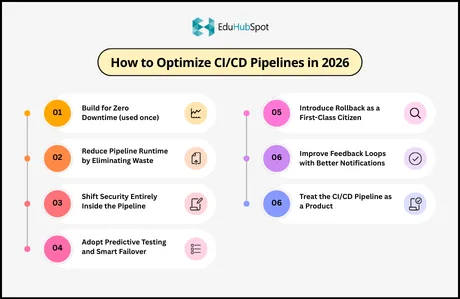
Here is the core of the article, the detailed optimization guide that teams can use to modernize their pipelines for 2026 and beyond.
Build for Zero Downtime
Modern applications cannot afford outages. Your CI/CD Pipeline must support:
- Blue-green deployments
- Canary rollouts
- Traffic shadowing
- Progressive exposure
This ensures updates replace each other without affecting users.
Reduce Pipeline Runtime by Eliminating Waste
Many pipelines are slow because they run unnecessary steps. Optimization methods include:
- Test parallelization
- Dependency caching
- Intelligent test selection
- Skipping builds for non-code changes
- Ephemeral environments
A fast CI/CD Pipeline means developers stay in flow instead of waiting.
Shift Security Entirely Inside the Pipeline
Security cannot rely on manual review. It must be:
- Automated
- Continuous
- Invisible to developers
- Integrated into every stage
The pipeline becomes the gateway to secure code.
Adopt Predictive Testing and Smart Failover
The CI/CD Pipeline should learn from historical data. With predictive testing:
- The riskiest code paths are tested first
- Flaky tests are flagged
- Failing areas get more coverage
- Deployment failures can be predicted in advance
This is the future: pipelines that think.
Introduce Rollback as a First-Class Citizen
An optimized pipeline treats rollback like deployment:
- Simple
- Automated
- Reversible
- Supported by instant traffic shifting
Rollback strategy is no longer optional.
Improve Feedback Loops with Better Notifications
Timely feedback transforms pipeline efficiency. This means:
- meaningful notifications
- developer-focused logs
- deployment impact summaries
- error context in one place
The faster the feedback, the faster the team.
Treat the CI/CD Pipeline as a Product
2026 pipelines should have:
- Owners
- Monthly upgrades
- Roadmap planning
- Testing baked into the pipeline itself
- Review cycles
- Dedicated maintenance time
The teams that treat their pipeline as internal infrastructure do better than teams that treat it as an afterthought.
The Most Common CI/CD Anti-Patterns and How to Fix
Too many checks, gates, plugins, and tools slow the pipeline down.
The fix: Focus on impactful automation, not excessive complexity.
Not Versioning Pipeline Configurations
A pipeline must evolve safely.
Lack of versioning leads to unpredictability.
Allowing Pipeline Failures to Become "Normal"
A failing pipeline signals chaos.
A healthy pipeline signals quality.
No Pipeline Observability
You cannot optimize what you cannot see.
Most pipelines have zero visibility into:
- Slowest stages
- Unstable components
- Bottlenecks
- Flakiest tests
Manual Steps Hidden Inside the Process
Any manual step, however small, is a point of failure.
Any manual step, however small, is a point of failure.
What the Future Holds?
It looks like:
- Autonomous (self-healing and self-optimizing)
- Context-aware (understanding the code it processes)
- Risk-scoring (scoring every commit)
- Deployment-strategic (choosing the best rollout method automatically)
- Environmentless (running entirely in ephemeral, cloud-based sandboxes)
The CI/CD Pipeline is not fading, it is becoming the most critical part of software engineering infrastructure.
Conclusion
The CI/CD Pipeline Is No Longer a Tool - It's Your Competitive Advantage
As we move deeper into 2026, the organizations that master the CI/CD Pipeline will outperform those that treat it as optional. The pipeline is now:
- The safeguard of reliability
- The engine of innovation
- The guardian of code quality
- The accelerator of release velocity
- The backbone of engineering culture
Optimizing your CI/CD Pipeline today means delivering better software tomorrow - and doing so predictably, safely, and at scale.
Frequently Asked Questions (FAQs)
What will you call the biggest mistake that teams make when it comes to CI/CD?
It can be overcomplicating a pipeline by adding unnecessary tools or steps that can slow down processes and frustrate developers.
Can small teams benefit from CI/CD, or does it work only for large companies?
Small teams can benefit the most as CI/CD allows them to move faster with fewer people and less overhead.
How does optimizing a CI/CD pipeline improve developer productivity?
It creates a simple workflow and reduces waiting times. It creates a scenario where developers can concentrate on building instead of fixing.
Explore Our Latest
Insights

Stay updated with our recent blog posts.
Explore Our
Course Gallery

Discover a diverse range of courses designed to elevate your skills and knowledge.

