What Is Multimodal AI?
How It Understands Text, Images & More in 2026


Table of Contents
Share This Article
The year 2026 is transforming into a revolutionary year in the field of AI. One major factor for this transformation is multimodal AI. It is a strong form of AI which integrates and elaborates data from different sources, including text, voice and images. We have left those days far behind when AI models could only process single inputs at a time. However, the smart applications of recent years are more spontaneous, conversational and human-like. This is due to the introduction of multimodal AI. But what exactly is this multimodal AI? And how does it understand text, images and other apps? Let's focus on this blog.
Understanding of Multimodal AI
The multimodal AI is a section of AI which combines data from different sources, like text, images, audio, and video, to gather a strong understanding of information. Unlike traditional AI models, which process only one type of data, multimodal AI includes different inputs to improve the context, interpretation and overall performance. Therefore, the main goal of multimodal AI is to use different types of data for more accurate analysis.
Let’s consider Zoom as an example, which analyses both audio and visual to improve virtual meetings with the help of using AI. Different features, such as emotional analysis and automatic meeting highlights, have become possible with the ability of the systems to discover the uncertainty symptoms or frustrations during conversation on the basis of expression or speech tone.
Therefore, by representing systems which understand human communication and context more precisely than single-modality AI, the multimodal AI is evolving the business.
Major Elements of Multimodal AI
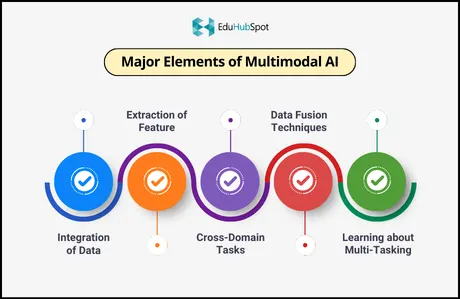
The five major elements of multimodal AI help in processing, aligning and understanding various kinds of data. Each component is essential in ensuring multimodal AI can comprehend and reason across modalities.
1. Integration of Data
Designing these systems includes merging and synchronising data from definite sources or modalities. This means transforming text, image, audio or video into a single representation.
Proper data integration enables the AI to discover context by highlighting all available information.
2. Extraction of Feature
This component involves the derivation of meaningful features from the respective modalities. For example, in images, this extraction feature includes recognition of various objects or patterns. On the other hand, in textual data, it includes analysing context, emotion and key phrases. Thus, the extraction of features is vital to AI as it helps the AI to understand the various types of data.
3. Cross-Domain Tasks
The shared representations are also learned through multiple domains. The knowledge of AI increases as it tries to outline the features learned from various data sets, based on how they are related to one another.
These cross-domain tasks offer AI in relating various types of data to each other, therefore, improving the overall understanding of the task.
4. Data Fusion Techniques
The data fusion technique selects data from various modalities and produces an integrated output. These technologies can also include different forms such as snipping, appeal process or higher scaffolds.
This effective information synthesis helps to pull information from various sources to develop a single comprehensible output or make a specific prediction.
5. Learning about Multi-Tasking
Multimodal AI leverages multitask learning, where a model is trained on different tasks using data from various modalities.
This multi-task learning helps the AI select all the relevant facts within the task framework, improving its speed and accuracy in managing the task complexity.
How Multimodal AI Works
Multimodal AI leverages different single-mode networks to manage various inputs, combines these inputs and produces outcomes based on particulars of the incoming data.
It can be illustrated in various ways, such as text-to-image models, text-to-audio models, audio-to-image models and all these combined together. These models share similar operating principles, whatever the modalities. The working procedures of the multimodal AI are as follows.
Text-to-Image models
This model begins with a procedure, which is known as diffusion. This process initially creates images from random patterns, known as Gaussian noise. A common problem with these early diffusion models was their lack of direction. They could generate any image, but without a clear focus.
To transform these models into more useful aspects, the text-to-image technology represents textual descriptions to supervise the image generation. That is, if you add the word ‘dog’ into the model, it will use the text to shape the noise into the clear image of a dog.
The text-to-image technology changes the text and images into mathematical vectors which capture their fundamental meaning. It helps the model to understand and interpret the text with proper images.
To start the process, consider that we have a dataset of images, each of which is paired with a caption. For each pair, we process the text and image through the respective encoders, which results in a pair of vectors for each image-caption pair.
Thus, to generate an image, this model implants the input text into the meaning space, translates the textual vector into a visual factor and then decodes this visual vector into the creation of the final image.
Text-to-audio models
These models transform written text into speech or other forms of audio output. They learn patterns of pronunciation, tone, and pacing to generate natural-sounding audio from text prompts.
Audio-to-Image Model
Transforming audio into images might sound direct, but it is actually complicated. At present, there is not a single model which directly transforms audio into images. Rather, we use a set of steps, including the multimodal models, to make this occur.
At first, we should start with audio input, such as elaborating on a scene. This audio will not be directly transformed into an image, but it will be transformed into text at first because text is a universal medium which connects different forms of data. This is because of the clarity and detail conveyed by the text, which are vital for the next steps.
After that, this text is used for image creation. There will be a component where the model is trained to provide both image and text during the learning phase. Users then interact with these outputs, selecting the ones that fulfil their needs. This interaction will help to learn the type of output text or image that is expected in different scenarios.
Key Benefits of Multimodal AI
Multimodal AI is an evolving technology which offers analytic benefits which single-modality AI systems cannot match. The benefits of multimodal AI are as follows.
More humanistic interactions
By elaborating visual prompting, voice tones and written text together, the smart apps become more compassionate and spontaneous.
Improved accessibility
Multimodal AI allows people with disabilities to cooperate with apps using different inputs, such as voice commands or image gestures.
Strategic personalisation
With rich data, apps can provide hyper-personalised experiences. For example, an app may recommend an exercise pattern based on your facial fatigue, spoken mood and typed aims.
Improved automation
Tasks which need human intelligence, such as reviewing the resumes (text and formatting), scrutinising charts or image and transcribing interviews are automated effectively.
Real World Applications of Multimodal AI
The practical use of multimodal AI is as follows:
Healthcare Assistants
Multimodal AI has transformed diagnostics. Consider an app where a medical professional uploads your reports, describes symptoms verbally and receives a detailed report, all assisted by a multimodal AI engine which understands the visual patterns and spoken context.
Language Learning Applications
Apps such as Duolingo use image+voice+text to improve engagement. You can tell a phrase, visualise a cue and get feedback; all procedures will take place seamlessly to enhance understanding.
Visual Shopping Tools
Place your phone on a dress, explain what kind of shoes you want, and the shopping app will show the results which match both the verbal and visual inputs. This is how multimodal AI works in e-commerce.
Smart Virtual Assistants
Nowadays, modern assistants not only respond to voice, but they also read messages, analyse screenshots, understand video instructions and help you to complete tasks across various platforms.
Final Thoughts
Multimodal AI is not only a trend, but it is the next generation of intelligence. In 2026, multimodal AI is no longer an innovative approach, but it powers the smart apps which we use in our daily lives. If it is improving online learning, stimulating accessible healthcare or redefining the shopping experience, this approach is developing a new standard.
Since AI is continuously evolving, the line between human and machine communication will become more blurred in future, and if you want to start your career with AI, then enrollment in the Gen AI course could be the smartest move.
Frequently Asked Questions (FAQs)
What is the aim of multimodal AI?
Multimodal AI connect and processes different types of inputs such as text, voice and images to understand the context more efficiently. It aims to create more natural and accurate AI systems to interact with humans.
How does multimodal AI enhance user experience?
It allows AI systems to understand and respond through different input types, such as text, voice, images and gestures. This results in more spontaneous and adaptive interactions.
Is ChatGPT considered to be multimodal AI?
Yes, ChatGPT is a multimodal AI which can process both images and text.
Explore Our Latest
Insights

Stay updated with our recent blog posts.
Explore Our
Course Gallery

Discover a diverse range of courses designed to elevate your skills and knowledge.

