Why PfMP? The Importance of Portfolio
Management In today's Business Environment

Discover why portfolio management (PfMP) is crucial in today's business environment. Learn how it enhances productivity and aligns investments with business objectives.


Table of Contents
Share This Article
If your organization wants to enhance its productivity and want to meet its goals and desires then you must look for portfolio management(PfMP) as a key tool. With portfolio management skills organizations can be agile, flexible, and sensitive to consumer needs which is crucial in today's business environment where competition is severe and market dynamics are changing rapidly. Organizations can better utilize resources, manage risks, and align investments with business objectives with the aid of portfolio management.
Organizations that successfully apply portfolio management methods are more likely to achieve their strategic goals and more likely to execute projects on schedule and within budget, according to a Project Management Institute (PMI) study.
Selecting, prioritizing, and managing a group of initiatives and programs that collectively produce company value is known as portfolio management. It offers a structure for locating and assessing investment opportunities, matching them to corporate objectives, and overseeing their execution to get the desired results. Effective portfolio management enables firms to avoid investing in projects that do not deliver enough value while concentrating on the projects and programs that are most important to attaining their strategic objectives.
The Function of Portfolio Management
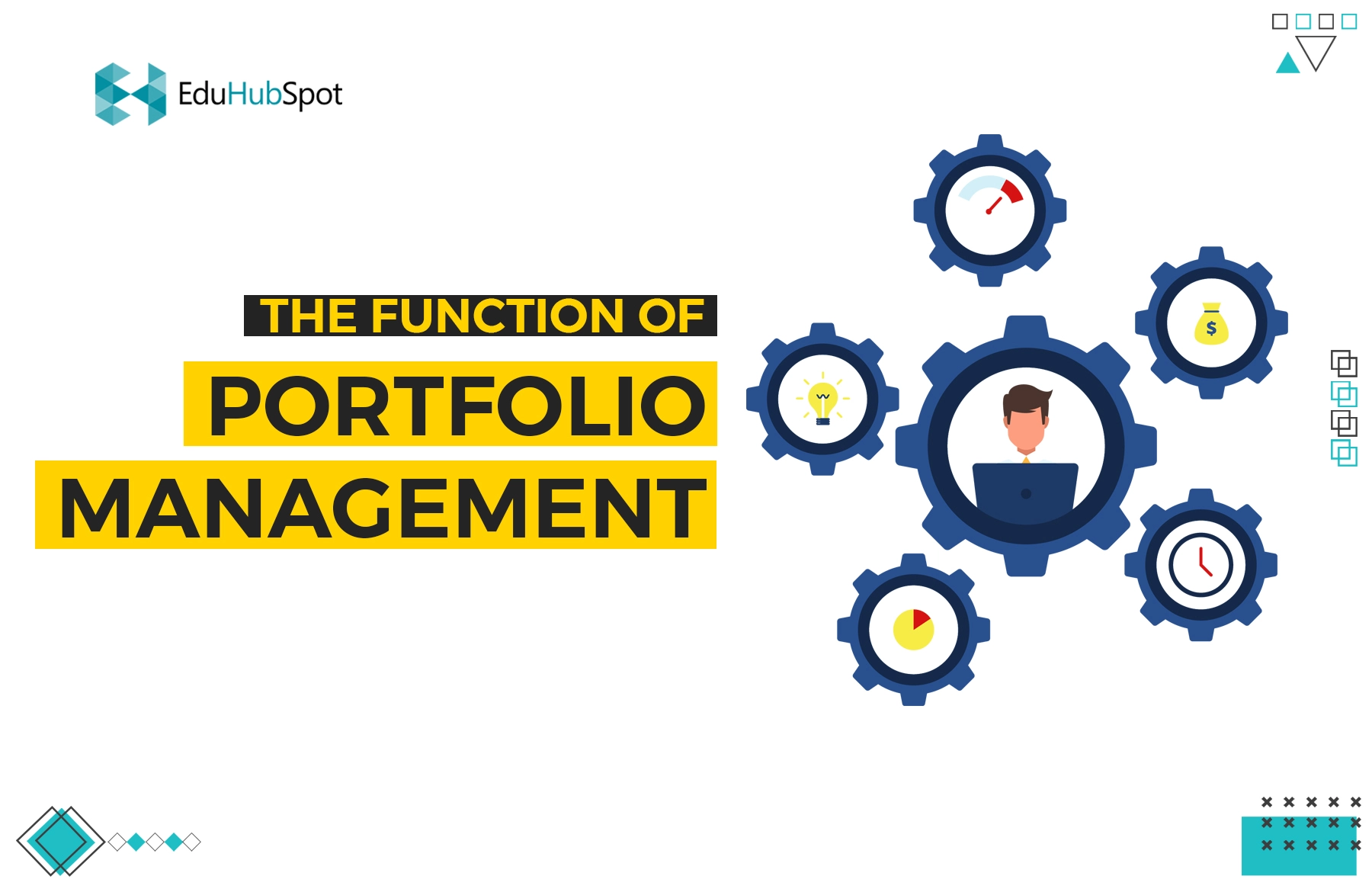
When it comes to portfolio management(PfMP), there is no one-size-fits-all method. A tailored and strategic investment plan is necessary because every person or business has a different set of investments. Now that you are aware of what portfolio management is, let's break it down into its component parts:
Planning
- Find out what the client wants: Recognize the demands of your clients, their long- and short-term ambitions, and their financial needs in terms of capital growth or steady returns.
- Limitations should be taken into account. Calculate associated risks, liquidity outlooks, and estimated returns from various asset pairings.
- Create a solid strategy: involves a strategic, tailored asset allocation based on the investor's objectives and market trends.
Execution
- Invest in successful ventures: After carefully evaluating the fundamentals, liquidity, and credibility of the chosen portfolio of securities, make investments therein.
- Reduce risk by diversifying your investments according to your spending plan, time frame, and financial objectives.
Feedback
- Assess efficiency: Track and evaluate the portfolio's risk-to-return ratio to ascertain its efficiency.
- Rebalance the portfolio's composition to maximize profits by making changes dependent on the state of the market.
The Role of the Portfolio Manager
Let's examine what a portfolio manager(PfMP) does as we have defined what portfolio management is. A portfolio might contain a range of investments that are spread over numerous accounts or put in a single account. This could be a taxable investment account or even a retirement account. Such selections are made simpler with the aid of a portfolio manager.
A portfolio manager's primary duties are as follows:
- Let the client know about any pertinent investment tools.
- conceive of and carry out individualized investment strategies
- Depending on your investment aims, select the best asset class.
- Construct and maintain financial portfolios
- Assessing and keeping an eye on the resources
- Monitoring performance and risk management
- Depending on market conditions, rebalance the portfolio.
A portfolio manager is simply someone who assists in creating and putting into action the greatest financial investment strategy, one that is well-diversified and produces high returns.
Benefits of Portfolio Management
1. Placing Investments in the Correct Location
Visualize a firm as a large jigsaw. It has objectives it hopes to accomplish. The individual who puts the puzzle pieces together is analogous to portfolio management(PfMP). They perform actions that are in line with the broad objectives of the business. By doing this, the business can avoid wasting resources on unimportant activities. The company becomes better at what it does and becomes more distinctive when the initiatives are matched with the objectives.
2. Reducing issues and judicious use of resources
Consider sowing various seeds in a garden. There are plenty of other seeds, so it's acceptable if some don't flourish. Spreading your projects out like seeds is how portfolio management works. The failure of one is not a major issue. Consider your gardening tools as well. You must make the best use of them. Managing a portfolio is similar to using your tools properly. By doing this, you avoid doing too little or too much.
3. Picking the Best Contents First
Imagine the projects as various toys you may have. Many more enjoyable toys exist than others. Choosing which toys to play with initially can be aided by portfolio management(PfMP). It examines the toys that generate the greatest revenue, the toys that are most popular, and the toys that satisfy customers. In this manner, the business can identify the coolest toys and prepare them first.
4. Decluttering and Money Saving
Assume you have a lot of things in your room, some of which you don't need. Cleaning up and getting rid of the stuff you don't use is a smart idea. Managing a portfolio is similar to organizing a room full of tasks. Projects that don't advance the company's objectives or offer little value are eliminated. Additionally, it's similar to managing your finances wisely to avoid overspending on unimportant items.
5. Improving Projects and Preventing Issues
Managing a portfolio is similar to monitoring all of your schoolwork. You can correct a project that isn't going well before it's too late. This enhances your academic performance. Portfolio management similarly monitors business projects. They have time to make adjustments if something does not go according to plan. Projects are improved as a result, and failure is avoided.
6. Being Prepared for Changes
Picture a business as a superhero that can instantly change into a new outfit. The environment we live in, such as the weather or what people prefer, changes quickly. The organization can alter swiftly with the aid of portfolio management. The business can swiftly modify its strategies if customers start to prefer alternative products or if new technology is introduced. This makes the business shrewd and competitive.
Portfolio management improves an organization's ability to react to market changes, client needs, and new opportunities. It offers a methodical approach to resource management, risk mitigation, and investment return optimization. It assists firms with risk management through efficient monitoring and control, impact assessments of various investment scenarios, and investment prioritization based on strategic priority.
Portfolio management can also assist businesses in streamlining their operations and cutting costs. By eliminating redundant and low-value projects, organizations can free up resources and concentrate on activities that generate greater value. Additionally, it helps reduce the chance of project failure and enhance overall project performance.
Conclusion
We came to know why PfMP is needed. Moreover, we understood that to enhance portfolio management, firms should have clear governance schemes that consist of regulations, suggestions, and frameworks for making selections. They should also spend money on hiring qualified staff, task management software, and data analytics technology to enable the best portfolio control. Conducting a Strengths, Weaknesses, Opportunities, and Threats (SWOT) analysis of the investment portfolio is one exercise to strengthen portfolio management. The SWOT analysis can be used to decide areas of strength and weakness, examine the outcomes of numerous conditions, and create plans to reduce risks and make high-quality use of resources. In the end, portfolio management(PfMP) is a vital tool for businesses seeking to alter their operations and attain their strategic dreams. Portfolio management aids firms in responding to market changes, client needs, and new possibilities by coordinating investments with organizational desires, controlling risks, and maximizing the use of resources. Operational simplification, cost-cutting, and enhanced performance of projects are the additional benefits of portfolio management.
Explore Our Latest
Insights

Stay updated with our recent blog posts.
Explore Our
Course Gallery

Discover a diverse range of courses designed to elevate your skills and knowledge.

