CMMI vs. OPM3: Key Differences and Choosing the
Right Model

Learn the key differences between CMMI and OPM3 maturity models and how to choose the right one for your organization.


Table of Contents
Share This Article
In today's cutthroat business landscape, organizations strive for efficiency, quality, and continuous improvement. To evaluate and improve their processes tech-savvy businesses use maturity models like CMMI (Capability Maturity Model Integration) and OPM3 (Organisational Project Management Maturity Model). So, CMMI vs OPM3, which one to choose?
Where CMMI concentrates on enhancing process capabilities and performance across several domains, OPM3 stresses matching project, program, and portfolio management with organisational strategy. Both strategies improve efficiency in developing firms, but they do different things. Therefore, If you want to build an effective project management, you can choose the model best suits your company's objectives, goals, and working environment.
A PMP-certified professional, can master both CMMI and OPM3 methodologies and can significantly augment the likelihood of their projects succeeding. This blog compares CMMI vs OPM3, their characteristics, areas of concentration, and how to choose the appropriate model for your firm.
Understanding CMMI
The Carnegie Mellon University Software Engineering Institute (SEI) created CMMI to improve software development. CMMI extends to systems engineering, service management, and product purchase. The concept improves company-wide operations with clear instructions. Organizations can better plan, execute, and assess their work.
CMMI can be tailored to different types of organisations. CMMI-DEV, SVC, and ACQ stand for Development, Services, and Acquisition, respectively. Each model emphasises growth, client service, or acquisition. This allows organisations to tailor the system to their business practices.
The maturity stages are a key concept in CMMI, representing a structured path that organizations follow to improve their processes over time. These stages, from "Initial" to "Optimising," help guide organizations in progressively refining their practices, achieving better efficiency, and ensuring continuous improvement. Each of the five levels shows how far the company has come in improving its processes:
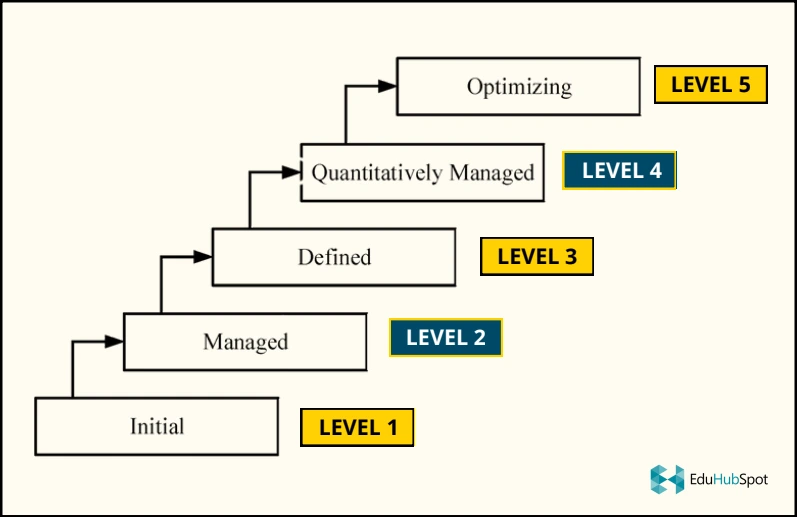
Initial (Level 1)
Processes are generally haphazard and unplanned. Individual effort is more important than structured routines for success.
Managed (Level 2)
Simple project management tools are set up to keep track of costs, timelines, and features.
Defined (Level 3)
As you move up to Level 3, processes are well-defined and known. They are spelt out in standards, procedures, and guidelines.
Quantitatively Managed (Level 4)
Processes are tracked and measured to ensure they are consistent and predictable.
Optimising (Level 5)
Focus on constantly improving the process by getting feedback and developing new ways to do things.
Each level in CMMI builds upon the previous one, meaning organizations must successfully meet specific performance criteria and process standards at each stage before progressing to the next level. This ensures continuous improvement and a solid foundation for more advanced practices. Following this method, CMMI helps businesses create processes that always meet quality standards, make them more efficient, and lower their risks.
Understanding OPM3
The Project Management Institute (PMI) made the Organisational Project Management Maturity Model (OPM3) to help companies evaluate and improve their project management methods at the corporate level.
In contrast to CMMI, which can be used for many organisational tasks, OPM3 is only concerned with project management. Its goal is to help companies better manage projects so that their work fits better with their general business strategy, brings more value, and is more successful overall.
According to OPM3, an organisation's project management techniques can be broken down into three separate levels of maturity:
Standardised (Level 1)
At this level, organisations have started using basic project management techniques, but they are not yet integrated into the organisation's structure.
Structured (Level 2)
The steps for managing projects are spelt out and built into the business's structure. At this stage, the organisation can start to better manage projects.
Optimised (Level 3)
The company's project management methods are improved and made even better so that projects always meet strategy goals and provide value.
Project Management, Program Management, and Portfolio Management are the three main areas of organisational project management development that OPM3 also discusses. All of these areas work together to ensure that projects are handled well, programs are in line with the organisation's goals, and portfolios are balanced to meet long-term business goals.
Key Differences Between CMMI vs OPM3
Both models try to make organisations and processes more mature and effective, but they do so differently and with distinct goals. The following sections will discuss some of the main ways that CMMI vs OPM3 are different.
1. Scope and Focus
CMMI and OPM3 have different goals, which is their main difference. CMMI is widely used in software and systems engineering to enhance process maturity. For example, it gives companies a complete picture of improving processes in product development, services, and deals because the flexible model can be used by companies in many fields, from industry to IT.
Whereas OPM3 is tailored to organizations seeking to improve their project, program, and portfolio management capabilities. Its main goal is to ensure that projects are in line with business strategy, are completed quickly, and lead to useful results.
2. Application Area
Companies in many fields, such as engineering, healthcare, software development, and aircraft, can use CMMI. There is no better way for businesses to enhance the quality and efficiency of their product development or service delivery processes than by following a structured framework like CMMI. An example of an industry that uses CMMI a lot is information technology, where making complicated systems and software needs a structured, mature approach.
OPM3, on the other hand, is best for companies that need to improve their project management methods and drive project success. This model works excellently for fields like building, consulting, or research and development, where projects are essential to the business. People who work for companies with many projects need OPM3 to ensure that every single one fits with their long-term goals and helps the company succeed.
3. Methodology and Approach
The CMMI framework makes it easy to improve processes. The model shows clear process areas, like project management, engineering, and support, with transparent practices and goals for each. The model goes through five stages of maturity that show organisations how to keep getting better. Before an organisation can move to the next level, it must show its improvement in key process areas.
OPM3 looks at things in a broader sense, focussing on how projects fit strategically with business goals. It helps businesses assess their project management maturity and propose solutions to enhance it.
Because OPM3 is more flexible than CMMI, firms may focus on their most crucial areas. However, CMMI uses set levels to track progress, while OPM3 lets organisations adapt to their specific problems and goals by offering a more flexible way to handle projects.
Which Model is Right for Your Organisation?
Your organisation's needs, goals, and process maturity will choose which CMMI or OPM3 to use. Consider these factors while choosing a model between CMMI vs OPM3:
1. Organisational Focus
If your company wants to optimise software development, product engineering, or service management processes, CMMI is right for you. CMMI improves numerous business processes and improves performance.
If your firm values project management, especially ensuring projects follow a business plan and succeed, OPM3 may be superior. For businesses where project management is key to their processes and long-term success, OPM3 is the best choice.
2. Project Complexity and Volume
OPM3 can help you manage complex, high-stakes projects, including large building projects, IT system rollouts, and research and development. This methodology simplifies project, plan, and portfolio management for enterprises.
Your process-driven product and service development organisation may profit more from CMMI, which can help improve all stages of production and service delivery.
3. Resource Availability
Because of its formal testing and certification methods, CMMI may require a lot of resources to implement. Organisations should consider CMMI if they have the means to conduct these assessments and a long-term plan for improving processes.
The flexible method of OPM3 might work better for groups that lack resources or want to improve without requiring a lot of resources. It can be changed little by little to fit the organisation's current needs.
Conclusion
In the comparison of CMMI vs OPM3, both are two process improvement frameworks, each designed for different organizational needs. While CMMI focuses on capability maturity, OPM3 enhances project, program, and portfolio management maturity.
CMMI is the better choice for enhancing the general maturity of processes in many areas, especially regarding development or service delivery. OPM3, on the other hand, is better if you need to improve your project management and ensure it fits your long-term business goals.
Frequently Asked Questions (FAQs)
What is the primary difference between CMMI vs OPM3?
By use of five maturity levels, CMMI enhances processes of product and service delivery. OPM3, however, improves project management by aligning initiatives with corporate strategy and delivering them. CMMI covers more than project, program, and portfolio management; OPM3 only does that.
Can an organization implement both CMMI and OPM3?
Yes, companies can use both models simultaneously. This is especially true if they need to improve the general maturity of their processes and how they manage projects. OPM3 prioritises project success and coordination, while CMMI enhances procedures overall.
How do I determine which model is best for my organisation?
Think about what your business does most while deciding between CMMI vs OPM3. CMMI is the best way to improve processes in many different areas. If you want to improve project management and ensure it fits your business plan, OPM3 is a better choice. When choosing, think about the resources you can access and how hard your projects are.
Explore Our Latest
Insights

Stay updated with our recent blog posts.
Explore Our
Course Gallery

Discover a diverse range of courses designed to elevate your skills and knowledge.

