Understanding the Principles of Management:
Why Henri Fayol's Ideas Still Matter in Today's Business World



Table of Contents
Share This Article
Introduction
Even in todays fast-moving business environment, evolving technology, and unpredictable world markets, the principles of management are still central to the success of an organization. First formalized by Henri Fayol over a century ago, these principles provide leaders with a timeless framework in managing project complexity and increasing efficiency. Fayol, known as the "Father of Modern Management," has made a significant contribution to business, especially his 14 principles of management. But how do these ideas, rooted in management history, remain relevant in 2026's tech-driven, agile workplaces? Let us check out!
Learning The History
To understand the principles for management we must go back to the beginning. Henri Fayol was a mining engineer who became one of the first people to see management as something that can be learned and improved. Fayol introduced 14 principles aimed at helping managers lead their teams more effectively in the year 1916. Fayol, unlike Frederick Taylor who was focused on the workers, looked at the larger picture - leadership, structure, teamwork. His ideas still influence modern-day businesses around the world. They demonstrate that good management is about planning, organizing and supporting people so they can work together on shared outcomes.
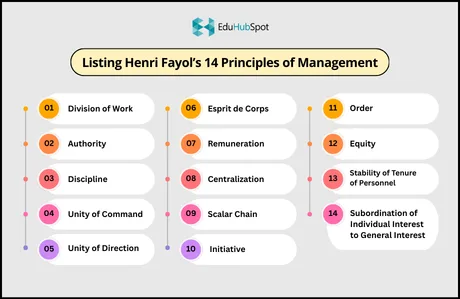
Listing Henri Fayol's 14 Principles of Management
1. Division of Work
This involves assigning tasks according to skills. Employees can focus on their strengths, such as coding, marketing, or design. They become more efficient. You can witness the application of Henri Fayol's principles of mgt in tech startup companies, encouraging specialization and collaboration across departments.
2. Authority
This management principle stresses the balance between power, accountability and responsibility. Project managers need to have the authority and responsibility for leading, while also being able to achieve results. Like, Spotify allows team leaders to make decisions, while still holding them accountable. Henri's advice can ensure that leadership is effective, without becoming unaccountable or overbearing.
3. Discipline
It is not about strict control but creating a culture that promotes trust and responsibility. For example, Salesforce promotes this management by promoting high ethical standards. Henri Fayol suggested that discipline is important to keeping teams efficient and aligned, particularly in the modern business scenario.
4. Unity of Command
This is among the principles of management which means that each employee reports only to one supervisor. It prevents confusion, and contradictory instructions. Clear leadership lines are important in modern matrix companies like Zoom, where teams operate remotely. This reduces stress and miscommunication and promotes clarity and flexibility in modern work environments.
On the other hand, modern matrix organizations require clear role definition and communication rather than strict single-line reporting.
5. Unity of Direction
This principle of management ensures that all efforts are aligned under a single plan and leader. Like, Netflix was able to achieve its streaming pivot through a team-based approach. Henry Fayol's concept fosters consistency and coordination, as seen in management history.
6. Subordination of Individual Interest to General Interest
Fayol teaches that team goals are more important than personal ones. The project team members at companies like Google align their work to the mission of the company, which creates harmony. This principle ensures that everyone's work supports the larger picture and prevents individual agendas from derailing the organization.
7. Remuneration
Employees are motivated by fair pay. This is among the principles of management that stresses that employees should receive salaries and benefits commensurate with their efforts. Microsoft and other companies offer wellness benefits and bonuses to employees in 2026, when the job market will be competitive. Henri Fayol's 14 principles for management emphasize fair compensation as a means to keep talent and build loyalty.
8. Centralization
Centralization refers to who makes the decisions. Like, Apple centralizes only the most important decisions in its larger companies. Fayol's principles of management suggest finding the right balance - giving employees some freedom, while maintaining control where needed. This flexibility allows businesses to remain efficient without losing their creativity.
9. Scalar Chain
Scalar chains are a way to communicate from the top of an organization down. The employees should be able to identify their manager and know how to contact higher-ups in case of need. Trello and Asana are modern shortcuts that speed up communication, while still respecting hierarchy. This management principle keeps information flowing.
10. Order
Order is about putting the resources - people, tools and money - at the right place, at the right moment. Like, Amazon uses data to organize their warehouses and ensure that products are available when needed. Fayol's management framework emphasizes the importance of this principle, which reduces waste and ensures that operations run smoothly.
11. Equity
To build trust, equity means treating everyone with kindness and fairness. Like, Accenture will focus their efforts on diversity and inclusion in 2026 to give equal opportunity to everyone. This is among principles of management, which is part of Henri Fayol's 14 management principles, builds loyal teams through fair treatment of employees.
12. Stability of Tenure of Personnel
According to this principle, keeping employees on the job for a long period of time increases efficiency. Constant turnover is a waste of time and money. Adobe offers training programs that keep employees skilled and engaged, which aligns with Fayol's belief that job security makes teams perform better.
13. Initiative
Encourage employees to share their ideas. Workers at 3M are given time to work on their own projects. This has led to innovations like the Post-it Note. This management principle empowers employees to be innovative and feel valued.
14. Esprit de Corps
Team spirit is all about unity and morale. Fayol's management principles focus on teams. Zappos is a great example of how a fun culture can increase employee performance. When businesspeople are in meetings, they will say "we" instead of "I", a pronoun shift that creates the feeling of togetherness and makes their teams more productive.
Why Fayol's Principles of Management Still Shine
Henri Fayol developed 14 principles of leadership over 100 years ago. They remain today a guide to leaders. The father of management made management a profession by focusing more on leadership than technical skills. These principles of management will help businesses in 2026 meet challenges related to remote work, AI and globalization.
Unity of command for example keeps remote teams structured, equity and remuneration address the issues of fair renders and inclusion, etc. In fully agile environments, while Fayol's principles were developed in a hierarchical context, selected principles such as unity of direction, equity, and initiative can still provide foundational guidance when adapted to modern and Agile environments - for example, you need discipline to maintain accountability and unity of direction to keep teams focused on the same project (for example app development or product launch).
Conclusion
Henri Fayol's principles of management are timeless and can be used by anyone who wants to lead an organization effectively. The tools and environments in which we work have changed dramatically, but the challenges of leadership and coordination have not.
Henry Fayol's 14 management principles can provide new perspectives for anyone, whether you're a student of management history, a young entrepreneur building a company, or an executive managing a large group.
It's easy in an age obsessed with innovation to forget the importance of foundational thinking. Looking backward can give us the clarity to move forward. Henri Fayol is still relevant in the business world today for this very reason.
Frequently Asked Questions (FAQs)
Why is Henri so important to management?
Henri Fayol introduced fourteen principles of management, also known as "the Father of Modern Management", in 1916. His work professionalized the management and offered timeless guidance for organization success.
Will Henri Fayol's principles be relevant in 2026?
Fayol's management principles adapt to the modern challenges of remote work, AI and other technologies. They provide structure for innovation, leadership and fairness in businesses today.
Can we apply Fayol's principles of mgt today?
To encourage creativity and agility in the workplace, businesses can adopt principles such as unity of command to ensure clear communication.
Explore Our Latest
Insights

Stay updated with our recent blog posts.
Explore Our
Course Gallery

Discover a diverse range of courses designed to elevate your skills and knowledge.

