What Is a PMIS
and Why Project Managers Rely on It?



Table of Contents
Share This Article

Investing time to search for information for a project is always worth it. Filtering data with the help of tools or documents, or running through long email threads to get the required information, is time-consuming. This often slows down the entire project. An infinite number of communications must occur for the progress of a project. The momentum of the project will be slow if you don’t understand the concept. According to PMI’s Pulse of the Profession, a significant portion of project failures are linked to poor communication and lack of planning. According to PMI’s Pulse of the Profession, poor communication and inadequate planning are among the leading causes of project failure.
For this case, there is a need for a Project Management Information System or PMIS. It is one of the appropriate ways that helps you to meet the deadline without wasting your team’s efforts. In this blog, we will explore the PMIS, its features, workings, and its benefits in project management.
What is a PMIS?
There is a huge amount of information to maintain track of, and in project management, it’s important to choose the required information from all the information. PMIS is a vital tool that provides instant access, and it is also crucial for future projects to minimise risks, improve efficiencies, and estimate costs. The main features of PMIS are as follows.
This PMIS helps project managers to plan, implement, and accomplish their projects and enables them to compile the deluge of data so that they can navigate the data without drowning.
This particular system collects and utilises information through various software applications. Cloud-based and advanced PMIS software can store and process links, documents, dashboards, schedules, reports and communication records. Then, it will share the exact data without any mistakes.
Features of PMIS
Stakeholder management is an essential process for projects as well as organisations, and it has a wide range of benefits, which are as follows:
Project Planning and Scheduling
Plans and schedules are two different factors when a project is being started. The PMIS incorporates scheduling tools that enable individuals to control the project. The program is often shared with the team members in advance for a smooth alignment.
Project Presentation
There is a modification in the plans of the Project Management Information Systems if any internal change has been made. Furthermore, some changes must be recognised and improved in the project plan. Therefore, calculations include, estimate to complete, the estimate at completion, and the variance at completion offer the current updates on the project.
Project Reports
Project reports are created for every task to understand the progress and deliver within time. The positive features of the project are also considered as a reference for future projects. The PMIS system creates progress reports, which you can use to interact with your team members and investors.
Integration
Many PMIS will gather information from various projects for multi-project analysis, aligning with other systems, including payroll and listing. The easier PMIS leads to less time consumption and less money for training.
Working of PMIS in Project Management
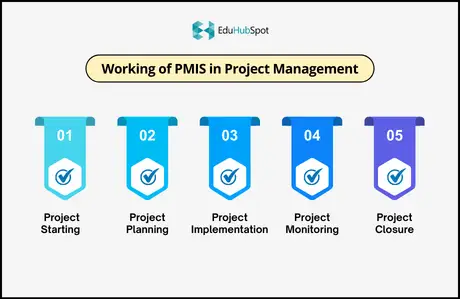
The Project Management Information System has various functions based on different phases of the project. At the initial level, PMIS provides the possibility to track the project scope, finances, and time. A strong PMIS includes a large variety of project management software features that you can use for the entire project life cycle. Let’s discuss the working of the PMIS to manage the project lifecycle.
Project Starting
In the initiating phase, a project manager utilises PMIS to create a primary financial plan, including cost estimation and resources. This PMIS is used:
- Connecting with other tools can help to plan the project.
- PMIS defines the scope of the task, helps in preparing the order, and can be used during data presentation to decision-makers.
Project Planning
During project planning, PMIS helps:
- To schedule the details, including responsibility and critical path analysis.
- To assist cost management planning, including WBS analysis and incorporation of control processes.
- A project management information system is also beneficial to project managers during resource planning in connection with the level and availability.
Project Implementation
When the project is executed, the PMIS gathers, manages, and restores data since it is provided by the project team. This information can be distinguished from the model projections.
- PMIS helps with finance and schedule forecasts to decide whether changes are needed in mid-project.
- Managing equipment, cost collection, and performance measurement are supported by PMIS.
Project Monitoring
The project review or monitoring stage is one of the most important phases in a project. The PMIS:
- Supports the effective accomplishment of different project modules, including material management, finance management, project performance evaluation, and project reporting.
- Enables a detailed assessment to ensure that the project goals have been fulfilled.
Project Closure
Every project has a particular preplanned goal. During the project closure stage, these goals are fulfilled. The PMIS:
- Manages and restores all project information for easy access and monitoring at a later stage.
- Gathers all project-related data as historical evidence to use in future projects.
- Helps to design final project reports and productivity analysis metrics for investors’ decision-making.
Benefits of Project Management Information System
The project management information systems have several benefits, and because of this, project managers rely on PMIS. The benefits are as follows.
Improved Teamwork and Cooperation
The interaction among the professionals is very productive with this PMIS. It empowers the teams to work together and manage collaboration. Therefore, the time and the expenses linked with the projects are minimised. Moreover, an individual can discover changes or disputes with other teams. This empowers team members to instantly start their tasks and perfectly share important documents at the same time.
Competitive Advantage
The competition in an industry is managed by using up-to-date technologies. PMIS is one of these technologies that helps you to manage every process of a project effectively without consuming more time or costs. Therefore, the organisation can accomplish more projects to increase the number of investors and clients.
Monitoring Everything
One of the major benefits of PMIS is to focus on and track everything. Project managers have the focus of completing a project with various tools and techniques. Therefore, the PMIS system supports informed decision-making and improved visibility across the project. Time and budget are the two vital factors of a project. Both factors can be tracked easily with the PMIS in project management.
Decision-Making Capacities
A project manager has a vital role during the decision-making in a particular project. It ensures that when the project is running seamlessly, there is no hustle and bustle. If the project gets out of control for any reason, the impacts will be very serious. To handle the project efficiently, the PMIS project management system is an important tool that helps project managers to make informed decisions.
Handling Multiple Projectst
PMIS software helps you manage various projects because it focuses on vital parameters. Therefore, the chances of inaccuracies and failures can be extremely minimised.
Final Thoughts
The key features and working mechanism of PMIS are beneficial for all project managers. Project management is an important aspect for project managers; therefore, PMIS helps you to complete all responsibilities associated with any project. This tool is a fortunate twist for project managers who can manage various projects efficiently and effectively.
Frequently Asked Questions (FAQs)
1. What do you mean by PMIS?
The project management information system is an assembled software platform that helps project managers to plan, implement, monitor, and complete projects effectively.
2. Why do the project managers have faith in a PMIS?
Project managers rely on PMIS because:
- PMIS minimizes data overload by organizing information in a structured, accessible format.
- Track progress and performance.
- Cooperate efficiently with teams and investors.
- Automatic scheduling and reporting.
3. What is the difference between PMIS and regular project management software?
Regular project management software focuses on task tracking and scheduling. On the other hand, PMIS provides a more significant solution. It initiates planning, cooperation, reporting, and document control into a unified system.
Explore Our Latest
Insights

Stay updated with our recent blog posts.
Explore Our
Course Gallery

Discover a diverse range of courses designed to elevate your skills and knowledge.

