What Is Resource Leveling & Why It Matters for Modern
Project Scheduling



Table of Contents
Share This Article

There is a time and resource constraint in every project. As projects outspread, you may face challenges and unexpected circumstances which lead you to rethink your allocation of resources and make changes in the project schedule.
Resource levelling redistributes resources to resolve constraints, often by adjusting the project schedule or activity start and end date based on resource availability or resource workload, to achieve realistic and feasible delivery.
It should be a part of the toolkit of every project manager. By optimising and managing resources across time, a project manager can prevent impractical expectations and determine the tentative date to accomplish the project.
In this article, we will focus on resource leveling, when to use it, and its importance in project scheduling.
What is Resource Leveling?
Resource leveling is a way of resource planning which includes the standardisation of available resources and schedules to complete the project within the stipulated time. A project comprises limited resources, and you need to finish the project by using these resources within the given time. That is, resource leveling adjusts the start date and end date of the project based on the resource constraints to balance the equilibrium of the available resources.
The main objective of resource levelling is to get better project scheduling. It is achieved by scheduling based on resource availability and task dependencies — that is, preventing team members from being overbooked when tasks are not held up due to a shortage of resources.
Major Benefits of Resource Leveling
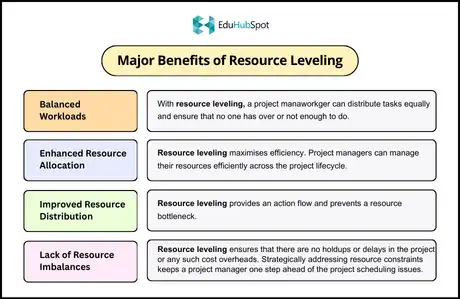
Here are the key benefits of resource leveling.
| Benefit | Description |
|---|---|
| Balanced Workloads | With resource leveling, a project manager can distribute tasks equally and ensure that no one has over or not enough to do. |
| Enhanced Resource Allocation | Resource leveling maximises efficiency. Project managers can manage their resources efficiently across the project lifecycle. |
| Improved Resource Distribution | Resource leveling provides an action flow and prevents a resource bottleneck. |
| Lack of Resource Imbalances | Resource leveling ensures that there are no holdups or delays in the project or any such cost overheads. Strategically addressing resource constraints keeps a project manager one step ahead of the project scheduling issues. |
When to Use Resource Leveling?
Resource leveling helps in different project scenarios. The scenarios are as follows.
Resource Optimisation
If projects are different and require various expertise, it is important to have a system to handle them. This system helps to allocate the perfect amount of work among the team members without overusing them.
Resource leveling helps to create a balanced environment where the workload among the team is manageable and similar to their expertise. This balance leads to the accomplishment of the task within time and has excellent productivity.
Preventing Scheduling Conflicts
Scheduling conflicts can hamper even the most well-designed projects. If the team members are booked with more tasks, it will lead to delays and frustrations. Resource leveling is an appropriate solution to this issue, which helps to prevent such conflicts.
Resource leveling ensures that every task has particular time slots to avoid the mess in the team's schedule. It enables a clear and organised idea of which task is done by whom and what the duration will be.
Avoiding Overbooking of Resources
Overbooking takes place when the team members are allocated more tasks than the available working hours. With resource leveling, an individual can balance workloads and distribute tasks as per the resource availability to prevent overbooking. This task allocation avoids burnout and enhances productivity and morale.
Ensuring a Quality of Project Output
Resource leveling empowers a project manager to handle both resources and the expectations of clients by managing a similar level of quality for project deliverables. It can be an important technique for mitigating budget issues, overallocation of resources and project delays.
Real-World Examples of Resource Leveling
For a better understanding of how resource leveling works, let's check out a real-life scenario. An individual managing a construction project is delaying the project date by weeks because of the weather conditions. There are several works which need to be redone, and the project team is lagging behind the planned timeline. Now, how can you deliver the project on time? What can you do if there are insufficient resources? And what can you do if the allotted time has come to an end? For this scenario, let's check two resource leveling examples.
Resource Leveling with Limited Resources
It's not possible to ask for extra resources every time; therefore, the project manager needs to extend the project schedule to finish all the work related to the construction project with the available resources. To know the schedule, you need to ask:
- Are all the works in the project scope reflected properly in the project schedule?
- Have project task dependencies been discovered?
- Are project resource requirements, objectives and priorities explained?
- Are there problems with governance, inaccuracy and problem management?
This adjustment helps industries, including the construction sector, where an insufficiency of raw materials postpones the start of the project. When supplies become normal, the contractor adjusts to maintain the project schedule.
Resource Leveling with Limited Time
When a construction project must be completed by a tentative date, a project manager needs to ask for more raw materials. If an individual decides to adjust the project, they will need to discover task dependencies to determine which tasks can be performed and which can't.
For instance, a contractor cannot build the roof without completing the wall. On the other hand, they can adjust activities which don't depend on each other, such as plumbing or electrical work. If the individual chooses the project, they will need to calculate the requirement of project resources for each task and allocate additional resources to quickly complete the project.
Why Does Resource Leveling Matter in Project Scheduling?
Resource levelling is a substitute for growing problems. The failure leads to a delay in the project, missing out of the resources being shuffled to different departments and costing the company money.
Problems occur because of the inferior resource leveling results in a domino effect. Delay in supplies, unavailability of factories, missed shipments, offset production, schedule compression, and leadership could be affected by the disruption of the bottom line.
In this situation, resource leveling is a crisis management method. It untangles the compounding conflicts during the expenses of the triple constraints of project management, that is, cost, scope and time.
As the processes are juggling resources between projects, and making things more complicated than they were at the project's outset. That's why it is vital to have the mechanism in place to monitor the project's timeline and milestones.
6 Ways Resource Leveling Helps Project Scheduling
By resource smoothing and reducing bottlenecks, resource leveling has become an important asset of a project. There are 6 ways in which resource leveling can increase the chance of the project's success.
1. Consistent Resource Optimisation
In a project, optimisation of resources efficiently and consistently is an important aspect. This is where resource leveling appears. It is a technique used in project management to optimise the allocation of resources.
By smoothing out the usage of resources and preventing resource overloads, a project manager can achieve improved resource consistency throughout the project.
Resource leveling allows the continuous use of resources.
This levelling, apart from facing different scenarios in resource demand, also helps in balancing the workload within the team. This not only increases productivity but also encourages a healthy and sustainable work environment.
These levelling strategies enable project managers to identify potential resource bottlenecks or ambiguities between resources and allow them to intervene accordingly, thereby avoiding project delays. Also, it helps to prevent overloading a particular team while others have comparatively lighter workloads and promotes impartiality and collaboration within the team.
2. Decreased Project Delays
Resource leveling is ideal for minimising project delays. It includes distributing resources among projects to meet the requirements of every task.
Project delays may have consequences for both project timelines and budgets. When there is insufficiency in resource allocation, some sections of the project may suffer due to the shortage of resources, and as a result, it causes delays.
On the other hand, excessive allocation of resources leads to idle time for other tasks which are waiting for resources to be available.
Resource leveling helps to stabilise the workload and ensures that resources are allocated evenly among all the tasks and projects. This avoids bottlenecks and leads to more efficient resource usage and decreased delays.
Reducing the amount of delays and downtime, resource leveling will keep projects on schedule and meet deadlines. This not only augments overall project value but also assures customer satisfaction.
3. Higher Project Success
There is another way to enhance project success by incorporating resource leveling with different project management methods. This empowers a comprehensive and adaptable approach, discovering different aspects of project optimised resource allocation, improved risk management, increased communication and an increase in the probability of project success. The ways are as follows.
• Agile Method
Inclusion of agile methodologies, such as Scrum or Kanban, with resource leveling can develop flexibility and adaptability in the project. By dividing these tasks into smaller units, it will be more manageable, and the project manager can easily identify the resource constraints and allocate them efficiently.
• Critical Path Method
By incorporating resource leveling with CPM, an individual can discover vital tasks and make sure they get the essential resources. It helps in determining the longest way of tasks of the project, and resource leveling offers equal resource allocation to prevent delays.
• Earned Value Management
Including EVM with resource leveling enables the individual to measure the performance based on cost and progress. By monitoring costs, resources and progress, the project manager can discover any change in the planned schedule and take action to maintain the track of the project.
4. Effective Project Prioritisation
By utilising resource leveling techniques, you can discover important tasks and allocate resources accordingly. This ensures the prioritisation of the important aspects of the project and efficient allocation of resources.
When there are fixed resources or fixed deadlines, resource leveling helps to make informed decisions about resource allocation to achieve the project objective.
Prioritising the important aspects related to the project also reduces project delays. By highlighting critical tasks, project managers can figure out potential risks and allocate resources accordingly to prevent delays. It allows the team to get an understanding of the project priorities and to achieve them efficiently.
5. Enhanced Productivity
In many projects, it is seen that a team member is occupied with a higher workload, whereas other members have comparatively less workload. This lack of balance leads to burnout, loss of motivation and an overall reduction in productivity.
Resource leveling highlights these issues by adjusting the distribution of work evenly throughout the team. Project managers can distribute tasks and resources efficiently after knowing the expertise and availability of the team members. This not only avoids overloading of work but also enables fair distribution of roles and responsibilities among project team members. As a result, it promotes a collaborative and supportive environment.
6. Avoiding Project Timeline Setbacks
When the project management is chaotic, project timelines can often become the cause of frustration, and it leads to missed deadlines, schedule lag, and delayed projects.
With the implementation of resource leveling, the project manager can strategically adjust timelines to ensure smooth execution of the project.
Resource leveling is based on comparing the availability of resources with the project requirements. The project manager can adjust the schedule by identifying resource constraints and project bottlenecks in a measured and calculated manner, rather than chaotic changes that disrupt the project flow.
Strategic adjustments in project timelines include considerations of different factors such as availability of resources, skillsets and task reliance. This will help you to create a balanced project schedule to minimise risks and optimise the use of resources.
Final Thought
The ultimate aim of resource leveling is to balance the demand and supply of the resource. It is a vital tool that helps in delivering high-quality projects within allocated time and budget. By understanding the concept of resource leveling and its use through deadline extensions, an increase in resource allocations and maximisation of current resources, a project manager can manage resource allocation hassles effectively. Leveling, a balanced approach, helps the team to work efficiently, avoid burnout and maintain project quality even with higher project constraints.
Frequently Asked Questions (FAQs)
What do you mean by resource leveling?
Resource leveling is used in project management to optimise resource allocation through a project to prevent overloading and enhance efficiency.
What is the role of resource leveling in project management?
Resource leveling helps in project management by ensuring balanced allocation of resources to reduce bottlenecks, increase productivity and develop project scheduling.
How can resource leveling decrease project delays?
Resource leveling ensures optimal allocation of resources throughout the project, prevents bottlenecks and minimises the probability of project delays because of the shortage of resources.
Can I apply resource leveling to any type of project?
Yes, it can be applied to different types of projects, whatever the size or complexity of the project. It is an important process for the optimisation of resource allocation in a project environment.
Explore Our Latest
Insights

Stay updated with our recent blog posts.
Explore Our
Course Gallery

Discover a diverse range of courses designed to elevate your skills and knowledge.

