What's an RFP Understanding? Its Role in Business and Project Management


Table of Contents
Share This Article
Introduction
Imagine a world where every conversation sparks connection, every word builds trust, and every interaction leaves a lasting impact. That's the power of interpersonal communication - the art of sharing thoughts, feelings, and ideas that brings us closer together. Whether it is a casual chat with a friend or an important meeting at work, it is important to understand that interpersonal communication is essential for building relationships, forming how we communicate, work with others, and interact in our daily lives. But exactly what is interpersonal communication, and how can it be improved? Let us check out everything below!
Understanding Interpersonal Communication Definition
It is the way two or more individuals share their thoughts, feelings, and ideas. This can be done through body language, texting, and even video calls. Interpersonal communication is direct and personal, like a friendly email or conversation, and not like announcements or ads that reach big crowds. The special significance of this communication comes from the ability to build connections that you can do with a simple smile, a good question, or a clear message.
The interpersonal communication concepts are essentially about one person communicating a message and another person interpreting it. The sender puts thoughts into words and actions; the receiver tries to figure out what the sender is trying to say. The receiver can provide feedback by nodding, replying, or otherwise indicating that they understand. This can be affected by distractions, culture, and emotions. Once you get the fundamentals of interpersonal communication, it's easy to connect and collaborate with others.
Why Interpersonal Communication Shines
This is essential because it fosters connection and collaboration with project team members. In personal relationships, it builds trust and empathy. In personal relationships, this is helpful for building trust and empathy; in the workplace, communication is important for collaboration, conflict resolution, and effective leadership. Without interpersonal communication, misunderstandings occur, relationships become strained, or opportunities are lost. You can learn interpersonal communication skills and use them to navigate social situations successfully and with confidence.
Important Interpersonal Communication Skills
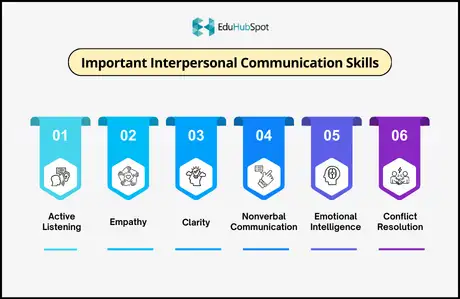
Listed below are a few important communication skills:
Active Listening: Listening goes more than just hearing the words; it involves engaging with the speaker and understanding their message. Active listening involves maintaining eye contact, nodding, and asking clarifying questions.
Empathy: Empathy is the capacity to share and understand another person's emotions. It is an important part of interpersonal communication for its capacity to build trust and rapport.
Clarity: Expressing thoughts clearly and succinctly can help avoid confusion. When writing or speaking, using precise words will enhance the meaning of your message.
Nonverbal Communication: The body language, facial expressions, and tone of voice often communicate more than the words. Communication is strengthened when you are aware of nonverbal signals.
Emotional Intelligence: Effective interpersonal communication requires that you understand and manage your emotions as well as those of others.
Conflict Resolution: It is inevitable that disagreements will arise, but the ability to handle them constructively by using a calm dialogue and mutual understanding is vital.
Interpersonal Communication Examples
Workplace Feedback: The project managers give a positive review of an employee's work, and use specific examples and a supportive tone to emphasize the strengths and areas that need improvement. This approach encourages the employee to grow without being discouraged.
Negotiating a Disagreement: Two friends have a disagreement about where to vacation. They reach an agreement that satisfies both friends by listening to one another and giving up some of their desires.
Customer Interaction: Retail workers take a negative and frustrating interaction and turn it positive by validating how the customer feels and offering a solution.
Team Discussion: Someone on the team is presenting an idea in the meeting, and they invite questions. They will use eye contact and listen actively to help their teammates be included in trying to find a way to have a productive discussion.
Interpersonal Communication Types
Understanding the different types of interpersonal communication will help you adapt to various contexts. Check out below:
Verbal Communication: This includes spoken words, whether in person, over the phone, or via video calls. The tone and the words you use, and short affirmations like "mm-hmm," can influence an interaction.
Nonverbal Communication: Expressions of the face, gestures, and postures convey feelings and intentions. A firm handshake, for example, can signal confidence, while crossed arms could indicate defensiveness.
Written Communication: To avoid misinterpretation, emails, texts, or social media posts should be written with clarity, correct grammar, and a tone that is appropriate.
Listening: Active listening is often underrated as a form of interpersonal communication. Active listening involves understanding the message of the speaker and responding with questions that demonstrate understanding.
The ability to simplify switching between the two types is important for having effective interpersonal communication.
Interpersonal Communication Strategies
Want to get better at connecting with others? Try these easy and practical communication tips:
- Really Listen: You must give full attention when someone's talking. Don't interrupt. Instead, try repeating what they said in your own words to show you understand.
- Watch Your Body Language: Your facial expressions, tone, and posture matter. For example, smiling and keeping an open posture make you seem friendly and easy to talk to.
- Adjust to the Situation: Talk differently depending on who you're with. Be more formal at work, and more casual with friends.
- Use "I" Statements: If something bothers you, say how you feel instead of blaming others. For example, "I feel upset when…" helps avoid arguments.
- Be Open to Feedback: Ask others how you can improve your communication. Honest feedback can help you grow.
- Stay in Control of Your Emotions: If things get heated, try to stay calm. Being aware of your feelings helps keep the conversation on track.
- Respect Cultural Differences: People from different backgrounds may communicate in different ways. Be mindful and respectful of those differences.
Check out our video on What Materials You Should Study To Pass The PMP Exam In 2025!
Common Communication Problems - and How to Solve Them
Even though communicating with others is something we do every day, it is not always an easy task. Here are some common communication problems - and simple ways to address them:
Misinterpretations: People can misinterpret your words - particularly if your tone or body language does not align with what you are saying.
Solution: Use simple, clear vocabulary, and check in with the other person by asking, "Does that make sense?" or "What do you think?"
Differences in Culture: Different cultures often have different ways of communicating, which can be confusing.
Solution: Learn about different cultures and don't be afraid to ask culturally informed and respectful questions to gain a better understanding.
Strong Emotions: If you are feeling stressed, angry, or upset, it is easy to say something you do not mean.
Solution: Before you speak, please think to take a breath and pause. Wait until you feel calmer before engaging in significant conversations.
Texting Issues: Messages via text or email can often be misinterpreted because there is no tone of voice or body language.
Solution: Pay close attention to the language you use, and where possible, for personal conversations, use video or voice calls.
Conclusion
Good communication is core to establishing productive relationships, cooperating with others, and growing personally. Once you understand what interpersonal communication is, and practice your skills in listening, empathy, and clear expression, you can more easily find and develop meaningful connections with others.
You know how much communication matters when you are providing feedback to an employee at the office or reflecting with a close personal friend. How you communicate matters, and even though your communications may not always turn out perfectly, that's acceptable. Consistently learning, practicing, and demonstrating care and understanding will help you improve and grow.
The more you utilize these skills, the more connected and confident you will feel, no matter where you are or whom you are working with.
Frequently Asked Questions (FAQs)
How do I improve my interpersonal skills?
Practice listening closely, be thoughtful about the words you use, and pay attention to body language. Simple advancements such as these can improve the effectiveness of your conversations and the valuable time spent with those you interact with.
What is an example of interpersonal communication in action?
Think of a time you resolved a disagreement with a friend calmly and collaboratively by actively listening to each other and finding a solution together. In this way, interpersonal communication allows for understanding and trust to develop.
Can anyone improve their interpersonal communication skills?
Yes. Everyone can enhance their communication and engagement when interacting with people through practice, feedback, and awareness that they can improve!
Explore Our Latest
Insights

Stay updated with our recent blog posts.
Explore Our
Course Gallery

Discover a diverse range of courses designed to elevate your skills and knowledge.

