What's an RFP Understanding? Its Role in Business and Project Management


Table of Contents
Share This Article

Have you ever made a puzzle without using the picture in the box as a guide? It's like making something big without knowing the final result. The same thing happens when people deal with a project without a clear procurement plan, known as an RFP (Request for Proposal).
According to a recent study, 77% of proposal professionals mention that their proposal process is imperfect. A huge number of people are facing challenges in their project journeys. But no need to worry! In this blog, we'll highlight the RFP, its importance, and its role in business and project management.
What is an RFP in Project Management?
An RFP or request for proposal is an official document which is created by organisations to request thorough proposals from qualified vendors or service providers. This document highlights the particular requirements, goals, and expectations of the organisation for a specific project. By releasing an RFP, a project manager or the organisation can invite offers from different suppliers, which allows them to analyse and estimate proposals based on preplanned criteria, including costs, skillset, timeline, and approach.
What is the importance of RFP in Business?
An RFP has a strategic role in business. A well-designed RFP not only increases competition but also encourages vendors to deliver the most compelling solutions. The importance of a request for proposal in business is as follows.
Encouraging healthy competition among vendors
The request for proposal is a coordinated platform for organisations which invite different vendors to be competitors for a project. By regulating the information shared with all competitors, businesses ensure that every vendor has an equal chance to represent their best offer. This competition leads to:
- Better costing because vendors aim to offer cost-effective solutions.
- Key to various approaches and technologies.
- Advanced ideas tailored to fulfil the requirements of a particular project.
Combining Vendor Proposals with Business Goals
An RFP helps organisations to declare their objectives comprehensively. This guarantees that the vendor's proposals are attached to the strategic goals. The major benefits are as follows:
- Refining the project's scope and expectations clearly.
- Representing proposals that fulfil both the cultural and technical fit.
- Find out vendors who have an idea about the long-term goals of the organisation.
Guaranteeing Clarity and Impartiality in Procurement
Transparency is one of the major aspects of the request for proposal process. By spreading the same requirements and assessment principles to all vendors, organisations create a field. This approach helps to:
- Develop trust among stakeholders.
- Minimise arguments and conflicts.
- Guarantees conformity with ethical and regulatory standards.
What are the steps of the RFP Process?
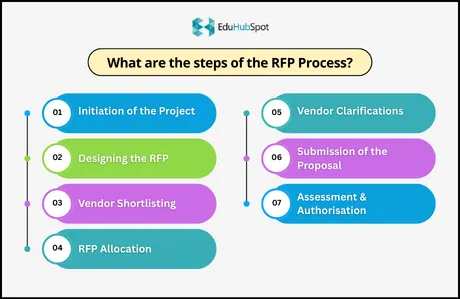
An RFP incorporates a structured mechanism that guarantees all important information is articulated to potential vendors. The seven steps of an RFP process are as follows:
- Initiation of the Project: Clearly articulate the objective, scope, timeline and budget of the project. Find out the requirements for advisory vendors and create the specific needs.
- Designing the RFP: Create a thorough RFP document that includes the framework of the project, extent of the work, specifications, assessment criteria, and submission guidelines.
- Vendor Shortlisting: Find out potential vendors according to their skillset, track record, and alignment with the project's objectives. Shortlist candidates who meet the project criteria and send them the RFP for response.
- RFP Allocation: Send the RFP to the shortlisted candidates and offer them abundant time to review the credentials, ask questions, and request clarifications.
- Vendor Clarifications: Resolve vendor queries quickly and fairly to ensure a smooth understanding of the project's needs and expectations.
- Submission of the Proposal: Obtain and assess vendor proposals as per the particular guidelines and evaluation criteria.
- Assessment & Authorisation: Examine vendor proposals depending on preplanned criteria, discuss terms and choose the vendor to connect with the project needs and objectives.
How to minimise risks in RFP?
In an RFP, there are several risks and uncertainties which hamper the project's success. The risks include financial, technical, legal, and reputational risks. To minimise these risks, an individual should conduct the risk assessment. The risk minimisation steps are as follows:
Discover the Risks
The initial step is to point out the risks that could impact the RFP project. To identify the risks, you need to analyse the request for proposal document and the situation of the vendor, along with the strengths and weaknesses of your own organisation, which helps to determine the factors that prevent your organisation from success.
Evaluate the Risks
The second step is to evaluate the risks that you have discovered. It refers to the assessment of the probability and effect of each risk and prioritising them as per their urgency and severity. A famous tool for risk evaluation is the risk matrix, which puts the risks on a grid depending on their probability and effects. These risks can then be categorised into four levels, such as low, medium, high and crucial.
Manage the risks
The last and final step is to manage the risks which has been evaluated. This refers to the implementation of the actions and plans which you have illustrated for each risk, and observing and reviewing the status of the risk and performance overall project lifecycle.
RFP and Project Management
An RFP in project management has a major role. These are as follows:
Strategic Sourcing
RFP offers a structured outline for sourcing of products and services to ensure consistency and impartiality in the selection of vendors. This approach helps to manage transparency and minimise the biased risks.
Clear Interactions
RFP encourages clear interactions of project needs, reducing misunderstandings and make sure all vendors have similar information. Clear interaction is an important way to avoid scope misunderstandings and ensure the alignment of all stakeholders.
Competitive Instruction
By welcoming several vendors to submit their proposals, business organisations can differentiate various solutions and select the appropriate choice for the project. This competitive instruction helps in optimising maximum project benefits.
Risk Minimisation
A detailed RFP process helps to figure out potential risks and challenges to enable active risk minimisation strategies. By assessing the approaches of vendors, organisations can discover potential risks in an early stage that enhance active risk management and project success.
Real-World Example of RFP in Project Management
Let's consider a general RFP for IT services. It is a well-designed proposal that discovers the client's needs and offers a clear and practical plan. The request for proposal form has priority on security, system performance, and vendor experience in IT projects. The example of RFP for IT services includes:
- A concise executive summary, highlighting organisational goals.
- A detailed implementation of the plan is designed within the RFP timeline.
- Technical documentation that supports infrastructure and data integration.
- A transparent cost breakdown with classified pricing for software, services, and maintenance.
Final Thoughts
Request for Proposal has a major role in business and project management. It offers a structured method to gather goods and services, guarantees transparent interaction, and motivates competitive direction. An effective RFP project management includes understandable project initiation, thorough RFP outlining, detailed assessment and strong project leadership.
By using the correct devices and methods, an organisation can rationalise the RFP processes, enhance communication and increase team alignment. Experiencing each RFP helps to clarify processes and enhance future outcomes. Thus, with these activities, RFP project management can navigate successful outcomes and achieve precious opportunities.
Frequently Asked Questions (FAQs)
1. What do you mean by RFP in project management?
A request for proposal in project management includes facilitating the process of preparing and submitting a response to an RFP. It involves planning, cooperation, and managing resources to guarantee high-quality proposals delivered on time.
2. What is the importance of early planning in RFP project management?
Early planning enables enough time to collect necessary information, highlight issues, and clarify the proposal. Early beginning helps to guarantee the on-time delivery and reduce last-minute complications.
3. What are the roles of project management tools in the RFP Process?
The project management tools help to monitor progress, manage deadlines and foster communication among the team members. Tools include Gantt Chart, task lists and cooperation platforms to keep the project on track and guarantee on-time delivery.
Explore Our Latest
Insights

Stay updated with our recent blog posts.
Explore Our
Course Gallery

Discover a diverse range of courses designed to elevate your skills and knowledge.

