How to Run Daily Stand-Ups
That Actually Improve Productivity and Communication



Table of Contents
Share This Article

Imagine you’re a project manager with a team scattered in different parts of the country, juggling tasks and deadlines. Since everyone is working remotely, emails, updates, and questions keep pouring into your inbox, making it feel like a traffic jam. You are wondering how to resolve them without aligning everyone and without losing the momentum.
That’s where a daily stand-up meeting takes place. In today’s expeditious world of project management, these meetings are not a ritual- but a vital tool for teams to stay focused, organised, and productive.
A well-planned daily stand-up meeting increases team collaboration, enhances productivity, and keeps projects on track. This blog will help you understand the daily stand-up meetings, align team members to manage blockages efficiently, and maximise progress.
What is a Daily Stand-up Meeting
The word “stand-up meeting” comes from the concept that team members should physically stand up during the gathering to keep the session brief and to the point. These meetings are not the time to discuss project details or ask in-depth questions, but it's all about effectiveness, finishing updates and highlighting the sprint goals.
These meetings are most effective when associated with agile methodologies, and these are designed to focus on immediate blockers and manage project momentum. Thus, a daily stand-up meeting or daily scrum is a 15-minute daily meeting where all team members gather at the same time to discuss the accomplished work, future goals, and highlight three questions: yesterday’s task, today’s role and any constraints.
These meetings are structured but adjustable, and the development team is responsible for taking part, while the scrum master accelerates to keep it efficient and focused, instead of sharing status reports with the manager.
What is the purpose of a Daily Stand-up Meeting?
When a group of people work together, it is natural to face some challenges. Direct or in-person discussion can significantly reduce conflicts, but the daily stand-up meetings help the team:
Maintain alignment
In an agile project, where many changes take place from one sprint to another, it is essential to keep the whole team conscious about what is happening and its effects on the project.
Engage with the team
Spending time with the team helps to connect with the team members as individuals. Team dynamics are not only impacted by the nature of work but also by the relationships within the team. Apart from mutual respect, it is essential that all the team members should be able to relate to each other.
Sharing ideas
Daily stand-up meetings improve problem-solving and optimisation of current practices; sharing of ideas within the team will improve efficiency.
Who should take part in a daily stand-up meeting?
In a daily stand-up meeting for an agile team, the scrum master, developers, product owners and stakeholders can take part.
The objective of these meetings is to motivate cooperation and communication among the team members; therefore, it is perfect to have the presence of all team members.
Components of a Successful Daily Stand-up Meeting
If the organisation conducts a 15-minute meeting, it will be an expensive meeting. Without effective meeting preparation and planning, the daily stand-up will transform into a useless meeting, from an efficiency enhancer. To make an effective daily stand-up meeting, you should include some core components, which are as follows.
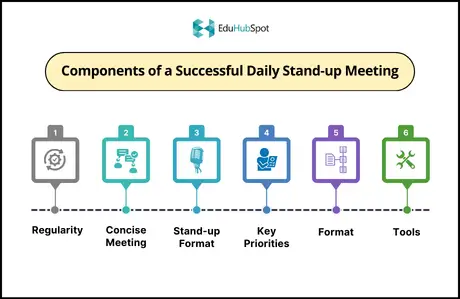
Regularity
Schedule the meeting daily at the same time, especially in the morning and place to maintain consistency and set the priorities for the day.
Concise Meeting
Keep the duration like a 15-minute meeting or less to maintain focus and resilience.
Stand-up Format
Motivate every team member to stand during the meeting to enhance the sense of engagement and conciseness.
Key Priorities
Always focus on these three questions:
- What did you complete yesterday?
- What are you working on today?
- Are there any hindrances?
These three questions focus on team alignment towards the common sprint goal. Nowadays, scrum masters may also add other check-in questions; however, apart from these three questions, other questions should not be discussed in the daily stand-up meetings.
Format
The Scrum Master facilitates the meeting, ensuring all team members, including relevant stakeholders, product owners, and facilitators, actively participate and listen to one another.
The concept of traditional stand-up meetings involved all the team members in a standing posture to ensure the discussion would not deviate from the agenda.
Presently, the daily stand-up meetings are conducted with the objective of self-organising teams. During the meeting, every team member speaks one after another.
Tools
Traditional stand-up meetings were held in a physical office environment, and they didn’t have the explicit tools to run the meeting. Teams can use different tools to manage the structure of the meeting. Different task boards, like JIRA, can be used to monitor the discussed tasks.
Since after pandemic, most teams have been scattered across the globe, the daily stand-up meetings are conducted virtually. For this, various video conferencing tools like Google Meet and Zoom come into play.
Benefits of a Stand-up Meeting
Daily stand-up meetings have several benefits, especially for smart, allocated and remote teams. The benefits of this meeting are as follows:
Enhance Communication
Communication is a vital aspect for developing strong teamwork. Poor communication between team members is one of the serious reasons for project failure in agile teams. A daily stand-up meeting is part of a smart methodology, as it helps develop communication among team members. Developing strong communication with face-to-face contact, as the team’s culture helps in designing a smarter workplace.
Maintain Project Transparency
A daily stand-up meeting is the most appropriate way to discuss every team member’s work with the rest of the team. It helps in memorising the project team members’ roles and responsibilities clearly, as well as preventing errors. This develops a sense of transparency about the progress of the project because every team member is completely aware of the role of the team and their accomplishments.
Building Trust among the Team
Effective communication and complete transparency with the team members develop a sense of faith, especially when the work is discussed regularly. The team has a common aim and has various roles in accomplishing it. With daily stand-up meetings, there is a feeling of being inclusive, which results in the development of trust among the team members and the whole project. This transparency is a very important aspect for the success of the project.
Discovering Issues within the Project
Focusing on the regular tasks during the project completion and sharing notes with other teammates will highlight the issues related to the project. Often, issues suffered by the whole company are revealed with regular stand-ups, irrespective of the department.
Organisations can use daily stand-ups to discuss the ways to introduce changes and eradicate issues that come with regular operations.
Improved Teamwork
A deadline enables team members to finish the task without any delay. This makes everyone occupied for a long time, and as a result, the concept of teamwork disappears. Daily stand-up enables team members to spend 15 minutes a day discussing their problems and achievements along with the tasks.
This makes some quality time that team members are able to spend with each other, and it creates a sense of teamwork. It enables teammates to work as a team and set reminders about the daily business objectives.
Improved Knowledge Sharing
Daily stand-up meetings not only improve the relationship between the employees and team members but also help in developing the rate of knowledge sharing within the organisation. It helps in developing an extensive understanding of the project within the team.
Understanding of Shared Goals
The main aim of a daily stand-up meeting is to discuss both the individual and team goals. It develops a shared understanding of all the general objectives related to the project and business objectives. Also, it develops the presence of shared goals because, without a shared goal, there is no team- only a group of employees working with each other.
Rules for a Successful Daily Stand-up Meeting
Proper preparation is one of the vital standup meeting rules. Here are some important steps to make sure of a successful daily stand-up meeting.
Fix Clear Expectations
Discuss the purpose and the format of the daily stand-up meeting with the team members and emphasise the importance of the stand-up meeting to maintain the project speed.
Select the Appropriate Tools
Choose the perfect tools to accelerate the daily start-up meetings, especially for remote team members.
Plan Prior Updates
Motivates all the team members to prepare the updates before the Scrum ceremonies for concise and relevant contributions.
Discover Potential Obstacles
Before starting the daily stand-up meeting, team members should highlight the blocked roads they are facing and allow rapid problem-solving during the meeting.
Track Project Progress
You should be familiar with the overall project status to offer guidance and required discussions.
These steps will help to get a focus and productive daily stand-up meetings to drive the project forward.
Steps to Run an Effective Daily Stand-up Meeting
To run a better stand-up meeting and become an efficient participant in the meeting, there are 6 vital steps, which are as follows.
1. Fix a Schedule and Stay Consistent
Consistency is an important step for stand-up meetings. Set the daily stand-up meeting at a particular time that is suitable for the whole team; therefore, it becomes a part of every team member’s routine.
For remote teams, think about the time zones to include every member. Moreover, using video solutions can be a great idea. Different tools enable members to record their updates metachronously, so that every member stays informed and engaged, irrespective of the location.
2. Set a Clear and Concise Agenda
A clear and concise agenda is crucial not only for stand-ups but for every meeting. To maintain the track of daily stand-up meetings, every member should prepare to share updates on the following three topics:
- What did you complete yesterday?
- What are you working on today?
- Are there any hindrances?
For example, if an individual manages a customer service team, they can add a question about the number of tickets each member has in their queue. Similarly, if the individual is in a software development team, they can include the questions about the potential bugs encountered by the team in a particular code. These pre-planned points and sharing updates about these points enable them to keep the meeting on track.
3. Make it Concise and Timeboxed
The sign of an effective stand-up meeting is its conciseness. The team members are responsible for conducting daily stand-ups and setting the limit of a 15-minute meeting to keep every member on topic.
4. Use of Visual Aids
There are various tools, such as a Kanban board can help to visualise tasks. Kanban boards, similar to those available in the project management software of Jira, anticipate where work stands, structured by different phrases like “To do”, “In progress”, “Done” and “Blocked”.
The main location for tracking blockers and action items is also beneficial. If a teammate can’t be able to attend, they can refer Kanban board for important updates.
5. Guaranteeing Team Participation
Every team member should be prepared to share updates. Motivate the team to be detailed but concise, and the Scrum master will take over if the conversation becomes irrelevant.
If a team member is working remotely or not able to attend, they can still take part by sharing a pre-recorded update.
6. Share Post-Session Updates
The final important way to optimise stand-up meetings is to prepare for the meetings and make short notes during the meeting. The scrum master can share the meeting notes after the completion of each day’s meeting. This shows the contents of the meeting and highlights the to-do lists.
There are several easy manual ways to perform this, like an Excel sheet, a Word document, emails, screen recording tools or project management tools. Making notes enables monitoring the progress of the team. Apart from this, using several stand-up questions as a benchmark enables the facilitator to compare daily productivity and discover any potential issues.
Final Thoughts
The daily stand-up meetings, when they are conducted effectively, are a strong tool for improving team collaboration, managing the pace of the project, and increasing overall productivity. Having an idea about the purpose, following best practices, and using state-of-the-art technologies, teams can convert these brief meetings into stimuli for project success.
Consistency, conciseness, and focus are the keys to a successful stand-up meeting. Motivate participation, figure out challenges, and continuously look for ways to develop the process. With extensive practice and perfection, the daily stand-up meetings will become an important part of the team’s workflow and help develop a culture of transparency.
Frequently Asked Questions (FAQs)
What is the definition of a daily stand-up meeting?
A stand-up meeting is a concise and focused team meeting, usually held for 10-15 minutes, where teammates share updates, accomplishments, plans, and difficulties. These meetings aim to enhance transparency, communication, and alignment.
What is the importance of these daily stand-up meetings?
The importance of these meetings includes the focus of the teams on priorities, prevention of delays, motivating accountability, and developing better communication among the team members.
What will be the ideal duration of a daily stand-up meeting?
A stand-up meeting should continue for a maximum of 15 minutes. The purpose of these meetings is to stay clear and concise and prevent the meeting from turning into a full meeting.
Who are the members of this stand-up meeting?
All the team members who are actively working on the project should attend the meeting. Managers can join occasionally, but the main focus should be on the progress of the team.
What are the issues for daily stand-up meetings?
The common mistakes include transforming the meeting into status reports for managers, dragging the discussion for a prolonged period, not highlighting the issues effectively, and skipping the meeting, which minimizes consistency.
Explore Our Latest
Insights

Stay updated with our recent blog posts.
Explore Our
Course Gallery

Discover a diverse range of courses designed to elevate your skills and knowledge.

