What Is Sprint Planning and Why Is It the Most Crucial Meeting in Scrum?


Table of Contents
Share This Article

In any agile team, there is one meeting that sets the tone on how everything else will look like for the upcoming iteration. It's not the daily stand-up, it's not the retrospective, and it's not the review. It's Sprint Planning - the first event in a new cycle, and really the most critical event in the Scrum framework.
Sprint planning is a way to set expectations, align, and ensure feasibility for everyone involved. This forms an essential foundation to the success of the team as without this framework, the team will likely begin the sprint and drift through without clarity, or purpose.
Know What is Sprint Planning
It is marked as a formal Scrum meeting that happens at the start of each sprint. It involves the full Scrum team - the Product Owner, Scrum Master, and Developers. It sets the expectations of what will be delivered and the complete execution path.
The project team selects items from the Product Backlog and creates a plan to execute the selected work. It is the session where ideas are filtered down into commitments and high-level direction into actionable steps.
Sprint Planning is important because everything in the sprint is built on what's decided at this meeting. The entire sprint gets to suffer if this meeting is unclear or poorly run.
What Makes it a Crucial Meeting in Scrum
1. It Establishes the Sprint Goal
A sprint becomes a collection of disconnected tasks without a proper set goal. Sprint Planning is there to help the team form a meaningful goal that is aligned with business priorities, which gives clarity to team members as to how to allocate their time and effort, and handle unexpected issues during the sprint.
2. It Creates Alignment Among the Entire Team
The meeting forces the team to synchronize. The Product Owner explains priorities and developers have focuses on feasibility. The Scrum Master facilitates the event and ensures Scrum principles are upheld. This planning gets everyone on the same page of understanding and expectations - before the sprint starts.
3. It Ensures Flow and Predictability
Teams can either overcommit, or under deliver without proper forecasting. The team uses velocity and capacity planning in Sprint Planning to create a realistic workload. These conversations help reduce chaos and improve delivery consistency by preventing burnout.
4. It Minimizes Mid-Sprint Confusion
Sprint planning is the ideal time to clarify all requirements. You can come across confusion during the sprint if you don't. It is an excellent opportunity to ask about:
- What is to be expected?
- What are the criteria for acceptance?
- What dependencies may affect development?
This preparation shields the sprint from unnecessary interruptions.
5. It Sets a Realistic Roadmap for the Iteration
The plan created in Sprint Planning acts as a roadmap. It's flexible. Scrum encourages adaptation but it still provides structure. Without this foundation, the sprint would feel directionless.
Its Core Elements
To make Sprint Planning productive and impactful, the Scrum team must cover three core aspects:
1. Why Is This Sprint Valuable?
The Product Owner begins the meeting by stating what the intent of the upcoming sprint will be. This value statement is the basis for the Sprint Goal - whether the focus lies on improving performance or adding new features.
2. What Can Be Done in This Sprint?
This is when the team examines Product Backlog items and picks the ones that fit with the sprint objective the best. They evaluate:
- Complexity
- Dependencies
- Risks
- Resource availability
- Historical velocity
The selected items evolve into the Sprint backlog, which becomes the official plan for the iteration.
3. How Will the Work Be Completed?
This is where technical discussion happens. The developers analyze the amount of effort needed to complete each task. The discussion will also revolve around architectures, possible test approaches, and engineering aspects of the work. This "how" phase is crucial to ensure the plan is technically feasible.
Roles in Sprint Planning
Product Owner
The Product Owner defines priorities and values with a focus on ensuring that the backlog items selected are clear and refined. Sprint Planning would lose direction without their input.
Scrum Master
The Scrum Master provides facilitation of the meeting and helps keep discussion aligned, to engage the entire team according to Scrum principles. They have the role of leadership in resolving obstacles and promote collaboration.
Developers
Their task is to estimate the effort required to commit to each sprint and ensure that the Sprint Backlog includes realistic and achievable goals.
Let Us Talk What Happens During Sprint Planning

Step 1: Reviewing Product Backlog Items
The meeting begins by reviewing the highest-priority items. These should already be refined and ready for development.
Step 2: Setting the Sprint Goal
The Scrum team collaborates to define a concise, specific goal. A strong Sprint Goal keeps everyone focused on the big picture.
Step 3: Selecting Items for the Sprint
The team picks items based on available capacity, historical velocity, and the nature of the work. This balance ensures commitment is both ambitious and realistic.
Step 4: Breaking Down Work
Developers then break stories into tasks. These tasks can help you determine how much work is there actually and identify any risks.
Step 5: Evaluation of Capacity and Effort
The team discusses capacity planning, availability impacted by leaves, ceremonies, training sessions, or support activities. Combining this with velocity helps finalise the sprint scope.
Step 6: Final Commitment
Only after thorough discussion does the team commit to the Sprint backlog. This commitment reflects their confidence and shared ownership.
How It Improves Team Performance
1. Encourages Proactive Instead of Reactive Work
Instead of improvising each day, the team begins with clarity. Sprint Planning ensures that the next few working days have been well thought out and carefully selected.
2. By Increasing Accountability
Everyone in the team will feel responsible when developers commit to each other during Sprint Planning. It becomes easy to track and identify issues when the tasks are clearly defined.
3. Creating Reduced Rework Scenarios
Uncertain requirements are a major cause of rework. This meeting clarifies all the information that needs to be known by the team before any coding can begin.
4. Strengthens Collaboration
Sprint Planning ensures open discussion between roles. Developers understand business priorities and the Product Owner understands which technical aspects.
5. Supports Continuous Improvement
The teams learn from past sprints like challenges and incomplete tasks. They use these insights to refine their planning. With time, this leads to better forecasts and delivery over time.
Ideal Approaches for a Highly Efficient Sprint Planning Meeting
1. Prepare Prior to the Meeting: The Product Backlog should be groomed ahead of time. Team members should join the meeting aware of priorities and potential items for selection.
2. Define a Clear Sprint Goal: A vague sprint goal leads to scattered work. The objective must be significant and attainable.
3. Use Data, Not Guesswork: Using historical velocity, and then some careful capacity planning, will allow the team to take commitments pridefully.
4. Keep the Discussions Focused: Always remember that the Scrum Master should guide the flow and keep it productive as off-topic conversations can derail the meeting.
5. Break Down Work to the Right Level: Overly large tasks hide risks. Overly small tasks cause clutter. You must have a focus on tasks that need to be completed in a day.
6. Encourage Active Participation: Every party involved must show active contribution equally.
7. Time-box the Meeting: Scrum recommends:
- 4 hours for a one-month sprints
- Shorter durations for shorter sprints.
Sticking to the timebox improves discipline and clarity.
8. Don't Overcommit: Overcommitting leads to incomplete sprints and burnout. The team must choose based on capacity, not external pressure.
9. Review Risks Early: You must focus on raising dependencies and challenges during Sprint Planning and not after work starts.
10. Keep the Sprint Backlog Visible: The Sprint Backlog should be made available to all team members with tools like Jira or Trello.
Common Mistakes Teams Make in Sprint Planning
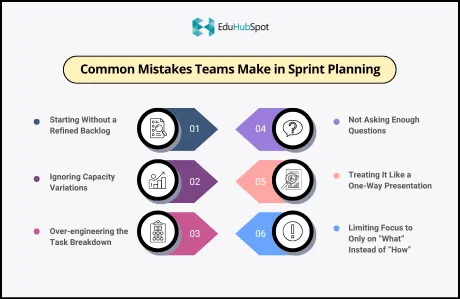
1. Starting Without a Refined Backlog
Without clear, well-defined items, Sprint Planning turns messy, causing confusion, delays, and unnecessary debates that slow down meaningful decision-making.
2. Ignoring Capacity Variations
Assuming full team availability leads to overcommitment. Ignoring leaves, support work, or training disrupts planning accuracy and impacts overall sprint delivery.
3. Over-engineering the Task Breakdown
Breaking work into excessive detail wastes time, while insufficient breakdown hides risks. Teams must find the right balance for effective execution.
4. Not Asking Enough Questions
When teams stay quiet, uncertainties surface later. Sprint Planning is the ideal moment to clarify expectations and prevent avoidable mid-sprint confusion.
5. Treating It Like a One-Way Presentation
A planning session dominated by one role fails. Sprint Planning is most effective when there is an open, team discussion with involvement from all parties.
6. Limiting Focus to Only on "What" Instead of "How"
Choosing work without discussing technical execution creates hidden risks. The teams might need clarity on deliverables and agreement on the approach.
How Sprint Planning Relates to Other Scrum Ceremonies
Daily Stand-Ups
Sprint Planning clarifies the tasks and priorities with responsibilities, to make daily stand-ups go smoothly. The team members can discuss the progress of their sprint, any blockers and the plan for today when they have a common understanding of the goal.
Sprint Review
Sprint Review inspects the Increment and gathers stakeholder feedback, supporting adaptation. The planned users stories are validated and accepted based on pre defined acceptance criterias.
Sprint Retrospective
The team will evaluate how well Sprint Planning has supported execution. They look at commitment accuracy, clear work, collaboration and challenges. These insights are used to improve the planning effectiveness of upcoming sprints and team performance.
Why Stakeholders Value Sprint Planning
While stakeholders may not always attend the meeting itself, they benefit from:
- Better predictability
- Clearer transparency
- Reduced surprises
- Better team engagement and accountability
The Future
When organizations start to grow with digital transformation, Sprint Planning has a focus on adapting:
- AI-based forecasting tools are helping analyze past velocity patterns.
- Remote facilitation methods are getting more sophisticated.
- Teams are moving towards inclusive discussions that balance technical excellence with business value.
- Teams are encouraged to discuss uncertainties and psychological safety during planning.
Conclusion
When conducted well, Sprint Planning becomes more than a meeting. It is the decision-making engine for every sprint. It helps teams to become united and have clarity about what they are building.
Within the Scrum world, where we need to constantly adapt and be fast, Sprint Planning is the one ceremony that offers structure within a constantly changing environment.
Frequently Asked Questions (FAQs)
How do teams handle unexpected work that appears after Sprint Planning?
The team and Product Owner discuss trade-offs and adjust scope in a scenario where unplanned work gets critical. They replace items in the Sprint backlog.
How do teams know how much work they can take on during Sprint Planning?
Teams rely on current capacity, and complexity of backlog items. They can use these factors to develop a feasible plan without either under-utilizing or over committing their time.
How long Sprint Planning take for different sprint lengths?
Sprint Planning is time-boxed based on sprint duration. A one-month sprint usually needs up to four hours, while shorter sprints typically require proportionally less time to finalize goals and scope.
Explore Our Latest
Insights

Stay updated with our recent blog posts.
Explore Our
Course Gallery

Discover a diverse range of courses designed to elevate your skills and knowledge.

