
4.9 stars

AI for Cybersecurity Certification Training Program

Boost your career with our AI for Cybersecurity Certification

Get end-to-end hands-on skills in AI-powered cybersecurity and AI threat detection.
Prepare for in-demand AI security engineer and AI red teaming job opportunities.
Learn from top industry experts with real-world SOC and DevSecMLOps experience.
Experience hands-on practicals across malware detection, adversarial ML, and LLM security.
Obtain a globally recognised AI cybersecurity certification.
AI for Cybersecurity Certification Training

Course

Overview

The AI for Cybersecurity Certification training course offers hands-on skills to secure, attack, and defend AI-driven systems using industry-standard frameworks and threat models like MITRE ATLAS and the OWASP LLM Top 10. This AI cybersecurity course enables learners to build intrusion detection models, red-team large language models, and harden ML pipelines against adversarial threats while deploying AI-powered SOC and DevSecMLOps workflows for real-world security operations. Learners often pair this AI security certification with our Agentic AI Certification Training program to build a complete AI career track.

Why Choose EduHubSpot's AI for Cybersecurity Certification Training?
Increased job opportunities in AI security engineering and red teaming.
Learn from an industry-standard AI cybersecurity curriculum.
Live sessions by top industry practitioners in AI-powered SOC and LLM security.
Develop confidence through hands-on adversarial ML and threat detection learning.
Career-assistance service for AI security roles.
Obtain a globally recognised AI cybersecurity certificate.
Delivery option:
Complete online (Live and Recorded). Accessible on both mobile and laptop — ideal for learners across India, the UAE, the US, and Canada seeking a flexible AI cybersecurity certification course.
Next Cohort Start on Loading...
Days
0
hours
0
Minutes
0
Seconds
0
Participant Name
Email
Phone Number
Message
By providing your contact details, you agree to our Privacy Policy
View Schedules

Our AI for Cybersecurity Certification Course

Includes

54 hours
Live classes
50 +
Assignments and quizzes
10 hours
Project
1-on-1 Doubt-Clearing Sessions

Get personalised support from mentors to resolve your doubts with clear, step-by-step guidance.

Lifetime Access

Revisit AI cybersecurity course materials anytime, learn at your own pace, from any device.

Resume & LinkedIn Help

Build a strong professional profile with expert guidance on resumes and LinkedIn optimisation for AI security roles.

Career Assistance Services

Access placement guidance, interview preparation, and career support tailored to AI security engineer and red team goals.

Industry Expert Mentorship

Learn directly from experienced AI security and SOC professionals with practical insights and real-world expertise.

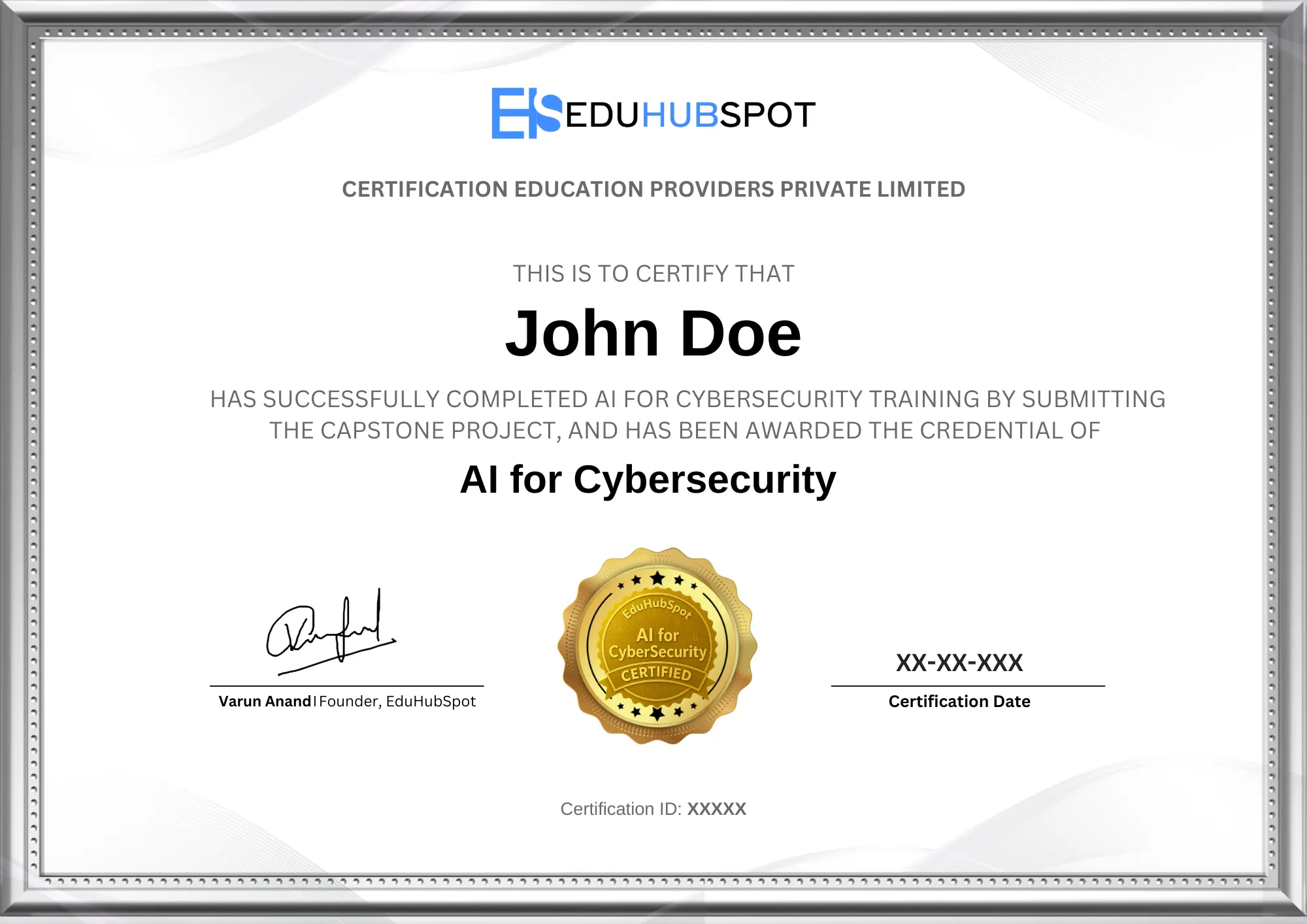
Global Certificate

Earn a globally recognised AI for Cybersecurity certification upon successful completion of the program.

Curriculum

Breakdown

Eighteen modules covering AI security foundations, deepfake defence, adversarial ML, LLM guardrails, agentic AI security, offensive security, DevSecMLOps, and enterprise governance — taught live with hands-on labs.

Course modules
01 Core Programming & Security Foundations
  • Build Python security tools (port scanner, log parser, PCAP reader)
  • Develop end-to-end ML pipelines from scratch
  • Explain TCP/IP, DNS, TLS for attack surface analysis
  • Apply CIA triad, OWASP Top 10, STRIDE in threat modeling
  • Detect and fix ML issues (data leakage, imbalance, overfitting)
  • Python for security: scripting, socket, scapy, pandas, scikit-learn
  • Networking fundamentals: TCP/IP, DNS, HTTP/S, TLS, and packet capture with Wireshark
  • Security core: CIA triad, OWASP Top 10, CVE/CVSS, STRIDE threat modelling, and pentest lifecycle
  • Math intuition for ML: probability, entropy, confusion matrices, ROC curves — no derivations
  • ML pipeline debugging: data leakage, SMOTE for class imbalance, overfitting diagnosis
  • Dev environment setup: Kali Linux VM, Jupyter Lab, Docker basics, VS Code with security extensions

  • Python Security Sprint: Write a port scanner + log parser using provided scaffolding; run automated unit tests to verify outputs. Focused on 2 scripts only.
  • Wireshark Packet Analysis: Load a pre-captured PCAP file; annotate the TLS handshake, DNS query, and one plaintext HTTP credential; answer 5 guided questions about packet-level behaviour.
  • ML Pipeline Repair: Given a broken spam classifier notebook, diagnose and fix 3 planted bugs (data leakage, wrong train/test split, unscaled features); verify F1 improves to ≥80%.
  • STRIDE Threat Modelling Sprint: Given a 2-tier web-app architecture diagram (app server + database), apply STRIDE to identify ≥6 threats; map each to OWASP Top 10 and assign a CVSSv3.1 base score; produce a 1-page threat brief with prioritised mitigations.
  • Python 3.11+
  • Jupyter Lab
  • scikit-learn
  • Wireshark
  • Docker
02 AI in Cybersecurity Decision-Making
  • Map AI paradigms to cybersecurity use cases
  • Evaluate when AI vs rule-based tools is appropriate
  • Benchmark LLMs and compare trade-offs
  • Identify hallucinations and unsafe outputs
  • Build and justify a basic RAG pipeline
  • Distinguish agentic AI workflows from single-shot LLM calls
  • AI paradigm map: Generative vs. Predictive AI vs. Rule-Based Automation — choosing correctly for IDS, SIEM, threat intel
  • How LLMs work: tokens, context windows, RLHF, and fine-tuning — intuition-first, practitioner depth
  • The constraint triangle: cost-per-inference, latency (p50/p95), output quality — always in operational tension
  • RAG vs. fine-tuning vs. prompt engineering — decision flowchart for security applications
  • The simpler-solution test: when YARA, Snort, regex, or scripting beats any AI model
  • Debugging AI outputs: hallucination patterns, confidence evaluation, unsafe-to-act-on identification
  • Agentic AI primer: what makes a system "agentic" (planning, tool use, memory, autonomy) vs. a single prompt-response call — why this distinction matters for risk
  • LLM Phishing Triage Comparison: Run 10 pre-provided phishing email samples through GPT-4o and Claude Sonnet independently; score each model on accuracy, false-positive rate, reasoning quality, and hallucination risk; produce a side-by-side comparison table with a 1-paragraph recommendation.
  • AI-or-Not Decision Brief: Select one real security workflow (alert triage or CVE scoring); apply the simpler-solution test using a provided checklist; produce a structured 1-page go/no-go decision with cost and latency estimates.
  • ChatGPT (GPT-4o)
  • Claude Sonnet
  • Jupyter Lab
03 ML Model Development & Deployment
  • Train IDS models using Random Forest/XGBoost
  • Deploy ML models via FastAPI and Docker
  • Track experiments using MLflow
  • Interpret precision, recall, and FP-rate
  • Compare supervised vs anomaly detection models
  • Network intrusion detection: CICIDS-2017 anatomy, class imbalance with SMOTE, feature engineering from flow stats
  • Supervised models: Random Forest vs. XGBoost — tuning with 3-fold CV (no exhaustive Optuna sweep)
  • Isolation Forest for anomaly detection when unsupervised outperforms supervised
  • Feature engineering: protocol encoding, inter-arrival timing, packet-length distributions
  • UEBA: ML models for insider threat and lateral movement detection
  • Model deployment: FastAPI REST endpoint, input validation, output schema, production logging
  • IDS Classifier Training: Load a provided 50 k-row CICIDS-2017 sample (pre-cleaned); apply SMOTE for class imbalance; train Random Forest and XGBoost with 3-fold CV; log both experiment runs in MLflow; target ≥90% F1 on the held-out test set.
  • FastAPI Model Deployment: Wrap the best MLflow-logged model in a FastAPI application with input validation and an output schema; containerise with Docker; POST 20 synthetic network-flow samples; record p50 inference latency and verify all responses match expected schema.
  • Anomaly Detection Comparison: Train an Isolation Forest on the same CICIDS-2017 dataset with no labels; compare its precision, recall, and FPR against the best supervised model from Lab 1; write a 1-page analysis identifying scenarios where the unsupervised approach outperforms supervised.
  • IOC Extraction Pipeline: Feed 3 pre-selected threat intelligence PDFs (provided) to an LLM via API; extract structured IOCs (IPs, hashes, domains, CVE IDs); map each IOC to a MITRE ATT&CK tactic; export a validated JSON report and verify it against a provided ground-truth set.
  • scikit-learn
  • XGBoost
  • MLflow
  • FastAPI
  • Docker

  • OpenCTI
04 Malware & Phishing Detection Systems
  • Train malware classifiers using EMBER dataset
  • Fine-tune NLP models for phishing detection
  • Debug ML pipelines and fix errors
  • Evaluate model performance on real datasets
  • Document model limitations and failure scenarios
  • Recognize LLM-generated phishing and evaluate detector robustness against it
  • Malware classification: PE static features (entropy, section stats, import hash)
  • CNN byte-plot malware detection: binary-to-image conversion
  • Metamorphic malware: HMM opcode sequence analysis — conceptual overview and degradation intuition
  • Transformer-based phishing detection: fine-tuning DistilBERT on PhishTank + Enron (2k-sample subset)
  • ML pipeline debugging: data leakage, label noise, feature scaling, metric mismatch
  • Failure mode analysis: communicating model limitations to security stakeholders
  • LLM-generated phishing: how generative models change email/SMS phishing at scale — grammar/tone tells disappearing, detector robustness implications
  • EMBER PE Classifier: Load a pre-engineered 5 k-sample EMBER subset; train XGBoost; diagnose and fix 2 planted bugs (data leakage + unscaled features); verify the repaired model achieves ≥93% F1 on a held-out test set; log the run in MLflow.
  • DistilBERT Phishing Detector: Fine-tune DistilBERT on a provided 2 k-email dataset using a provided training script (~15 min GPU runtime); evaluate on 200 held-out emails; record precision, recall, and FPR; deploy the trained model as a FastAPI endpoint and verify it with 10 sample requests.
  • Model Limitations Audit: For both Lab 1 and Lab 2 models, write a structured 1-page limitations brief: 3 failure scenarios per model, evasion risks, and recommended monitoring signals; present findings in a table and a narrative summary.
  • PyTorch
  • Hugging Face Transformers
  • scikit-learn
  • FastAPI
  • Jupyter Lab
05 Deepfake & Synthetic Media Defense
  • Detect voice-cloned audio and deepfake video using classifier and artefact-based methods
  • Evaluate liveness detection systems and their bypass techniques
  • Design and implement out-of-band verification protocols against synthetic media fraud
  • Build an enterprise deepfake incident response and awareness programme
  • Deepfake threat landscape: voice cloning from as little as 3 seconds of audio, video deepfakes, and documented executive-impersonation fraud cases
  • Audio deepfake detection: spectral artefact analysis, pre-trained classifier evaluation, and known detection blind spots
  • Video deepfake detection: temporal inconsistency analysis, liveness detection, and biometric authentication bypass techniques
  • Procedural defences: out-of-band verification, pre-agreed verification codes, and call-back protocols for high-risk transactions (wire transfers, credential resets)
  • Enterprise deepfake incident response: detection-to-escalation workflow, awareness training design, and board-level reporting on synthetic media risk
  • Audio Deepfake Detection: Using a provided dataset of 20 audio clips (10 real, 10 voice-cloned), run a pre-trained deepfake audio classifier and measure accuracy; identify the spectral/artefact features driving correct vs incorrect classifications; document 3 cases where the classifier fails and explain the likely cause.
  • Video Deepfake & Liveness Bypass Assessment: Given a provided set of 6 short video clips (3 authentic, 3 deepfake) and a liveness-detection demo tool, run detection on all 6; attempt a documented bypass technique against the liveness check using a provided synthetic sample; record the bypass success rate and produce a 1-page technical note on why the bypass worked.
  • Pre-trained deepfake audio classifier (provided)
  • Liveness detection demo tool
  • Librosa
06 Adversarial AI & Attack Techniques
  • Generate FGSM and PGD adversarial attacks
  • Execute backdoor and data poisoning attacks
  • Perform membership inference attacks
  • Conduct model stealing attacks
  • Map attack techniques to MITRE ATLAS
  • FGSM, PGD evasion of IDS classifiers and malware models
  • Minimum perturbation analysis: ε vs. evasion rate, feature-space vs. problem-space attacks
  • Data poisoning: backdoor injection (BadNets), label flipping impact on training pipelines
  • Model inversion and membership inference — privacy implications and legal context
  • Black-box model stealing
  • MITRE ATLAS framework: mapping adversarial ML techniques to enterprise AI deployments
  • Adversarial Evasion Attack: Using ART, train a fresh Random Forest IDS classifier on the provided 50 k-row CICIDS-2017 sample; craft FGSM then PGD adversarial flows at ε = 0.05, 0.1, 0.2; plot the evasion-rate curve; map the top finding to MITRE ATLAS technique ML05.
  • Backdoor Poisoning Attack: Inject 5% trigger-feature samples into a provided 10 k-row training subset; train an XGBoost classifier from scratch; verify the trigger achieves ≥80% attack success rate while clean-data F1 stays ≥88%; document the full attack as a reproducible Jupyter notebook.
  • Membership Inference Attack: Train a fresh anomaly detection model (Isolation Forest) on a provided CICIDS-2017 split; run ML Privacy Meter against it; record attack AUC; identify the top 5 most vulnerable records; write 2 concrete defences (DP-SGD + output rounding) with implementation notes.
  • Black-Box Model Stealing: Deploy a provided intentionally vulnerable FastAPI IDS endpoint (pre-built Docker image); query it with 500 synthetic input vectors; use the query responses to train a surrogate XGBoost classifier; measure surrogate fidelity (agreement rate vs oracle); identify the minimum query budget to reach 85% fidelity; document 2 architectural defences (query-rate limiting, output perturbation).

  • Adversarial Robustness Toolbox (ART)
  • ML Privacy Meter

  • MITRE ATLAS Navigator

  • PyTorch
  • scikit-learn
07 LLM Security & Guardrails
  • Execute OWASP LLM Top 10 attacks
  • Implement guardrails (Presidio, NeMo, Llama Guard)
  • Measure guardrail effectiveness improvements
  • Run automated LLM vulnerability scans (Garak)
  • Design mitigations for multi-agent AI attacks
  • OWASP LLM Top 10: prompt injection, insecure output handling, training data poisoning, model DoS
  • Direct vs. indirect prompt injection — system prompt override, goal hijacking, multi-turn persistence
  • RAG pipeline attacks: document poisoning via malicious PDF, context window stuffing
  • Jailbreaking taxonomy: many-shot, virtualization, roleplay bypass with detection signatures
  • Guardrail architecture: NeMo Guardrails, Llama Guard 3, Presidio PII redaction
  • OWASP LLM Top 5 Attacks: Deploy Ollama Llama 3.2 with a minimal LangChain RAG pipeline (pre-built Docker Compose provided); execute 5 attacks (prompt injection, insecure output handling, data exfiltration, excessive agency, supply-chain poisoning); document attack vector, payload, and severity for each.
  • Garak Automated Vulnerability Probes: Run Garak jailbreak, PII leakage, and hallucination probe suites against the local LLM deployed in Lab 1; read the HTML report; write a 1-page remediation specification for the top 3 findings including priority, effort estimate, and success metric.
  • Guardrail Stack Implementation: Layer Presidio (PII scrubbing) → NeMo Guardrails (topical rails) → Llama Guard 3 (output safety) on the Lab 1 deployment; re-run the same 5 attacks; record block rate before and after; log residual risk with a risk acceptance statement for each unblocked attack.
  • Ollama (Llama 3.2)
  • LangChain
  • Garak
  • NeMo Guardrails
  • Llama Guard 3
  • Presidio
08 Adversarial Defense & Privacy Engineering
  • Apply adversarial training techniques
  • Implement differential privacy (DP-SGD)
  • Evaluate privacy–accuracy trade-offs
  • Adversarial training: PGD-AT clean vs. robust accuracy trade-off
  • Certified defences: randomised smoothing — ℓ₂ certification radius, intuition only
  • Differential privacy: DP-SGD mechanics, ε calibration, privacy budget accounting
  • Adversarial Training Defence: Train a fresh XGBoost malware classifier on the provided 5 k-sample EMBER subset; apply PGD-AT (via ART) at ε = 0.05 and ε = 0.1; add feature squeezing as a pre-processing defence; evaluate and plot a 4-point comparison chart showing clean accuracy vs robust accuracy for baseline, PGD-AT, and feature squeezing.
  • Differential Privacy Implementation: Train a neural network IDS on a provided 20 k-row CICIDS-2017 split using TensorFlow Privacy with DP-SGD at ε = 1 and ε = 10; record model accuracy at each privacy budget; write a 1-paragraph GDPR Article 25 privacy impact assessment comparing the two epsilon settings.
  • ART
  • TensorFlow Privacy
09 AI Model Integrity & Explainability
  • Secure models using signing and validation
  • Generate explainability reports (SHAP)
  • Generate and audit an AI Bill of Materials (AI-BOM) for a deployed AI system
  • Evaluate federated learning security trade-offs
  • AI supply chain security: model provenance, ModelScan, safe deserialization, cosign signing
  • AI Bill of Materials (AI-BOM): CycloneDX ML-BOM and SPDX AI Profile formats, what a defensible AI-BOM covers (models, datasets, code, licenses, weights identifiers, known biases), and how it extends a traditional SBOM
  • Explainable AI for security: SHAP TreeExplainer (global + local)
  • Federated learning for security — cross-org threat model sharing
  • Supply Chain & SHAP Audit: (a) Download a provided mock pickle-exploit model; scan it with ModelScan; add cosign pinning to an MLflow pipeline; verify the gate blocks the tampered artefact. (b) Train a fresh XGBoost classifier on the provided CICIDS-2017 split; generate a SHAP global importance plot and 3 waterfall plots for individual predictions; format findings as a 1-page audit card.
  • Federated Learning Security Simulation: Using a provided PySyft notebook, simulate a 3-client federated learning round on a partitioned CICIDS-2017 dataset; inject a model-poisoning payload from one malicious client; measure the impact on global model accuracy and detection rate; apply a clipping + FedAvg norm-clipping aggregation defence; document residual risk and compliance implications under GDPR Article 25.
  • AI-BOM Generation & Audit: Given a provided multi-component AI system (fine-tuned classifier + RAG pipeline + 2 third-party API dependencies), generate a CycloneDX ML-BOM documenting every model, dataset, and dependency with source, license, and provenance fields; cross-check it against a provided vendor disclosure pack to identify ≥3 undisclosed components (an unlisted base model, an unlicensed dataset, an unpinned dependency version); produce a 1-page gap report flagging each as a supply-chain risk.
  • ModelScan
  • cosign
  • SHAP
  • MLflow
  • CycloneDX
  • PySyft
10 Agentic AI Attack Surface & Identity
  • Design least-privilege identity and authorization controls for autonomous agents
  • Detect and mitigate orchestration hijacking, tool abuse, and cascading agent failures
  • Identify and mitigate MCP-specific attack vectors in tool-connected agents
  • Non-human identity & least privilege: authorization models for autonomous agents, scoped credentials, session-bound permissions
  • Multi-agent vulnerabilities: orchestration hijacking, tool abuse, cascading failures, goal hijacking via indirect prompt injection
  • MCP (Model Context Protocol) security: malicious/poisoned MCP servers, tool-description injection, server impersonation and spoofing, over-broad tool scopes, and MCP server vetting practices before connecting an agent to a new server
  • Multi-Agent Orchestration Hijacking: Deploy a 2-agent LangChain pipeline (planner + executor) that processes user-supplied task descriptions; craft 3 indirect prompt injection payloads embedded in a "retrieved document"; demonstrate goal hijacking, tool abuse, and data exfiltration via the executor agent; implement a tool-call approval gate and sandboxed output parser as mitigations; document each attack vector with a MITRE ATLAS mapping.
  • Least-Privilege Agent Identity Design: Given a provided 3-agent workflow (research agent, code-execution agent, email-sending agent) with over-permissioned shared credentials, redesign the authorization model using scoped, session-bound credentials per agent; implement the redesign in the provided LangChain scaffold; verify via 5 test scenarios that no agent can exceed its intended scope even under a successful prompt injection.
  • Malicious MCP Server Detection: Connect a provided agent to 3 pre-built MCP servers, one of which contains a poisoned tool description designed to hijack agent behaviour and one of which requests over-broad scopes for its stated function; use a provided vetting checklist to inspect each server's tool manifest before granting access; identify the malicious server and the over-scoped server; document the specific manifest red flags that gave each away and implement a scope-limiting wrapper as a mitigation.
  • LangChain
  • Ollama (Llama 3.2)
  • Model Context Protocol (MCP) SDK
  • MITRE ATLAS Navigator
11 Agentic AI Governance & Oversight
  • Apply NIST AI RMF (Govern/Map/Measure/Manage) to an agentic AI deployment
  • Build an agent accountability register and kill-switch design
  • Map agentic risk to ISO/IEC 42001 and EU AI Act risk tiers
  • NIST AI RMF for agentic systems: Govern, Map, Measure, Manage — applying the Map function to tool-integration surface, authorization scope, and inter-agent interaction
  • Human oversight design: approval gates, sandboxed output parsers, kill-switches, and when full autonomy is inappropriate
  • Governance frameworks compared: ISO/IEC 42001 (AI management systems) vs. EU AI Act risk-tiering vs. NIST AI RMF — practical crosswalk for enterprise use
  • Agent accountability register: business owner, technical owner, delegation lineage, and review triggers for autonomous decisions
  • NIST AI RMF Gap Assessment: Given a 1-page description of a fictional company's agentic SOC-automation deployment, complete a provided NIST AI RMF (Govern/Map/Measure/Manage) worksheet; identify ≥6 concrete gaps; produce a prioritised remediation plan mapped to each RMF function with owner and target date per item.
  • Kill-Switch & Accountability Register: Design and implement a kill-switch mechanism (hard stop + graceful degradation path) for the agent pipeline built in the previous module; test it under 3 failure scenarios (runaway loop, unauthorized tool call, conflicting agent instructions); build an agent accountability register documenting business owner, technical owner, delegation lineage, and review triggers for the full pipeline.
  • NIST AI RMF worksheet templates
12 Offensive Security & Pentesting with AI
  • Perform OSINT reconnaissance using AI tools
  • Generate and validate exploit payloads (SQLi, SSRF)
  • Use fuzzing tools (AFL++) for vulnerability discovery
  • Analyze and classify vulnerabilities
  • Write CVSS-based pentest reports
  • Assess AI agents and autonomous tool-use as part of the attack surface
  • AI-assisted recon: LLM-powered OSINT, Shodan queries, subdomain enumeration, cloud asset discovery
  • LLM payload generation: SQLi, XSS, SSRF, XXE — validation workflow and hallucination detection
  • BurpSuite + Nuclei AI templates: AI-native pentest workflow — capabilities, limitations, quality control
  • ML-guided fuzzing: AFL++ smart seed generation and AI-assisted crash triage
  • Critical AI evaluation: verifying AI outputs, flagging hallucinations, documenting false leads
  • Agentic attack surface recon: identifying exposed AI agents, tool-use endpoints, and orchestration layers during reconnaissance
  • AI-Assisted Recon: Use Nmap + Shodan + Claude against a pre-built DVWA/Juice Shop target environment; produce a target profile document; list the top 3 attack vectors with LLM-generated rationale; verify each attack vector manually and log AI accuracy (correct vs hallucinated assertions).
  • AI Payload Generation & Exploitation: Generate SQLi and SSRF payloads via GPT-4o/Claude for the DVWA/Juice Shop target; validate each payload manually in BurpSuite before execution; exploit one confirmed vulnerability with Metasploit; log AI accuracy (hits vs hallucinations) and append a 1-paragraph reflection on safe AI-assisted exploitation practice.
  • BurpSuite Community Edition
  • Metasploit
  • Nmap
  • Nuclei
  • AFL++
  • Shodan
  • GPT-4o / Claude
13 Red Teaming & Simulation
  • Conduct AI red teaming using STRIDE + MITRE ATLAS
  • Simulate attacks and measure evasion rates
  • Use CyberBattleSim for attack simulations
  • Analyze attack impact and detection gaps
  • Deliver executive-level risk reports
  • Red team a multi-agent AI system end-to-end
  • AI red team lifecycle: scoping, Rules of Engagement, STRIDE + MITRE ATLAS threat modelling, evidence standards
  • MITRE ATLAS attack catalogue: reconnaissance through impact — enterprise AI kill chain mapping
  • Adversarial evasion of AI security tools: exploiting model blind spots in AI-powered EDR and WAF
  • Reinforcement learning for offensive security: CyberBattleSim — agent design, reward shaping, evaluation
  • Board-level risk communication: translating red team findings into business risk and remediation investment
  • Agentic red teaming: extending STRIDE + MITRE ATLAS to multi-agent kill chains — delegation abuse, inter-agent trust exploitation
  • Scoped LLM Red Team: Deploy a fresh Ollama Llama 3.2 + LangChain RAG stack using the provided Docker Compose; build a STRIDE + MITRE ATLAS DFD for the deployment; execute 6 attacks across the OWASP LLM Top 10; assign CVSSv3.1 severity to each finding; capture evidence screenshots and payloads in a structured report.
  • SIEM Evasion Testing: Load a provided 10 k-row CICIDS-2017 sample into a local Elastic instance; train a basic ML anomaly job; craft 3 adversarial network flow payloads using ART to evade detection; measure evasion rate and record minimum perturbation required; map each evasion technique to a MITRE ATLAS technique ID.
  • CyberBattleSim (Microsoft)
  • ART
  • MITRE ATLAS Navigator
  • Metasploit
  • Garak
  • Elastic SIEM
14 SOC, SIEM & Incident Response
  • Build anomaly detection systems in SIEM
  • Create SOAR workflows for automated response
  • Perform memory forensics using Volatility
  • Develop SIEM correlation rules
  • Write incident response and post-mortem reports
  • Design human-in-the-loop controls for autonomous SOC triage agents
  • AI-powered SIEM: ML anomaly detection in Elastic, alert correlation, and threshold calibration
  • SOAR + LLM integration: LangChain-powered playbooks, NLP case management, intelligent alert enrichment
  • AI-assisted digital forensics: Volatility 3 memory analysis and automated IOC extraction
  • Incident response for AI-specific attacks: model theft, adversarial bypass, LLM prompt injection in production
  • SOC ROI measurement: MTTD/MTTR improvement, FP reduction, analyst hours saved
  • Enterprise SecOps platforms: Microsoft Sentinel Copilot, Cortex XSIAM, Vectra AI NDR
  • Agentic SOC operations: autonomous triage agents, AI copilots (Microsoft Sentinel Copilot-style workflows), and where human-in-the-loop review remains mandatory
  • Failure modes of autonomous triage: alert auto-closure risk, escalation blind spots, and audit trail requirements for agent-taken actions
  • Elastic SIEM Tuning: Load a pre-ingested CICIDS-2017 sample into a provided Elastic stack; create an ML anomaly detection job targeting port-scan and brute-force patterns; adjust the anomaly threshold to cut FPs by ≥30% without introducing new FNs; build a 3-panel Kibana dashboard with an ATT&CK tactic overlay.
  • SOAR Playbook Automation: Build a 4-step automated workflow in Shuffle/n8n: SIEM alert trigger → VirusTotal IOC enrichment → GPT-4o triage summary → JIRA ticket creation; test the workflow against 5 pre-built alert payloads; record automated processing time vs a manual baseline and calculate analyst hours saved per 100 alerts.
  • Elastic SIEM / Kibana
  • Shuffle / n8n (SOAR)
  • Volatility 3
  • LangSmith
  • VirusTotal API
  • Wazuh
15 DevSecMLOps & Cloud Security
  • Scan and secure cloud ML environments
  • Implement model signing and validation pipelines
  • Monitor runtime threats using security tools
  • Secure Kubernetes and container environments
  • Design DevSecMLOps pipelines with security gates
  • Cloud AI threat landscape: compute hijacking, model exfiltration, training data poisoning, misconfigured stores
  • AWS SageMaker security controls: IAM least privilege, VPC endpoints, CloudTrail logging
  • DevSecMLOps: security gates in MLflow — model signing, vulnerability scanning, compliance gates
  • Container & Kubernetes security for AI: Falco (eBPF), Trivy image scanning, NetworkPolicies
  • IaC security for AI: Checkov + Snyk IaC scanning of Terraform for AI-specific misconfigurations
  • SageMaker Hardening: Start from a pre-deployed SageMaker environment with 4 intentional misconfigurations (over-permissive IAM role, public S3 bucket, missing CloudTrail logging, open inference endpoint); scan with Prowler + Checkov; remediate all CRITICAL findings; re-scan to verify a clean pass.
  • Secure MLflow Pipeline: Implement cosign model signing + SHA-256 hash pinning + a model-promotion gate in a provided Docker Compose MLflow stack; inject a tampered model artefact into the registry; verify the gate blocks promotion.
  • Kubernetes Runtime Security: Deploy an ML inference pod in a local kind Kubernetes cluster using a provided manifest; install Falco; simulate a privilege escalation attack and a credential exfiltration attempt; confirm Falco fires the expected alerts; write one Kubernetes NetworkPolicy per attack path to prevent recurrence.
  • AWS SageMaker
  • Prowler
  • Checkov / Snyk IaC
  • MLflow
  • Falco
  • Trivy
  • cosign
  • Terraform
16 AI Risk, Compliance & Enterprise Governance
  • Discover and inventory shadow AI usage across an organization
  • Assess third-party AI vendor risk using a structured framework
  • Draft an enterprise AI usage policy covering acceptable use and data handling
  • Translate technical AI risk findings into board-level risk reporting
  • Map an AI deployment against EU AI Act risk tiers and NIST AI RMF concurrently
  • Shadow AI risk: discovering unsanctioned AI tool usage, browser-extension and API-key sprawl, data exfiltration risk via consumer AI tools
  • AI asset inventory: building and maintaining a register of models, agents, MCP servers, and AI vendors in use across an organization, anchored to the AI-BOM built in Module 9
  • Third-party AI vendor risk assessment: structured questionnaires, data handling review, model provenance checks for SaaS AI tools
  • Enterprise AI policy design: acceptable use policy, data classification rules for AI inputs, approval workflows for new AI tool adoption
  • Regulatory crosswalk: mapping one deployment simultaneously against NIST AI RMF, ISO/IEC 42001, and EU AI Act risk tiers — where they agree and where they diverge
  • Board-level risk communication: translating technical AI risk register entries into business-risk narrative and investment asks
  • Shadow AI Discovery Exercise: Given a provided synthetic network/SaaS-log dataset for a 200-person fictional company, identify ≥10 instances of unsanctioned AI tool usage (browser extensions, unofficial API keys, unauthorised SaaS AI integrations); classify each by data-exposure risk; produce a prioritised remediation list.
  • Third-Party AI Vendor Risk Assessment: Using a provided vendor-risk questionnaire template, assess 2 fictional AI SaaS vendors (one strong, one weak on data handling and model provenance) from provided vendor documentation packs; score each against 8 risk criteria; produce a go/no-go recommendation with conditions for the weaker vendor.
  • Notion / Google Docs
  • Google Sheets
  • NIST AI RMF worksheet templates
  • Claude / GPT-4o
17 Capstone Part I: Specification & Attack
  • Create a detailed AI security specification for an original prototype
  • Threat model an AI system at engagement depth using STRIDE + MITRE ATLAS + OWASP LLM Top 10
  • Deploy a working prototype and execute a structured red team engagement
  • Score and document findings with CVSSv3.1 severity and evidence
  • Capstone scope: choose one — AI-powered IDS, LLM security layer, or multi-agent SOC automation
  • Threat modelling at engagement depth: STRIDE + MITRE ATLAS + OWASP LLM Top 10 with DFD (Level 0 + Level 1)
  • Specification standards: input/output spec, 6-dimension evaluation rubric, compliance checklist (EU AI Act + NIST AI RMF + ISO/IEC 42001), agent accountability register if the prototype is agentic, 3-phase rollout with gate criteria
  • Red team execution: drawing on Modules 6, 7, 12, 13 techniques — structured, evidenced, CVSSv3.1-scored
  • Plan & Specify (4h): Write the AI Security Specification — problem statement, STRIDE + MITRE ATLAS DFD, input/output spec, 6-dimension evaluation rubric, compliance checklist (EU AI Act + NIST AI RMF + ISO/IEC 42001), agent accountability register if the prototype is agentic, and 3-phase rollout with gate criteria.
  • Build & Attack (8h): Deploy the chosen prototype; run ≥6 structured attack scenarios from Modules 6, 7, 12, 13; score each against the rubric; assign CVSSv3.1 severity; document evidence.
  • All course tools
  • Elastic SIEM
  • MLflow
18 Capstone Part II: Hardening & Governance Report
  • Apply targeted defences and measure security posture improvement
  • Produce a board-level AI risk and compliance report
  • Build a business case with ROI analysis
  • Deliver a portfolio-ready technical report
  • Defensive hardening: applying Modules 8, 9, and 16 controls; measuring rubric improvement; logging residual risk
  • Business case construction: 6-month TCO, ROI projection, risk-adjusted break-even
  • Board-level AI risk reporting: risk narrative, compliance posture, investment ask
  • Portfolio standards: technical report structure, executive narrative
  • Harden & Measure (5h): Apply targeted defences from Modules 8, 9, and 16; re-run attacks; record rubric delta (before vs. after); write residual risk register and v2 iteration plan.
  • Govern & Report (3h): Produce a board-level AI risk report for the completed engagement — risk narrative, compliance posture against the Module 16 crosswalk, and investment ask.
  • All course tools
  • Elastic SIEM
  • MLflow

Want the full breakdown? The detailed syllabus lists every topic, tool and hands-on activity covered in each module.

View detailed syllabus

AI for Cybersecurity Course By

EduHubSpot

Is Suitable For

Security Analysts upskilling into AI security
SOC Engineers upskilling into AI security
Data Scientists moving into cybersecurity
ML Engineers moving into cybersecurity
Penetration Testers adding AI red teaming skills
Red Teamers adding AI red teaming skills
DevSecOps securing AI pipelines
Cloud Security Engineers securing AI pipelines
Security Leaders exploring AI-driven defence strategy
PMP Training Session

Upskill Your Career

Anytime, Anywhere!

After completing this AI for Cybersecurity Certification Training Course, EduHubSpot helps participants transition to successful careers, leading to increased growth and higher salaries.

Top Recommendations
online Bootcamp

Do you want to upskill your career without any hassle? Our online bootcamp is the solution! In an online session, our mentors are ready to help.

₹23,999

Enroll now
Batch starting from:
March 28, 2026
View all schedules
54 hours live classes.
50+ assignments and quizzes.
10 hours project.
1:1 doubt clearing.
24/7 technical support.
Best Choice
Corporate Training

Corporate training is a specialised training program for organisations to enhance employee skills, increase team collaboration, and support business growth with an industry-focused curriculum.

View Details
Customisation of the learning model according to the team’s requirements. Get online resources, expert-led sessions or both.
Get flexible pricing options as per your organisation’s requirements.
Simple and interactive learning management system (LMS).
Enterprise dashboard for individual learners or teams.
24/7 technical assistance for learners.

Schedules for AI for Cybersecurity Training

Live Online Classes
Flexi Pass - Reschedule cohort within first 90 days
No Schedules Available
Weekdays
Weekend

AI for Cybersecurity Skills

Covered

Build production-ready AI security skills across threat detection, LLM guardrails, adversarial ML, and DevSecMLOps.

AI-Powered Threat Detection & Analytics

Build ML-based intrusion detection models, analyze network flows, and deploy threat analytics endpoints with FastAPI and Docker.

LLM Security & Guardrail Architecture

Design layered guardrails for LLM apps using OWASP LLM Top 10, NeMo Guardrails, Presidio, and output validation.

Adversarial Machine Learning & Red Teaming

Execute FGSM and PGD attacks, test poisoning and backdoors, and map adversarial risks to MITRE ATLAS.

DevSecMLOps & Cloud AI Hardening

Harden cloud ML pipelines with SageMaker security, MLflow gates, Kubernetes policies, and Terraform scanning.

AI-Driven SOC & SOAR Automation

Build AI-powered SIEM dashboards, automate SOAR workflows, and orchestrate incident response with LLM playbooks.

AI Security Governance & Threat Modeling

Apply STRIDE and MITRE ATLAS threat modeling, define AI security governance, and measure enterprise risk posture.

AI for Cybersecurity training session

Tools You Will Learn During

AI for Cybersecurity Training

AI for Cybersecurity Certification

Projects

Salary Packages &

Hiring By Companies

Director – AI Security & Governance – Leads the strategic vision, risk posture, and enterprise deployment of AI-driven security programs. Drives cross-functional alignment between security, data science, and compliance teams.

Hiring Companies

CrowdStrike
Palo Alto Networks
Microsoft

📈 Market Outlook

32%–38% CAGR (Projected)

Salary

₹34 LPA
Min
₹71 LPA
Average
₹85 LPA
Max
Director – AI Security & Governance

Adversarial ML / AI Red Team Specialist – Designs and executes adversarial attacks, red-team exercises, and robustness evaluations against production AI/ML systems, mapping findings to MITRE ATLAS.

Hiring Companies

Google DeepMind
IBM Security
Mandiant

📈 Market Outlook

32%–38% CAGR (Projected)

Salary

₹18 LPA
Min
₹38 LPA
Average
₹60 LPA
Max
Adversarial ML / Red Team Specialist

AI Security Engineer – Builds and deploys AI-powered detection systems, integrates guardrails for LLM applications, and secures ML pipelines across the DevSecMLOps lifecycle.

Hiring Companies

Cisco
Fortinet
Anthropic

📈 Market Outlook

32%–38% CAGR (Projected)

Salary

₹17 LPA
Min
₹28 LPA
Average
₹32 LPA
Max
AI Security Engineer

What Will You Learn From This

AI for Cybersecurity Course

1
Core Programming & Security Foundations

Learn Python security scripting, examine TCP/IP packet mechanics, and apply fundamental ML debugging techniques to resolve data leakage and class imbalance.

2
Strategic AI Evaluation & Decision-Making

Comprehend when to choose AI over rule-based automation, evaluate LLM performance trade-offs, and discover how to design cost-effective RAG pipelines.

3
Intrusion Detection & Behavioral Analytics

Analyze network flow data, construct classification models using Random Forest and XGBoost, and deploy working detection endpoints via FastAPI and Docker.

4
Malware & Phishing Threat Systems

Review static PE features and byte plots for malware identification, and fine-tune transformer models like DistilBERT for email threat detection.

5
Deepfake Defence & Adversarial AI

Detect voice-cloned audio and deepfake video, then explore FGSM/PGD evasion, data poisoning, and MITRE ATLAS mapping for adversarial ML attacks.

6
LLM Guardrails & Agentic AI Security

Test OWASP LLM Top 10 risks with NeMo, Llama Guard, and Presidio, then secure autonomous agents, MCP servers, and least-privilege identities.

7
Privacy, Model Integrity & Governance

Apply DP-SGD and PGD-AT, generate SHAP reports and an AI-BOM, and map deployments to NIST AI RMF, ISO/IEC 42001, and the EU AI Act.

8
AI-Assisted Offensive Security & Red Teaming

Use AI for OSINT, payload drafting, and AFL++ fuzzing, then run STRIDE + MITRE ATLAS red-team exercises including multi-agent kill chains.

9
SOC Automation, DevSecMLOps & Capstone

Build SIEM/SOAR workflows, harden SageMaker and Kubernetes pipelines, then complete a two-part capstone covering attack, hardening, and board reporting.

Your Learning Journey at

EduHubSpot

From registration to certification — your structured path to mastering AI for Cybersecurity.

1

Registration

Register through the Official Website of EduHubSpot; get instant access to your learner dashboard.

2

Select your Batch

Choose weekday or weekend batches that fit your schedule.

3

Pre-Requisites

Brush up on foundational Python and networking concepts using curated LMS study materials.

4

Live Classes

Attend interactive, instructor-led sessions with real-world case studies and hands-on labs.

5

Assessments & Quizzes

Reinforce learning through regular evaluations at every module.

6

Certification

Earn an industry-recognised AI cybersecurity certification from EduHubSpot upon completing classes, quizzes, and the capstone project.

Certification &

Career

AI for Cybersecurity Certification navigates you towards a successful career.

Earn a globally recognised certificate that unlocks AI security roles and upgrades your career in cybersecurity and machine learning.

Get Started

Reviews from our

Students

Career Assistance

Services

Comprehensive career support to help you land AI security roles — from resume building to interview readiness.

Webinar

Career Assistance Services

Resume Preparation

Craft ATS-job-ready resumes through expert assistance.

Materials for Interview Prep

Interview questions consolidated for a hassle-free interview preparation.

Career Counselling

Know where you stand today in terms of skills and technology.

Hear what our customer are

Saying Globally

★★★★★
Drag to rotate

Get Started With

Your Course

Subscribe to our newsletter for the latest updates, tips, and exclusive content from Eduhubspot.

By clicking Join Now, you agree to our Terms and Conditions.

Frequently Asked

Questions

You're serious about getting certified — and we're here to make sure no doubt stands in your way.

Do I need any prior coding knowledge for this AI cybersecurity course?

Basic Python knowledge is preferred. We offer Python programming fundamentals as a complementary part of the course content.

Is advanced coding included in the AI for Cybersecurity certification?

Yes, this course involves hands-on Python coding for ML pipelines, security tooling, and adversarial testing, alongside industry-standard frameworks like scikit-learn, PyTorch, and LangChain.

How can I work on the practicals?

EduHubSpot helps you set up the required environments for practicals, including Kali Linux VMs, Docker, Jupyter Lab, and API keys for LLM tools.

What is the duration of this AI cybersecurity certification course? How long can I access the materials?

The course duration is 1.5 months, including the capstone project. Candidates get lifetime access to the course materials.

Who are the mentors for this AI security certification?

Our mentors are senior industry experts with real-world experience in AI security, red teaming, and SOC operations.

Can I get assistance if I miss a class?

All live classes are recorded and auto-added to your LMS. You can catch up on missed lectures through the recordings.

What is the best AI cybersecurity certification in 2026?

EduHubSpot's AI for Cybersecurity Certification is among the most comprehensive programs in 2026, covering MITRE ATLAS, OWASP LLM Top 10, adversarial ML, LLM guardrails, AI red teaming, and DevSecMLOps through hands-on labs and a capstone project — designed for learners in India, the UAE, the US, and Canada.

How do I become an AI security engineer?

Start with foundational Python and networking, then enroll in EduHubSpot's AI for Cybersecurity Certification to build skills in threat detection, LLM security, adversarial ML, and SOC automation. Complete the capstone project, earn your certificate, and use our career assistance for resume building, LinkedIn optimisation, and interview prep.

Is an AI cybersecurity certification worth it?

Yes — AI security roles are projected to grow at 32%–38% CAGR, with AI Security Engineer salaries in India averaging ₹28 LPA. A certification validates hands-on skills in MITRE ATLAS, OWASP LLM Top 10, and DevSecMLOps that employers actively seek.

Is the AI for Cybersecurity certification globally recognised?

The AI for Cybersecurity certification is designed in collaboration with industry experts and meets global standards, offering a competitive advantage in the job market across India, the UAE, the US, and Canada.

Can I get placement assistance after completing this AI cybersecurity course?

Once you complete the capstone project, we help all candidates with profile building, interview prep, and mock interviews.

Who should enroll in this AI cybersecurity certification course?

This course is suitable for security analysts, SOC engineers, penetration testers, ML engineers moving into security, DevSecOps engineers, and freshers looking to enter AI security roles.

What is the learning format of this AI cybersecurity certification program?

This course is delivered online under the guidance of live expert sessions, recorded lectures, and guided projects, designed for working professionals who need flexibility without compromising on hands-on learning.

Are the projects in this AI cybersecurity course based on real-world problems?

Yes, all projects are based on real-world challenges from industries including BFSI, healthcare, technology, and enterprise SecOps.

What does an AI cybersecurity course cover?

EduHubSpot's 18-module AI for Cybersecurity Certification covers Python security scripting, ML-based intrusion detection, malware and phishing classifiers, deepfake defence, adversarial attacks (FGSM, PGD), LLM guardrails, agentic AI security, privacy and compliance, AI-assisted pentesting, red teaming, SOC/SIEM automation, DevSecMLOps, enterprise AI governance, and a two-part capstone project.

Which certification teaches MITRE ATLAS and OWASP LLM Top 10?

EduHubSpot's AI for Cybersecurity Certification explicitly maps adversarial ML techniques to MITRE ATLAS (Modules 6 and 13) and tests OWASP LLM Top 10 vulnerabilities with hands-on guardrail labs in Module 7.

What is the salary of an AI security engineer in India?

In India, AI Security Engineers earn ₹17 LPA (min), ₹28 LPA (average), and up to ₹32 LPA (max) in 2026. Adversarial ML / Red Team Specialists earn ₹18–60 LPA, and Director-level AI Security & Governance roles reach ₹34–85 LPA.

Enroll to continue

Complete your details to proceed