DMAIC Methodology Mastery
Learn to apply the Define, Measure, Analyze, Improve, and Control framework to solve complex business challenges and drive continuous improvement.
Master advanced Lean Six Sigma methodologies to lead enterprise-wide process improvement initiatives, reduce operational waste, improve quality, and drive measurable business results using data-driven decision-making and the DMAIC framework.

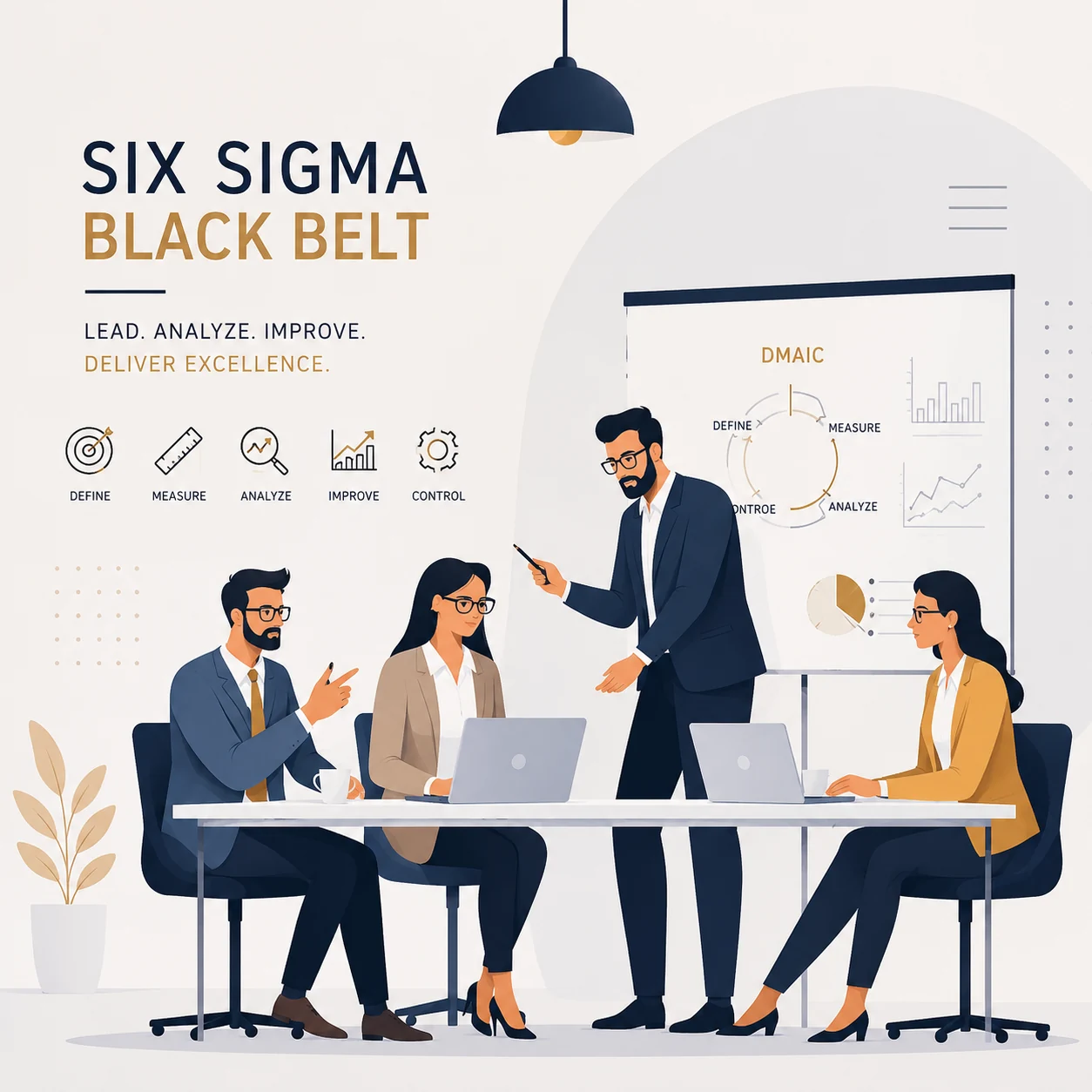

Develop advanced process improvement, quality management, and operational excellence skills through hands-on training aligned with globally recognized Six Sigma methodologies.

Master the Define, Measure, Analyze, Improve, and Control framework to solve complex business problems and drive continuous improvement.
Learn advanced statistical tools to analyze process performance, identify trends, and make data-driven business decisions.
Identify the underlying causes of defects, inefficiencies, and process failures using proven Six Sigma problem-solving techniques.
Evaluate process effectiveness through capability analysis, performance metrics, and quality measurement frameworks.
Apply Lean Six Sigma principles to eliminate waste, improve efficiency, and optimize operational workflows.
Develop expertise in experimental design techniques to validate improvements and optimize critical business processes.
Implement quality management strategies that reduce variation, improve consistency, and enhance customer satisfaction.
Gain practical experience through industry-relevant case studies and project scenarios that mirror real organizational challenges.
Build the skills required to lead cross-functional improvement initiatives, manage stakeholders, and drive sustainable business transformation.
Develop advanced process improvement, statistical analysis, and operational excellence skills that enable you to lead business transformation and quality improvement initiatives with confidence.
Learn to apply the Define, Measure, Analyze, Improve, and Control framework to solve complex business challenges and drive continuous improvement.
Develop the ability to analyze process data, identify trends, validate improvements, and make informed business decisions using statistical tools.
Master proven techniques to identify underlying process issues, eliminate recurring problems, and improve operational performance.
Learn how to measure process performance, assess capability, and identify opportunities for quality and efficiency improvements.
Apply Lean Six Sigma principles to reduce waste, streamline workflows, and maximize value across business processes.
Gain expertise in planning and analyzing experiments to optimize processes and validate improvement initiatives.
Develop skills to reduce process variation, improve consistency, and deliver higher-quality products and services.
Learn to monitor process stability, track key performance indicators, and sustain long-term improvements.
Build the leadership capabilities required to drive organizational change, lead improvement teams, and foster a culture of continuous improvement.

 Introduction to Lean Six Sigma Methodology
Understanding Black Belt Roles & Responsibilities
Principles of Continuous Improvement
Overview of DMAIC Framework
Six Sigma Deployment Strategies
Voice of Customer (VOC)
Critical to Quality (CTQ) Requirements
Project Charter Development
Stakeholder Analysis
SIPOC Mapping
Project Selection & Prioritization
Process Mapping Techniques
Data Collection Planning
Measurement System Analysis (MSA)
Baseline Performance Measurement
Process Capability Analysis
Key Performance Indicators (KPIs)
Root Cause Analysis
Cause & Effect (Fishbone) Diagrams
Pareto Analysis
Failure Mode and Effects Analysis (FMEA)
Hypothesis Testing Fundamentals
Identifying Process Variation Sources
Descriptive Statistics
Probability Distributions
Correlation & Regression Analysis
Confidence Intervals
Statistical Process Control (SPC)
Data Interpretation Techniques
Lean Waste Elimination Techniques
Kaizen & Continuous Improvement
Solution Selection Methods
Process Optimization Strategies
Design of Experiments (DOE)
Pilot Testing & Validation
Control Plans Development
Control Charts & Monitoring
Standard Operating Procedures (SOPs)
Sustainability Planning
Process Documentation
Performance Tracking & Governance
Lean Principles & Value Stream Mapping
Waste Identification & Reduction
Process Flow Optimization
Operational Excellence Frameworks
Business Process Improvement
Enterprise Transformation Strategies
Leading Cross-Functional Teams
Stakeholder Communication
Managing Organizational Change
Conflict Resolution
Influencing Without Authority
Building a Continuous Improvement Culture
Real-World Lean Six Sigma Project
DMAIC Project Implementation
Case Study Reviews
Certification Exam Preparation
Mock Assessments
Final Project Presentation

Develop advanced process improvement, quality management, and leadership capabilities that empower you to drive operational excellence and deliver measurable business results.
Designed for professionals who want to master Lean Six Sigma to lead process improvement, operational excellence, and business transformation initiatives.

Hear from professionals who turned their Six Sigma Black Belt training into business transformation, career growth, and leadership success.
Find answers to common questions about Lean Six Sigma Black Belt Certification Training.
Lean Six Sigma Black Belt Certification is an advanced professional credential that validates your expertise in process improvement, quality management, statistical analysis, and operational excellence using Lean Six Sigma methodologies.
This course is ideal for Quality Managers, Process Improvement Specialists, Operations Managers, Manufacturing Professionals, Project Managers, Business Analysts, Continuous Improvement Leaders, and professionals aspiring to leadership roles.
While prior knowledge of Six Sigma concepts is beneficial, there are no strict prerequisites for most Lean Six Sigma Black Belt training programs. Professionals with experience in quality, operations, project management, or business improvement will find the course especially valuable.
You will learn DMAIC methodology, statistical analysis, process capability analysis, root cause analysis, hypothesis testing, Design of Experiments (DOE), Lean principles, control charts, quality management, and change leadership.
This certification enhances your ability to lead business transformation initiatives, improve operational performance, reduce costs, and qualify for higher-level roles in Quality Management, Process Excellence, Operations, and Continuous Improvement.
Yes. Lean Six Sigma Black Belt is one of the most widely recognized certifications in quality management and process improvement and is valued across manufacturing, healthcare, IT, finance, logistics, and service industries worldwide.
Lean Six Sigma methodologies are widely used in Manufacturing, Healthcare, Information Technology, Banking & Financial Services, Supply Chain & Logistics, Telecommunications, Retail, and Government sectors.
DMAIC stands for Define, Measure, Analyze, Improve, and Control. It is the core Six Sigma framework used to identify process inefficiencies, solve business problems, and implement sustainable improvements.
Yes. The training includes practical exercises, case studies, process improvement scenarios, and project-based learning to help you apply Lean Six Sigma concepts in real business environments.
Common roles include: Lean Six Sigma Black Belt, Quality Manager, Process Excellence Manager, Continuous Improvement Manager, Operational Excellence Leader, Business Transformation Consultant, Process Improvement Specialist, and Operations Manager.
The duration varies by training format. Most professionals complete the certification training within a few weeks to a few months while balancing work commitments.
EduHubSpot's training combines industry-relevant curriculum, practical case studies, expert-led instruction, hands-on learning, and certification preparation designed to help professionals gain real-world process improvement expertise and career-ready skills.


