


Businessman in glasses interacting with futuristic digital data and graphs on a transparent screen in an office.
Futuristic humanoid robot interacting with glowing digital interface displaying complex code and data.
Man in a business suit working on a laptop with floating digital icons representing AI and data analytics in an office.
Live Instructor-Led

GenerativeAI Professional Certification Program

Become a GenerativeAI Specialist through our Live Instructor-led and Hands-on enriched GenerativeAI training.

Upon completion, participants will,
Master prompt engineering techniques to optimize LLM outputs.
Design generative AI applications using frameworks like LangChain and LlamaIndex.
Master Concepts like RAG, GraphRAG, Constitutional AI (CAI), RLHF
Master Multimodal Generative AI, Guardrails, Testing and LLMOps for Deployment.
4.9+ Ratings (Trusted by 50,000 students)

Why Enroll for

GenerativeAI Training?

Transform your career with cutting-edge GenerativeAI and prompt engineering skills

On-Demand skillset

Demand for GenerativeAI professionals is exploding globally, far outpacing talent supply, with massive growth

Top-notch Curriculum

The curriculum covers end to end Generative Practices Including, LLMs, RAG, LangChain, GraphRAG, RLHF, Multimodal GenAI, Guardrails and LLMOps

Learn On Demand GenAI Practices

Master Concepts like RAG, GraphRAG, LangChain, Constitutional AI (CAI), RLHF

Learn from Industry Leaders

Learn from top Industry practitioners with extensive expertise in GenerativeAI and AI systems

Hands-on Learning

Build confidence through hands-on practicals and real-world use cases with a final capstone project

Live Instructor Led classes

Attend live and interactive weekend classes led by senior Industry practitioners. Also get doubt clearing sessions

Career Assistance Services

Profile building, Interview preparation material, Mock Interviews - By Senior Experts

Global Certificate

Receive a globally accepted certificate to validate your learning and career advancement

Career

Benefits

GenerativeAI Job Trends

GenAI Lead – Leads strategic generative AI initiatives, drives enterprise adoption, and shapes innovation roadmaps. Grows into a senior leadership role with +40% CAGR trajectory.

Hiring Companies

Microsoft
Google
Amazon
Fractal

📈 Market Outlook

+40% CAGR – Path to GenAI Lead

Salary

₹23 LPA
Min
₹28 LPA
Average
₹45 LPA
Max
GenAI Lead

AI Project Lead – Oversees end-to-end AI project delivery, coordinates cross-functional teams, and ensures business impact. Moves into project leadership with +40% CAGR growth.

Hiring Companies

TCS
Wipro
Infosys
Accenture

📈 Market Outlook

+40% CAGR – Moves to AI Project Lead

Salary

₹13 LPA
Min
₹15 LPA
Average
₹23 LPA
Max
AI Project Lead

Prompt Engineer – Designs and optimises prompts for generative AI models, builds rapid prototypes, and supports enterprise GenAI applications. Fast-track growth in prompt engineering with +40% CAGR.

Hiring Companies

TCS
Wipro
Infosys
Accenture

📈 Market Outlook

+40% CAGR – Fast growth in prompt engineering

Salary

₹10 LPA
Min
₹15 LPA
Average
₹20 LPA
Max
Prompt Engineer

Features

& Benefits

Participants will get all the below exclusive benefits through our GenerativeAI training

1
Live Interactive Classes

45 hours of Live classes

2
Practicals and Assignments

30+ Assignments to practice & Quizzes to reinforce concepts

3
Hands-on Labs

Hands-on Labs with real-world projects

4
Industry Leaders

Learn from Top Industry leaders

5
1:1 Doubt Clearing

1:1 Doubt-Clearing Sessions

6
Resume Building

Resume and LinkedIn Building

7
Career Assistance

Career Assistance Services

8
Capstone Project

Capstone project: Design and implement end-to-end GenerativeAI solutions

9
Certificate

Certificate of Completion

10
24/7 Support

24/7 Technical Support

11
Lifetime Access

Lifetime access to the course material

12
Career Mentoring

Career Mentoring sessions

Course

Curriculum

Module 1: Foundations of Generative AI & Large Language Models

Learning Outcomes:

  • Explain the evolution from traditional ML to generative AI and foundation models
  • Differentiate between discriminative and generative modeling paradigms
  • Describe the Transformer architecture, self-attention mechanism, and positional encoding
  • Identify key LLM families (GPT, LLaMA, Gemini, Claude, Mistral) and their trade-offs

Topics Covered:

  • AI/ML landscape: supervised, unsupervised, and generative paradigms
  • History & milestones: GANs → VAEs → Transformers → Foundation Models
  • Transformer deep-dive: encoder-decoder, multi-head self-attention, positional encoding
  • Pre-training objectives: causal LM, masked LM, seq2seq denoising
  • Scaling laws, emergent abilities, and model benchmarks (MMLU, HumanEval, GPQA)
  • Open-source vs proprietary LLMs: licensing landscape (Apache 2.0 vs community licenses vs proprietary APIs)

Hands-on Lab Activities:

  • Lab 1: Explore tokenization with tiktoken — analyze token counts, vocabulary sizes, and encoding strategies across GPT-4o and open-source tokenizers; visualize token boundaries on code vs natural language
  • Lab 2: Run inference on a pre-trained LLM (LLaMA 3 / Mistral 7B) via Hugging Face Transformers — compare outputs with varying temperature, top-p, top-k, and repetition penalty settings
Module 2: Prompt Engineering & Context Engineering

Learning Outcomes:

  • Design effective prompts using zero-shot, few-shot, and chain-of-thought techniques
  • Apply structured prompt patterns (ReAct, persona, meta-prompting) for complex reasoning
  • Implement context engineering strategies to manage what enters the LLM context window
  • Evaluate prompt quality using systematic scoring frameworks

Topics Covered:

  • Anatomy of a prompt: system instructions, user messages, assistant pre-fill
  • Zero-shot, one-shot, and few-shot prompting strategies with example selection
  • Chain-of-Thought (CoT), Tree-of-Thought, Self-Consistency, and Step-Back prompting
  • Prompt patterns: persona, template, meta-prompting, ReAct reasoning
  • Context engineering: managing retrieval context, tool outputs, memory, and system instructions within token budgets
  • Prompt injection, jailbreaking risks, and defensive prompting techniques
  • Prompt evaluation: relevance scoring, faithfulness checks, coherence metrics

Hands-on Lab Activities:

  • Lab 1: Build a prompt engineering workbench using OpenAI API — systematically test and compare zero-shot vs CoT vs few-shot across code generation, mathematical reasoning, and summarization tasks; log results with scoring rubrics
  • Lab 2: Implement a context engineering pipeline — given a 100K-token knowledge base, build a system that dynamically selects, prioritizes, and compresses context to fit within a 16K-token window while maximizing answer quality
Module 3: Working with LLM APIs & Application Frameworks

Learning Outcomes:

  • Integrate OpenAI, Anthropic, and open-source LLM APIs into Python applications
  • Implement streaming responses, retry logic, rate-limit handling, and error recovery
  • Build LLM-powered applications using LangChain and LlamaIndex frameworks
  • Manage conversation context, memory types, and structured output parsing

Topics Covered:

  • OpenAI Chat Completions API: models, parameters, JSON mode, structured outputs
  • Anthropic Messages API: system prompts, tool use, extended thinking, prompt caching
  • Hugging Face Inference API and local model serving with Ollama
  • LangChain fundamentals: chains, prompt templates, output parsers, LCEL
  • LlamaIndex basics: data connectors, node parsers, indexing, query engines
  • Conversation memory: buffer, summary, token-window, and vector-store-backed memory
  • Structured output extraction: JSON mode, Pydantic models, Instructor library

Hands-on Lab Activities:

  • Lab 1: Build a multi-provider LLM gateway in Python that routes requests to OpenAI, Anthropic, or local Ollama based on task type — implement unified streaming, automatic retries with exponential backoff, and cost tracking per request
  • Lab 2: Create a structured data extraction pipeline using Instructor + Pydantic — extract product specifications from unstructured e-commerce descriptions into validated, typed JSON schemas with error handling and retry logic
Module 4: Text Embeddings & Vector Databases

Learning Outcomes:

  • Explain how text embeddings represent semantic meaning in high-dimensional vector space
  • Select embedding models based on task requirements and benchmark performance
  • Set up and query vector databases with metadata filtering
  • Implement semantic search and hybrid retrieval pipelines (dense + sparse)

Topics Covered:

  • Embedding evolution: Word2Vec → GloVe → BERT → Sentence-BERT → modern embeddings
  • Models: OpenAI text-embedding-3, Cohere Embed v3, BGE, E5, Jina
  • Evaluation: cosine similarity, MTEB, dimensionality and matryoshka embeddings
  • Vector DB architecture: HNSW, IVF-PQ, metadata filtering, namespaces
  • Chunking strategies: fixed, recursive, semantic, document-aware, parent-child
  • Hybrid search: dense + BM25 with reciprocal rank fusion

Hands-on Lab Activities:

  • Lab 1: Build a semantic code search engine — embed Python functions using OpenAI embeddings, store in ChromaDB with metadata (file, class, docstring), and retrieve relevant code by natural language queries with re-ranking
  • Lab 2: Benchmark chunking strategies (fixed 512-token vs recursive vs semantic) on a technical PDF corpus — measure retrieval quality using hit-rate@k, MRR, and nDCG metrics across 50 test queries
Module 5: Retrieval-Augmented Generation (RAG)

Learning Outcomes:

  • Architect end-to-end RAG pipelines for knowledge-grounded generation
  • Implement advanced retrieval: re-ranking, query transformation, multi-step retrieval
  • Evaluate RAG systems using RAGAS (faithfulness, relevance, context metrics)
  • Optimize RAG for latency, accuracy, cost, and hallucination reduction

Topics Covered:

  • RAG architecture: indexing → retrieval → augmentation → generation
  • Naive vs Advanced RAG: failure modes and improvements
  • Query transformation: HyDE, multi-query expansion, step-back prompting
  • Re-ranking: Cohere Rerank, BGE Reranker, ColBERT
  • Context strategies: stuffing, map-reduce, refine, tree-summarize
  • Evaluation with RAGAS

Hands-on Lab Activities:

  • Lab 1: Build an Advanced RAG pipeline using LlamaIndex — implement query decomposition, hybrid retrieval (vector + BM25 with reciprocal rank fusion), Cohere Rerank, and source citation over a multi-document technical knowledge base
  • Lab 2: Evaluate and optimize the pipeline using RAGAS — auto-generate a synthetic test set, measure all four RAGAS metrics, iterate on chunking size, retrieval top-k, and reranker threshold to improve scores by at least 15%
Module 6: Graph RAG & Knowledge Graphs for GenAI

Learning Outcomes:

  • Explain limitations of vector-only RAG and when Graph RAG is a better fit
  • Build knowledge graphs from unstructured text using LLM extraction
  • Implement Graph RAG combining graph traversal with vector retrieval
  • Query KGs using natural language via LLM-generated Cypher

Topics Covered:

  • Vector RAG limitations: multi-hop, global summarization, entity resolution
  • Knowledge graph fundamentals: entities, relations, triples, property graphs
  • LLM KG construction: entities, relations, coreference
  • Microsoft GraphRAG: community detection and hierarchical summarization
  • Neo4j + LangChain integration and hybrid retrieval
  • Use case selection: vector vs graph vs hybrid

Hands-on Lab Activities:

  • Lab 1: Build a knowledge graph from a technical documentation corpus using LLM-based entity/relation extraction — store in Neo4j, visualize the graph, and implement natural language querying via LLM-generated Cypher
  • Lab 2: Implement a hybrid Graph RAG system — combine Neo4j graph traversal for multi-hop entity questions with vector retrieval for general queries; compare answer accuracy against pure vector RAG on a 30-question benchmark
Module 7: Fine-Tuning LLMs

Learning Outcomes:

  • Apply the decision framework: prompt vs RAG vs fine-tune
  • Prepare datasets for instruction tuning
  • Fine-tune an open-source LLM using QLoRA
  • Evaluate and distill models for cost optimization

Topics Covered:

  • Fine-tuning methods: LoRA, QLoRA, prefix tuning, adapters
  • Dataset formatting, filtering, deduplication, synthetic data
  • QLoRA training with PEFT/TRL and quantization
  • Training config and evaluation strategies
  • Model distillation and cost-performance trade-offs

Hands-on Lab Activities:

  • Lab 1: Fine-tune LLaMA 3 (8B) using QLoRA on a custom instruction dataset for domain-specific code generation — configure 4-bit quantization, train with SFT Trainer, and merge LoRA adapters into the base model
  • Lab 2: Implement model distillation — use GPT-4o to generate high-quality training data, fine-tune a smaller model (Mistral 7B) on the distilled dataset, and compare performance vs cost against the teacher model on a held-out benchmark
Module 8: RLHF, Alignment & Preference Optimization

Learning Outcomes:

  • Explain the RLHF pipeline from SFT through reward modeling to PPO optimization
  • Implement Direct Preference Optimization (DPO) to align a fine-tuned model
  • Understand Constitutional AI, RLAIF, and emerging self-alignment techniques
  • Conduct systematic red-teaming to identify model safety failure modes

Topics Covered:

  • The alignment problem: why pre-training and SFT alone are insufficient for safe deployment
  • RLHF pipeline: SFT → reward model training → PPO optimization (conceptual deep-dive)
  • Direct Preference Optimization (DPO): eliminating the reward model, loss function intuition
  • Constitutional AI, RLAIF, and iterative self-alignment approaches
  • Preference data collection: human annotation guidelines, inter-annotator agreement, synthetic preference generation
  • Red-teaming methodology: systematic probing for harmful outputs, hallucinations, bias, and prompt injection vulnerabilities

Hands-on Lab Activities:

  • Lab 1: Align a model with DPO using TRL — take the SFT model from Module 7, construct a preference dataset (chosen/rejected pairs for helpfulness and safety), train with DPO Trainer, and evaluate alignment improvements
  • Lab 2: Red-team the aligned model — design a systematic evaluation covering toxicity, hallucination rates, prompt injection resistance, and refusal appropriateness; produce a structured safety scorecard
Module 9: Generative AI for Code: Code LLMs & AI-Assisted Development

Learning Outcomes:

  • Leverage code-specialized LLMs for generation, completion, review, and refactoring
  • Integrate AI coding assistants (GitHub Copilot, Cursor, Claude Code) into development workflows
  • Build custom code generation and automated testing tools using LLM APIs
  • Assess and mitigate risks in AI-generated code: hallucinated APIs, license issues, security vulnerabilities

Topics Covered:

  • Code LLMs: CodeLlama, StarCoder 2, DeepSeek-Coder V2 — architecture, training data, and benchmark performance
  • AI coding assistants: GitHub Copilot, Cursor, Claude Code, Codeium — workflow integration patterns
  • Code generation patterns: function synthesis from docstrings, test generation, refactoring, code translation
  • Automated code review: bug detection, security vulnerability scanning, anti-pattern identification with LLMs
  • Documentation generation: docstrings, README files, API documentation from source code
  • Risks and limitations: hallucinated APIs, license compliance (copyleft contamination), security risks, over-reliance patterns

Hands-on Lab Activities:

  • Lab 1: Build an AI-powered code review bot — ingest a Python repository, use an LLM to analyze each function for bugs, code smells, type issues, and security vulnerabilities; output structured review comments in GitHub PR format
  • Lab 2: Create an automated test generation tool — given a Python module, generate pytest unit tests using an LLM, execute them, capture failures, feed errors back to the LLM for self-correction, and measure final code coverage
Module 10: Multimodal Generative AI: Vision, Audio & Beyond

Learning Outcomes:

  • Work with multimodal models that process and generate text, images, and audio
  • Build applications using vision-language models (GPT-4o, Gemini, Claude Vision, LLaVA)
  • Implement text-to-image generation and image understanding pipelines
  • Integrate speech-to-text (Whisper) and text-to-speech capabilities into applications

Topics Covered:

  • Multimodal architectures: vision encoders (ViT, SigLIP), cross-attention fusion, early vs late fusion strategies
  • Vision-Language Models: GPT-4o, Gemini Pro Vision, Claude Vision, LLaVA — capabilities and API usage
  • Text-to-image generation: Stable Diffusion, DALL-E 3, Flux — diffusion model fundamentals and controlability
  • Image understanding: captioning, visual question answering, document/chart/diagram analysis with VLMs
  • Audio models: Whisper (speech-to-text), ElevenLabs / XTTS (text-to-speech), audio understanding
  • Emerging modalities: video understanding (Gemini, GPT-4o), video generation, and omni-modal models

Hands-on Lab Activities:

  • Lab 1: Build a multimodal document analyzer — use GPT-4o Vision API to extract structured data (tables, charts, key figures) from scanned financial reports and engineering diagrams; output validated JSON with confidence scores
  • Lab 2: Create an end-to-end voice-interactive assistant — integrate Whisper for speech input, an LLM for reasoning, and a TTS engine for spoken output; build a FastAPI endpoint supporting real-time audio streaming
Module 11: AI Agents & Tool Use

Learning Outcomes:

  • Design autonomous AI agents with planning, reasoning, memory, and tool-use capabilities
  • Implement function calling and structured tool integration across OpenAI, Anthropic, and open-source APIs
  • Build stateful multi-step agent workflows using LangGraph with conditional branching
  • Integrate agents with external systems using Model Context Protocol (MCP) for standardized tool access

Topics Covered:

  • AI agent architecture: perception → reasoning → planning → action → observation loop
  • Function calling: OpenAI tools API, Anthropic tool use, parallel and sequential tool execution
  • ReAct (Reasoning + Acting) agents: thought-action-observation cycles, scratchpad management
  • LangChain agents: tool selection, agent executor, custom tool creation, structured tool outputs
  • LangGraph: stateful workflows with conditional edges, cycles, persistence, and checkpointing
  • Model Context Protocol (MCP): standardized tool integration, MCP servers, client architecture
  • Human-in-the-loop patterns: approval gates, clarification requests, escalation, and fallback strategies

Hands-on Lab Activities:

  • Lab 1: Build a ReAct research agent with custom tools — create an agent that can search the web, execute Python code, query a SQL database, and read files; orchestrate a multi-step research workflow that synthesizes findings into a structured report
  • Lab 2: Implement a LangGraph customer support agent — design a stateful workflow with branching (ticket classification → intent routing → knowledge retrieval → resolution → escalation), persistence across sessions, and human approval gates at critical decision points
Module 12: Guardrails, Safety & Responsible AI in Production

Learning Outcomes:

  • Implement input validation, output filtering, and content moderation guardrails for LLM applications
  • Deploy PII detection, hallucination checks, and toxicity filtering in production pipelines
  • Use guardrail frameworks (NeMo Guardrails, Guardrails AI, LlamaGuard) to enforce safety policies
  • Design responsible AI governance: bias auditing, fairness testing, and compliance with AI regulations

Topics Covered:

  • Guardrail taxonomy: input guards (prompt injection detection, topic restriction, PII masking) vs output guards (hallucination detection, toxicity filtering, format validation)
  • NeMo Guardrails: Colang flows, topical rails, fact-checking rails, moderation rails
  • Guardrails AI (RAIL spec): validators, on-fail actions, structured output enforcement
  • LlamaGuard & ShieldGemma: safety classification models for content moderation
  • PII detection and redaction: regex + NER hybrid approaches, Microsoft Presidio integration
  • Hallucination detection: self-consistency checks, NLI-based verification, source grounding validation
  • Responsible AI: bias auditing, fairness metrics, EU AI Act basics, model cards, and transparency reporting

Hands-on Lab Activities:

  • Lab 1: Build a multi-layered guardrail system using NeMo Guardrails — implement input rails (prompt injection detection, topic restriction, PII masking), output rails (hallucination check via NLI, toxicity scoring, format validation), and test against an adversarial prompt suite of 50+ attack vectors
  • Lab 2: Integrate Guardrails AI into a RAG application — add Pydantic-based output validators, implement factual consistency checks against retrieved sources, build a PII redaction pipeline with Presidio, and generate a safety compliance report with pass/fail metrics
Module 13: LLM Evaluation, Testing & Production Deployment

Learning Outcomes:

  • Design comprehensive evaluation strategies: LLM-as-judge, automated benchmarks, and human evaluation
  • Implement CI/CD-integrated prompt testing and regression detection pipelines
  • Deploy LLM applications to production with optimized inference and observability
  • Manage cost, latency, and reliability using caching, model routing, and fallback chains

Topics Covered:

  • LLM evaluation paradigms: reference-based metrics (BLEU, ROUGE), LLM-as-judge, human evaluation protocols
  • Automated testing: Promptfoo for prompt regression testing, DeepEval for unit-testing LLM outputs, CI/CD integration
  • A/B testing prompts and models: experiment design, statistical significance, guardrail-aware rollout
  • Serving frameworks: vLLM, TGI, Triton Inference Server — continuous batching, KV-cache, speculative decoding
  • Deployment: cloud APIs (AWS Bedrock, Azure OpenAI, GCP Vertex), self-hosted, serverless architectures
  • Inference optimization: quantization (GPTQ, AWQ), prompt caching (Anthropic, OpenAI), semantic response caching with Redis
  • Observability: LangSmith, Langfuse, Phoenix — distributed tracing, cost tracking, latency monitoring, error dashboards
  • Cost management: token budgeting, tiered model routing (complex → GPT-4o, simple → Haiku), fallback chains

Hands-on Lab Activities:

  • Lab 1: Build an LLM testing and evaluation pipeline — use Promptfoo to create a test suite with 30+ test cases across accuracy, safety, and format dimensions; integrate with GitHub Actions for CI/CD prompt regression detection; implement LLM-as-judge scoring with calibrated rubrics
  • Lab 2: Deploy a production-ready LLM application — serve a quantized model with vLLM behind FastAPI, instrument with Langfuse tracing, implement semantic caching with Redis, set up model routing (GPT-4o for complex queries, Haiku for simple ones), and build a Grafana-compatible monitoring dashboard tracking latency (TTFT, TPS), cost per query, and error rates
Module 14: LLMOps - Deployment Strategies

Learning Outcomes:

  • Understand the fundamentals of LLMOps for managing LLMs in production
  • Explore best practices and tools for deploying LLMs
  • Design deployment pipelines for Generative AI applications
  • Implement basic LLM deployment using containerization and orchestration
  • Integrate n8n for automating deployment workflows

Topics Covered:

  • Introduction to LLMOps: definition, importance, and lifecycle management of LLMs
  • LLM Deployment Best Practices: model serving, API endpoints, latency optimization
  • Containerization: Docker for packaging LLM applications
  • Orchestration: introduction to Kubernetes for scalable deployment
  • Model Serving Frameworks: TensorFlow Serving, TorchServe, Hugging Face Inference Endpoints
  • CI/CD Pipelines for LLMs: automating build, test, and deployment
  • n8n for workflow automation in AI deployments

Hands-on Lab Activities:

  • Hands-on: Containerizing a simple LLM application using Docker
  • Deploying a containerized LLM application to a local Kubernetes cluster (Minikube)
  • Setting up a basic CI/CD pipeline for an LLM application (e.g., using GitHub Actions)
  • Use n8n to create automated workflows for AI model deployments (e.g., automating model updates or monitoring tasks)
Module 15: Capstone Project: End-to-End Production GenAI Application

Learning Outcomes:

  • Architect and build a production-grade Generative AI application integrating multiple modules
  • Implement RAG (vector + graph), agentic tool use, guardrails, and observability in a single system
  • Demonstrate systematic evaluation with automated test suites and safety benchmarks

Topics Covered:

  • Project briefing: requirements specification, evaluation rubric, and deliverable checklist
  • Architecture design session: component selection, data flow diagramming, integration planning
  • Implementation sprint: guided build with mentor checkpoints at each integration stage
  • Testing & evaluation: functional testing, RAG evaluation (RAGAS), safety checks (guardrail test suite), load testing
  • Career pathways in Generative AI: roles (AI Engineer, LLM Ops, Prompt Engineer), certifications, and industry trends

Hands-on Lab Activities:

  • Capstone: Build an AI-Powered Enterprise Knowledge Assistant — a full-stack application integrating: (1) Advanced RAG with hybrid vector + graph retrieval and re-ranking over a multi-format document corpus (2) Agentic tool use with LangGraph — code execution, web search, database queries, and MCP-based integrations (3) Multi-layered guardrails — input validation, PII detection, hallucination checking, and output filtering (4) Production infrastructure — FastAPI serving, Langfuse observability, semantic caching, and model routing
  • Deliverables: working application, architecture document, Promptfoo test suite (30+ cases), RAGAS evaluation report, safety scorecard
Download Curriculum

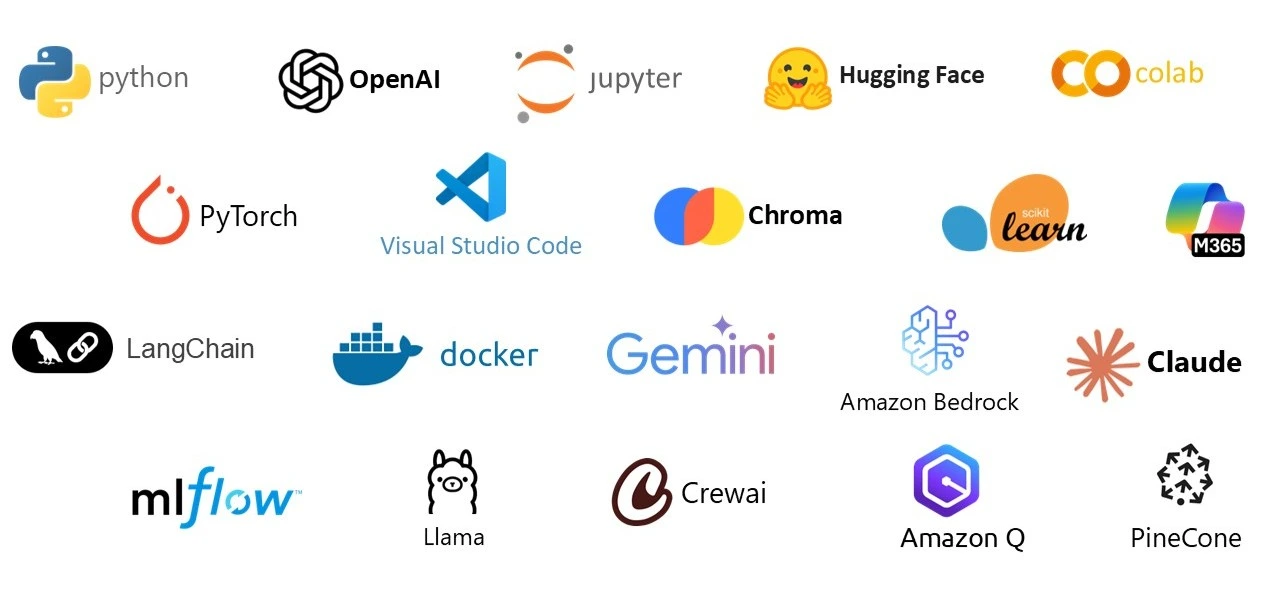
Tools you will learn during th

Training
Projects

What Your Certificate Will

Look Like

A customised certificate from EduHubSpot on the successful completion of GenerativeAI and Prompt Engineering Training Program.

GenAI Certificate Of Achievement

Past Participant

Testimonials

Hear from professionals who turned their PMP® training into promotions, pay raises, and dream roles — and know that you can be next.

Featured In Leading

Publications

Career Assistance

Services

Webinar
Live Sessions

Career Assistance Services

Resume Preparation

Craft ATS Job-Ready resumes through Expert Asisstance.

1.5 Building a LinkedIn Profile

Interview Questions consolidated for an Hassle Free Interview Prep.

Materials for Interview Prep

Self-Branding through best Linkedin Profile.

Career Counselling

Know where you stand today in Terms of Skills and Technology

Frequently Asked

Questions

Common questions about our GenerativeAI Professional Training Program.

What is the Total Duration to complete this course?

The course will go on for 3 Months and additionally one more month to complete the project work. Within 4 Months learners can complete the course and get certified.

What are the prerequisites to learn this course?
  • Basic knowledge of programming concepts (any language)
  • Fundamental understanding of operating systems
  • Basic command-line experience
  • Familiarity with cloud computing concepts (helpful but not required)
What if I miss any live class?

All the live classes are recorded and auto added to your LMS. You can cover the missed lectures through recordings.

What all will get as part of the course contents?

Our specially designed course LMS will give you complete course contents consisting of PPTs, docs, quizzes, assignment files and lab related docs.

How long will I have access to the course contents?

We provide one year access to the entire course contents with class recordings.

What is the process to renew my course access after 1 year?

We suggest all learners complete the course within one year. If not completed due to circumstances, learners can pay a renewal fee of INR 5000 (or) USD 100 to activate content for another 3 Months. During this renewal period, only one live batch can be accessed.

How recognised is your course completion certificate?

Eduhubspot's certification courses are designed in collaboration with industry experts and adhere to global standards. The course completion certificate you earn is highly regarded by major organizations, giving you a competitive edge in the job market.

Thank you! Your submission has been received!
Oops! Something went wrong while submitting the form.