What is GitOps?
9 Reasons GitOps Is the Future of DevOps Automation in 2026


Table of Contents
Share This Article

If you're working in the IT domain, you might have noticed that handling applications and infrastructures has now become very complex- even with the perfect DevOps practices. Manual configurations and scripting deployments, and sometimes, there will be a hope that nothing will interrupt the process.
What if there were a less complicated way? A way to manage the infrastructure and applications with the same competence and accuracy you bring to your code. This is the promise of GitOps. More than a jargon, it is a paradigm shift in DevOps and automation with a promise to convert the process of developing, deploying and managing software.
This article will focus on the understanding of GitOps along with its components, key features and why it is responsible for the future of DevOps automation, a topic increasingly explored by professionals through a DevOps online course focused on modern automation practices.
What is GitOps?
GitOps is a functional framework which uses Git as the essential source of truth for maintaining both infrastructure and application configurations. It enables teams to elaborate, deploy and sustain resources declaratively using Git repositories. GitOps integrates with CI/CD tools, automating the deployment process and ensuring that the actual state of the system aligns with the desired state described in Git.
What are the Features of GitOps?
GitOps offers a developer-centric experience, which allows team members to sustain and control the internal capacities of cloud-native applications. It offers developers a strategy of application development which can be used to originate pull requests as a means of accelerating and interpreting infrastructure changes. It acts as a tool to help businesses offer new features by programming the continuous delivery of cloud-native applications. The features of GitOps are as follows:
Declarative Infrastructure
GitOps contains a declarative infrastructure approach, where the individual defines the necessary state of the system in code, and the system automatically configures itself to meet the state. It is similar to the concept of the thermostat at home, where an individual specifies the required temperature and the system tries to reach and maintain the temperature. This approach shows how a system can be used to achieve the desired result seamlessly without being overused with manual issues.
Version Control
Git is the single source of truth, and therefore, it is easy to make adjustments and required changes. Declarative configuration can be restored in a single location within version control systems to enhance development collaboration. These changes will be monitored and give a complete audit trail, and make the rollbacks effortless.
Automation
GitOps operators continuously track the Git repository and the live infrastructure to figure out any differences between the desired state and the actual state, and adjust them. Apart from maintaining consistency, it will help to prevent manual errors, respond to interactions and enable self-healing capacities.
Use of Software Agents
Software agents automatically adapt to potential issues that take place when the desired state is not similar to the system's existing state. When there is a system malfunction or potential failure, software agents give feedback to software development teams and as a result of this, the entire system acts in a self-healing manner.
CI/CD
As a natural impact of the automation capacities, GitOps streamlines the CI/CD pipelines. If the changes are committed towards the Git repository, a pipeline is stirred up that manages developing, testing and deploying the application. These ways ensure that the applications will be synchronised with the current code and configurations.
What are the Benefits of GitOps?
GitOps impacts beyond the technological processes. It has several benefits to work for the productivity, collaboration and the success of the team. The benefits are as follows.
Enhanced Trustworthiness
There will be no worry about configuration drift and manual mistakes. Reducing human intervention and incorporating a sole source of truth results in more genuine and stable systems. GitOps tools can automatically restart a failed pod and ensure the running of the application.
Rapid Delivery
GitOps allows continuous deployment and automated synchronisation, which minimises time-to-market and enables businesses to deliver innovative features and updates in a very short period. For example, new features or bug fixes pushed to Git are deployed to Kubernetes management without any manual approval.
Enhanced Collaboration
GitOps motivates transparency and teamwork between development and operations. It is the main USP for a smooth and efficient workflow. This collaboration makes the Git repository a single source of truth for the team.
For example, developers explain application configurations, operators deploy these configurations, and the security team make sure that the configurations meet compliance needs, all with the help of GitOps.
Improved Security
Here, every change is monitored, and every action is examined. GitOps offers an audit trail and improves the security posture.
Enhanced Productivity
GitOps reduces manual tasks and helps to focus on innovation.
Enhanced Developer Experience
Working with different cloud-native technologies, such as Kubernetes, is easier with GitOps, since an individual can reuse the known Git workflows.
Stability
GitOps makes things easier with rapid recovery when things go wrong.
Why GitOps is the Future of DevOps Automation in 2026?
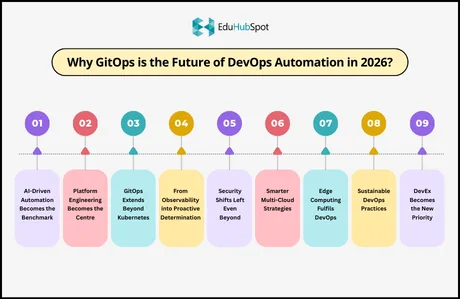
2026 is knocking at the door, and the DevOps scenario is prepared for another year of transformation. Technologies such as AI-driven automation, platform engineering and security-first development have now become the standard practice for competitive teams. With mature cloud ecosystems and accelerated development cycles, organisations need to stay ahead of these transformations to remain efficient and secure. Here are the top 9 reasons that illustrate the impactful trends of DevOps in 2026.
1. AI-Driven Automation Becomes the Benchmark
Since AI has already found its route into DevOps lines, 2026 will witness the AI-driven automation transforming from experimental use to an everyday requirement. The machine learning models will manage tasks, such as the predictive planning methods of infrastructure failure, optimisation of CI/CD pipelines and suggestion of code improvements in real time.
Effects: Quick releases, decreased downtime, and tactical problem prevention.
Suggestion: Start combining AI-driven observability devices and anomaly detection systems for the AI-enabled workflows in 2026.
2. Platform Engineering Becomes the Centre
Platform engineering or building internal developer platforms, which streamline development as well as deployment, will become a major focus for large and medium-sized organisations. This approach enhances the experience of the developer by providing self-service capacities and implementing best practices.
Effects: Minimised operational bottlenecks and developed scalability.
Suggestions: Invest in designing a centralised platform team that links security and DevOps.
3. GitOps Extends Beyond Kubernetes
GitOps has been closely associated with Kubernetes workflows, but in 2026, it will expand into broader infrastructure and application management. Expect Git-driven practices for multi-cloud orchestration, security policy implementation, and serverless architectures.
Effects: Invariability, auditability, and reversal capabilities across the entire infrastructure.
Suggestions: Use GitOps tools such as Flux and experiment with the application beyond container workloads.
4. From Observability into Proactive Determination
In 2026, the observability will grow from just an observation to actively ensuring determination. This encompasses leveraging telemetry information to forecast problems before they happen, integrating AI to support solutions and automating responses.
Effects: Decreased mean time to recovery (MTTR) and lower customer-facing outages.
Suggestions: Integrate distributed tracing, logs and metrics in a collective observability stack similar to OpenTelemetry.
5. Security Shifts Left Even Beyond
DevOps has been a jargon for several years, but 2026 will witness a deeper security incorporation in the initial stages of development. From AI-powered code scanning to automated compliance audits, the "shift-left" situation will be non-negotiable.
Effects: Lower vulnerabilities towards production, strong compliance posture.
Suggestions: Incorporate security checks straight into CI/CD pipelines for continuous deployment and integration.
6. Smarter Multi-Cloud Strategies
Organisations will revise multi-cloud strategies in 2026, not only for overabundance but for cost optimisation, regulatory compliance and performance. AI-driven cost prediction and smart workload positioning will play a vital role.
Effects: Minimised vendor lock-in and optimised resource outlay.
Suggestions: Regularise infrastructure deployments with Crossplane to manage consistency across providers.
7. Edge Computing Fulfils DevOps
As organisations deliver applications near the users, DevOps strategies will be accustomed to the extraordinary challenges of edge computing- minimal resources, distributed growth, and real-time requirements.
Effects: Rapid user experiences and new opportunities for the Internet of Things and real-time analytics.
Suggestions: Analyse lightweight container runtime for edge workload.
8. Sustainable DevOps Practices
Sustainable DevOps will expand relevantly as organisations face higher pressure to minimise their carbon footprint. Effective coding, optimised developments and energy-efficient delivery will become part of normal DevOps pipelines.
Effects: Reduced infrastructure costs and enhanced environmental responsibility.
Suggestions: Monitor energy usage metrics side by side with standard performance KPIs.
9. DevEx Becomes the New Priority
In 2026, organisations will acknowledge that productivity and innovation will be dependent upon the experience of the developer. It includes workload stability, psychological clarity, AI-governance and a modern development environment. A perfect DevEx not only have the appropriate tools but also optimises the developer workflows to increase productivity and collaboration.
Effects: Increased satisfaction of the developer, quick onboarding and accelerated deployment cycle.
Suggestions: Invest in a developer assistance tool, use AI-powered assistants for code and infrastructure.
How to Implement GitOps in an Organisation?
Introducing GitOps in an organisation needs a set of steps to ensure smooth implementation. By following the appropriate practices and leveraging the perfect tools, an organisation can set up a strong GitOps pipeline which automates Kubernetes management and infrastructure. The steps to implement GitOps are as follows:
Step-1: Explain GitOps Workflow
Select the tools which are suitable for the existing DevOps practices and infrastructure. The best tools for GitOps are ArgoCD, Flux, and Helm. For example, you can choose ArgoCD for Kubernetes management and Flux for Git-driven deliveries.
Step-2: Save Configuration in Git
Restore all infrastructure and application configurations in Git repositories. Ensure configurations are declarative and follow the suitable practices for version control. This will help an individual to store Kubernetes deployment files, Helm charts and application configurations in a Git repository.
Step-3: Combine CI/CD Tools
Combine GitOps tools with the CI/CD pipelines to systematise testing, building and delivering changes of the codes to Kubernetes. For instance, you can establish a pipeline that instigates tests and develops when code changes are constrained to Git, followed by an automatic delivery to the Kubernetes cluster.
Step-4: Systematise Continuous Resolution
Configure the GitOps tool to automatically track the Git repository and reconcile Kubernetes clusters with the desirable state. An individual can use Flux to track Git and synchronise Kubernetes clusters with the current configuration saved in Git.
Step-5: Approve Monitoring and Reversal
Track deliveries and make sure any incongruities will be automatically reconciled. Incorporate reversal mechanisms in Git to recover rapidly from failed deliveries. For instance, a reversal of the last steady commit in Git if a delivery includes any issues.
These steps help to implement GitOps in an organisation and ensure the DevOps processes are completely automated and genuine.
Final Thought
GitOps is not only a catchword, but it is a basic shift that states how one can approach DevOps operations, and it now forms a core conceptual pillar in many DevOps certification course programs covering next-generation automation models. It leverages the power of Git and a declarative strategy to develop simplicity, reliability, and expertise in infrastructure and management of applications.
By incorporating AI-first automation, investing in platform engineering, and placing security and deeper observability into workflows, an individual can set the organisation up for a robust year ahead. The future trend of DevOps is active, intelligent and extremely collaborative, and 2026 will be the year when these trends will take place effectively.
Frequently Asked Questions (FAQs)
1. What is meant by GitOps?
GitOps is a state-of-the-art DevOps practice which utilises Git as the single source of truth for infrastructure and the configuration of applications. It systemises deliveries, tracking and management by applying Git workflows to operations and permits consistency and easy reversal.
2. What is the difference between GitOps and traditional DevOps?
Traditional DevOps depends on CI/CD pipelines and human interventions. On the other hand, GitOps increases Git-based workflows to infrastructure. It implies version-controlled changes, peer review, and minimising manual error and enhancing reliability.
3. Why GitOps is the future of DevOps automation in 2026?
In 2026, GitOps is growing beyond Kubernetes into multi-cloud harmony, serverless architectures and security policy implementation. Its capability to deploy consistency, auditability and resilience turns it into a foundation of next-gen DevOps automation.
4. What is the role of AI in GitOps automation?
AI increases GitOps by forecasting infrastructure failures, optimising CI/CD pipelines and code improvements in real time. This composition of GitOps and AI-driven automation helps in rapid releases, decreased downtime and active problem solving.
Explore Our Latest
Insights

Stay updated with our recent blog posts.
Explore Our
Course Gallery

Discover a diverse range of courses designed to elevate your skills and knowledge.

