Understanding the Psychology of Team Building and
How Group Dynamics Influence Workplace Success

Learn about team building psychology and group dynamics. Discover theories, exercises, and how team dynamics enhance productivity and project management success.


Table of Contents
Share This Article

Every organization's success is driven by the team's hard work. Teams play a very crucial role in helping the organization grow and expand. However, if there is any heyday in the team's dynamics then of course the work gets affected and so does the performance of the organization as a whole. This thereby affects the whole cycle of an organization's functionality.
Team building is the process of bringing in individuals together to work towards common goals which will eventually help the organization grow.
Google organizes no meeting weeks, to ensure that the employees leave their work aside for some time and engage with their team to enhance effectiveness and collaboration.
In order to build a team and ensure its smooth functioning, it's vital to deeply understand the psychology of team building and how a team actually functions.
In this article, we'll study about:
- Importance of team building
- Theories of team building
- Team Building Exercises
- Relationship between team building and project management
- How team dynamics enhance productivity?
- Repercussions of negative team dynamics
So, let's get started!
Importance of Team Building
Every organization is driven by its people and the teams involved. Team building, is hence, a vital concept thereby creating a positive and growing work environment. Teams help in bringing people together which further helps in problem solving and decision making.
Here are some of the reasons why team building is crucial:
Helps in building trust
In order to function together as a team, people should have trust in each other. They should know when to rely on whom when things are necessary or if there's any crisis situation. This thereby creates a sense of security and makes people feel psychologically safe.
Improves performance
Team building leads to working together and collaboratively. This collaborative work thereby helps in improving performance of the team as a whole, a skill highly valued in the context of PMP certification. If any employee has less responsibilities, then they can share other team members with their tasks. The teams who have strong dynamics have shown almost 21% of increase in their productivity.
Enhanced and better communication
When employees work together collaboratively and have shared responsibilities, they strategize tasks accordingly to deliver the best possible results. Proper communication helps employees grow together as a team. Studies have shown that team building helps in better communication by approximately 50%
Healthy competition
When employees work together in a team, their understanding with their peers is at an appropriate level. This thereby creates a healthy competition, driving them to achieve more.
Team bonding
As employees work together, their relationship with the team strives to grow and expand thereby enhancing team bonding.
Problem solving
When employees come together and work collaboratively on any given task, their ability to solve any problem enhances. Every individual presents his or her own solution, thereby helping to solve a problem in less time with a variety of solutions possible.
Theories of Team Building
The psychology of team building revolves around understanding group or team dynamics in terms of team situation and individual temperament.
Here are some theories or models given by certain psychologists, which will help to understand the psyche of any team and its functionality:
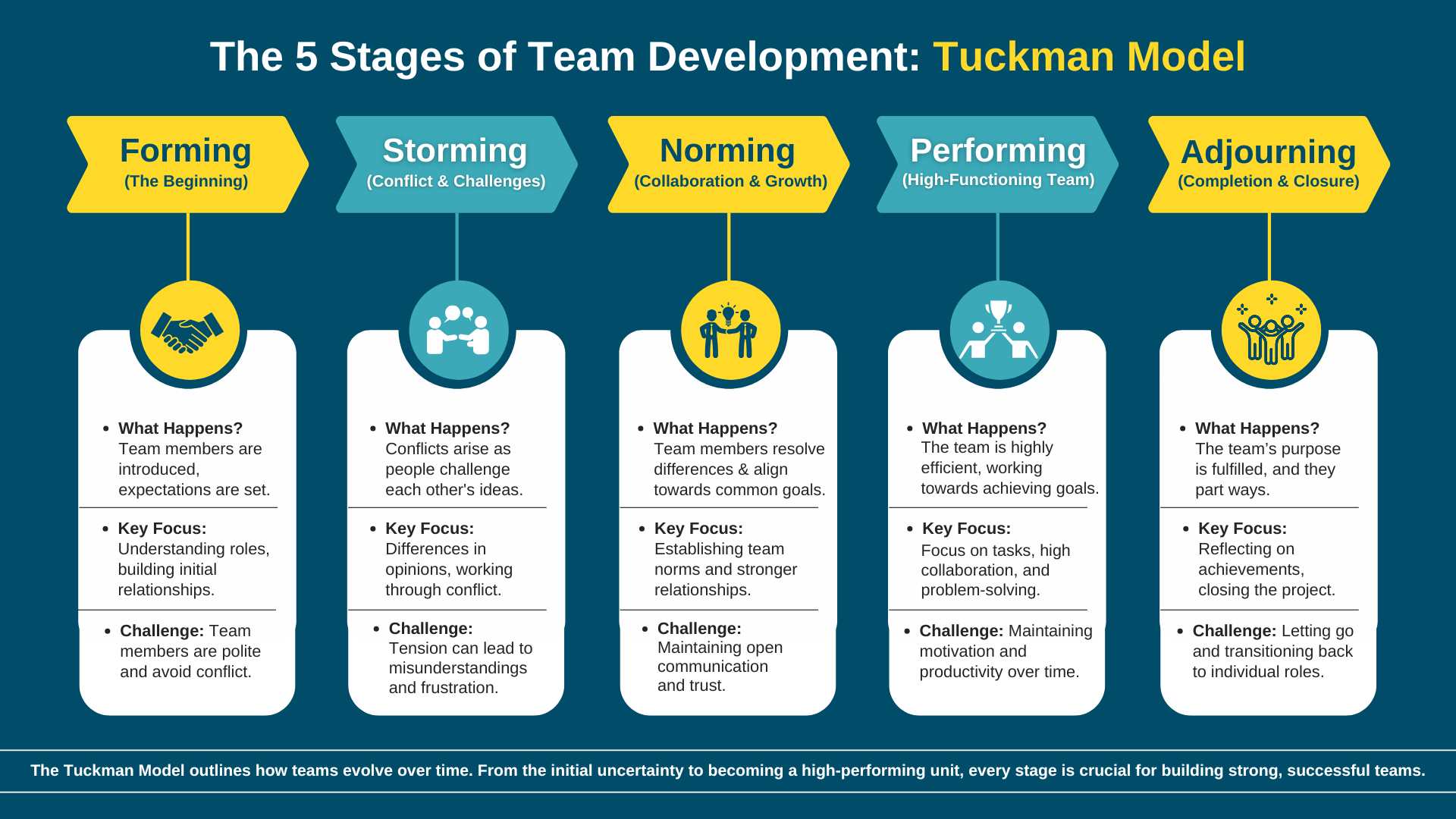
The Tuckman Team Model
The Tuckman Team Model was given by Bruce Tuckman in 1985. This model focuses on five stages of how a team evolves and grows with time. These five stages are: forming, storming, norming, performing and at last, adjourning. The team moves through all the stages one by one.
Forming is the initial stage of team building. Here, teams are formed, expectations are set, boundaries are made, and the main purpose of forming a team is decided and discussed.
After a team is formed and the guidelines are set, the team moves towards the next stage which is the storming stage. In this stage, all the guidelines and expectations that were formed in the first stage, are challenged in the storming stage. In this stage, there are high chances of group conflict as the boundaries that are set get challenged.
Individuals learn more about others' and how the other person works and functions. The main purpose of this stage is to brainstorm ideas and work collaboratively towards the purpose of the team. Additionally, also understand each other's weaknesses and strengths.
Post this, the team moves towards the third stage of a team building referred to as the 'norming stage'. In this stage, each individual works towards the goals of the team both collaboratively and independently. This stage is smoothly functioning only if the conflicts between the individuals are resolved.
Subsequently comes the fourth stage which is the performing stage. Only a few teams come up to the performing stage. Here in this stage the team's hard work is for a show now. This happens when the teams have worked well on several projects, have understood each other well and are now ready to showcase to the world what they have achieved.
Last, but not the least comes the fifth stage which is the adjourning stage. Since the purpose of the team is fulfilled, goals are achieved hence the team can now have adjourned.
2. DISC Model
Dr. William Moulton Marston developed the DISC theory in 1928. This model predicts how an individual behaves in a team depending on four personality traits, namely, dominance (D), influence (I), steadiness (S), and compliance. (C).
| Traits | Strengths | Weaknesses | |
|---|---|---|---|
| Dominance | Direct, decisive, ego-driven, problem solver and risk taker | Great organizer, Good time management skills, innovative | Argumentative, disrespectful towards authority, blunt, stubborn, takes on too much work. |
| Influence | Enthusiastic, persuasive, optimistic, impulsive, charismatic. | Problem solver, great cheerleader, negotiator, peace maker, people's person | Impulsive, focuses on too much detail, focuses only on popularity |
| Steadiness | Reliable, predictive, friendly, team player, empathetic, good listener, easy going | Dependable, loyal, empathetic, has patience, knows how to resolve conflicts. | Cannot take criticism, too sensitive to accept change, has difficulty making priorities |
| Compliance | Has high standards, values precision, even-tempered, realistic, logical, methodical | Great researcher, defines situations precisely, and accurately. | Difficulty setting clear boundaries, cannot accept criticism, avoid conflicts. |
3. GRPI Model
GRPI model was developed by Richard Beckhard in 1972 and this model focuses on four key components which are crucial to enhance effectiveness in a team.
Here are the four crucial components of GRPI model:
Goals
A team is always formed because of an agenda. Hence, everyone must be clear about the team's goals and should have accountability as a whole. Also, everyone's goals must be aligned with each other so that each individual is on the same page.
Roles
Also, not only as a team but as an individual one must be aware about what role they play and what are their own responsibilities as a person.
Processes
This component of the GRPI model focuses on making different systems or strategies with which every team functions smoothly with decision making, problem solving, and conflict resolution.
Interpersonal relationships
Teams can function well when everyone is not only clear about their goals and roles, but also have a good interpersonal relationship with each other in the team. Openness, trust, high communication not only helps the team grow but also assists in dealing with conflicts effectively.
Team Building Exercises
Team building exercises or activities are vital in helping a team grow and also connect with each other on a personal level.
Some of the effective team building exercises are:
Personal histories
This exercise is a 30 minutes long activity, wherein team members answer certain questions about themselves. These are very basic and easy to answer questions. Don't worry, nobody's taking a test!
These questions can be:
- Where do you live?
- What are your hobbies?
- What's the funniest experience you ever had?
- What was your memorable moment in life?
Answering these questions helps individuals know about their team members and also connect with them on a personal level. This thereby helps in vibing with them, also fostering openness and trust.
Personal histories help in understanding people and their lives. It assists in seeing people as a whole and where they are coming from. This reflection thereby helps in team building and bonding.
Failure Funerals
This exercise basically helps the team understand and learn about handling failures. Rather than blaming each other and creating negativity around this exercise helps to reflect.
So here, team members gather for around 15-30 minutes, in cases of any failure, client escalations or setbacks and reflect on:
- What went wrong?
- How could that have been managed?
- What was the learning from the experience?
- What are certain things to be kept in mind for the future?
Back writing
This one's favorite!
Back writing exercise helps in positive social interactions and having fun. In this exercise, each participant has a paper attached on their back. Everyone moves around the room randomly and writes something on each other's back such as, giving compliments, drawing anything that reflects the person, etc.
At the end, participants remove the paper and read the comments aloud. This exercise supports psychological well-being and promotes security and safety within the team.
Relationship between team building and project management
Now that we have understood how crucial it is to build a team, it's also vital to understand a significant relationship between team building and project management.
Every team has a certain goal or a project they'll be working on. The project a team is working on will definitely drive its success depending on how strongly the team is aligned.
In 1994, the Construction Industry Institute conducted an in-depth study in some geographically examined areas in the US. This study lasted for around three years. The purpose was to see the impact of team building on project management amongst the private sectors. Results showed that organizational teams' collaboration had a significant impact on the project outcomes. This basically led to reduction in cost, enhanced quality and also stronger work relationships.
The major goal in project management is to ensure that the project is delivered on time and this cannot be possible without a team. And this is where team building comes into the picture. Team building activities which ensure trust, communication and openness is truly crucial to ensure the success of the project.

How team dynamics enhance productivity?
Having a team is great, but how to know if that team will effectively work or not? If there is any crisis situation, how will the team manage to strive through that? Team dynamics refer to a team's personal interaction with each other which has a direct impact on productivity.
Team dynamics play a very crucial role in making any team as 'the best team'. Team dynamics will either make or break the business. No matter the organization size, if the team isn't having the best dynamics then it can have a very strong impact not only on the team but also on the success of the organization as a whole.
Some of the crucial components of team dynamics are:
- Communication
- Trust
- Openness
- Shared roles and responsibilities
- Conflict resolution
Strong team dynamics not only enhances productivity but also positively impacts job satisfaction, creativity, increased innovation, decision making, problem solving and ability to resolve conflicts.
Repercussions of negative team dynamics
Negative team dynamics occur when individuals or groups negatively impact the other person' ability to work and grow effectively in a team which can significantly impact productivity.
Not only productivity but also it impacts the relationship of team members with each other.
The Success and overall performance of the team could ultimately be affected by the cumulative impact of negative team dynamics – Kamlesh Dangi, Group Head, Human Resources, InCred.
Some of the possible repercussion of negative team dynamics include:
- Decreased productivity
- Poor job satisfaction
- Conflicts in the team
- Loss of trust
- Increased attrition rate
Some of the scenarios which reflect negative team dynamics can include someone dominating the whole conversation and not allowing the other person to speak, thereby affecting the creativity.
Another scenario can be, critically blaming other team members in case of any crisis situation or escalation from the client.
Henceforth, it's crucial that the team leader takes charge to make sure that the team works efficiently and works on improving the dynamics of the team.
Conclusion
Team is an essential part of any organization and what makes a team successful is the people involved. In order to ensure the success of both- team and organization, it's vital to understand the psychology behind team dynamics.
There are multiple exercises that can be conducted in order to enhance team building and also further improve team dynamics. However, negative team dynamics is something that can spoil the whole mood. So it's important to make sure that the team has a great relationship and connection with each other to enhance effectiveness and collaboration in work.
Frequently Asked Questions (FAQs)
1. What is team building?
Team building is the process of creating a group together which has a common purpose and motive that will eventually help the business to grow.
2. Why is team building important?
Team building is important as it enhances collaboration, boosts productivity, helps in problem solving, better decision making and promotes healthy competition.
3. What are the essential components of a good team building exercise?
A good team building exercise must focus on components, like, relevancy, inclusiveness, engagement, collaboration, interaction, psychological safety and security.
4. What are the stages of a team?
There are five stages of a team: forming, storming, norming, performing and adjourning
Explore Our Latest
Insights

Stay updated with our recent blog posts.
Explore Our
Course Gallery

Discover a diverse range of courses designed to elevate your skills and knowledge.

