Critical Chain Project Management:
Improve Efficiency & Speed

Discover how Critical Chain Project Management (CCPM) improves efficiency and speed in project execution. Learn about buffer management, resource optimization, and how CCPM helps deliver projects faster.


Table of Contents
Share This Article
PMP-licensed professionals are always looking for new ways to work faster and better in the competitive project management business. Critical chain project management (CCPM) is a new way to address project delays and resource shortages. It grounds itself on the Theory of Constraints or TOC.
CCPM is special in one aspect; it emphasizes job dependencies and resource access. This improves the running efficiency of projects and accelerates their completion. For PMP-certified professionals, mastering CCPM can significantly augment the likelihood of their projects succeeding. How? Because it increases speed and helps to minimize issues.
But what is CCPM, and why is it so vital for project management nowadays? Let's examine more attentively its salient features and underlying concepts.
Critical Chain Project Management or CCPM
In 1997, Dr. Eliyahu M. Goldratt created Critical Chain Project Management and made it known to the world. People who follow this project management method say it's different from the standard procedure recommended and other project management standards.
This article will give you a quick rundown of what is Critical Chain Project Management? How it works, and how it can be used to manage projects in all kinds of organizations and fields.
Are you excited about making a name for yourself in Project Management? If so, sign up for the PMP Certification Training Course right away to move toward your job goal.
The Critical Chain Method comes from the Theory of Constraints (TOC), another idea that Dr. Goldratt came up with. This project management plan is used after the first project blueprint is made, which includes figuring out how tasks depend on each other. The Critical Chain Method is used to change the evolving critical path. To do this, the methodology takes into account the limitations of each job.
Important Points
- Learn the basics of Critical Chain Project Management and how it is based on the Theory of Constraints.
- The main ideas behind critical chain project management are necessary condition reasoning, efficient management of resources, accurate estimation of tasks, and buffer management.
- Looking at the benefits of Critical Chain Project Management, like faster project completion, less multitasking, and a focus on deliverables over internal goals.
- Talking about possible problems and issues, like the need for correct figures and the worries that come with short deadlines.
- Looking at real-life case studies and examples of how CCPM has been used successfully in different businesses.
- Using CCPM along with other project management tools and methods (Agile, Lean, and Waterfall).
- New ideas about upcoming trends and the future of CCPM in the project management world that is changing.
Key Critical Chain Scheduling Principles
One of the main ideas behind Critical Chain Project Management is resource availability, making it a key factor in setting project timelines. Traditional methods often don't take into account limited resources until much later. CCPM, on the other hand, manages resources from the very beginning.
Project managers carefully assign resources to jobs and deal with any problems or conflicts that could slow work. CCPM uses a strategic buffer management method to protect against a sudden lack of resources. These resource gaps let project teams know early on when they might need more resources, allowing them to take proactive steps to keep work flowing smoothly.
1. Effective Task Estimation
Critical Chain Project Management supports a more aggressive approach to task estimates. Because people tend to overestimate how long things will take as a way to build safety margins.
When project teams set deadlines for tasks, they should aim for a 50% confidence level. This means they should consider how long the task would take to finish in perfect conditions. The method pushes team members to work at their best and eliminates the extra buffer times that are often built into predictions for individual tasks.
2. Setting up the Critical Chain
Critical Chain Project Management is based on the critical chain, which is the largest chain of tasks that depend on each other and have limited resources. These tasks determine how long it takes to finish the project.
By figuring out this key path early on, project teams can focus on the tasks that have the most direct effect on the project's success. Instead of using traditional sequential scheduling methods, CCPM encourages using a parallel approach whenever it is allowed.
3. Implementing Buffer Management
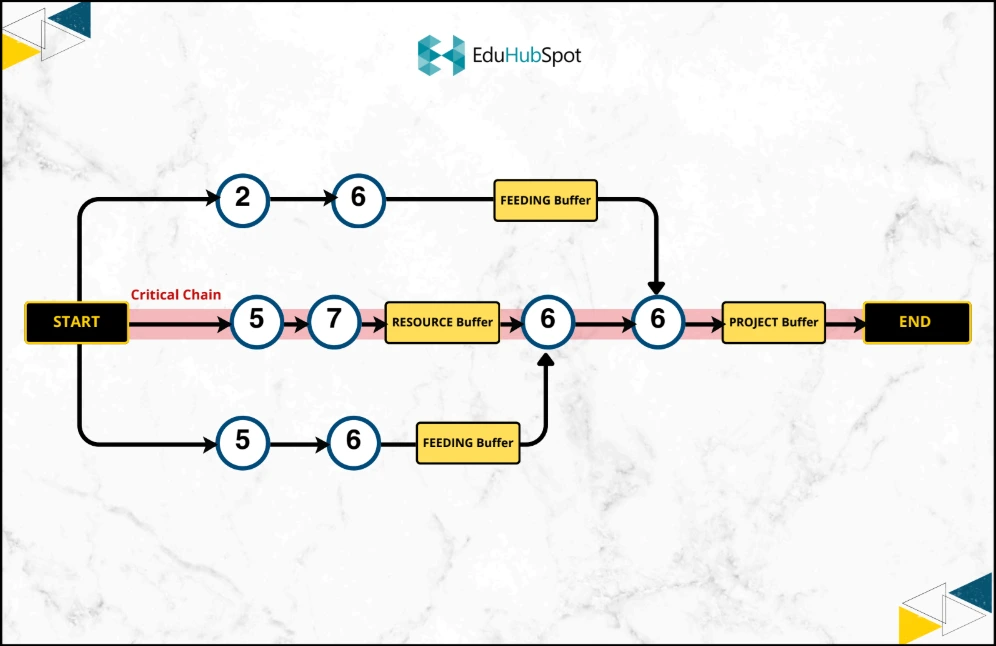
While critical chain project management eliminates unnecessary buffer times in job estimates, it uses three different kinds of buffers to keep the critical chain running smoothly.
a) Project buffers
Placing project gaps at the end of the critical chain provides a safety net for the whole project in case something goes wrong. They prepare for unplanned delays and ensure the project's due date stays the same.
b) Feeding buffers
People sometimes call these feeding buffers or integration buffers. They are put where two non-critical chains meet with one critical chain. Their job is to keep delays in the supply lines from affecting the critical path.
c) Resource buffers
They let you know when you need more resources before they are required on the critical chain. This proactive method makes sure that the resources that are needed are easy to find when they are necessary, which reduces the chance of problems.
Critical Chain Project Management Benefits
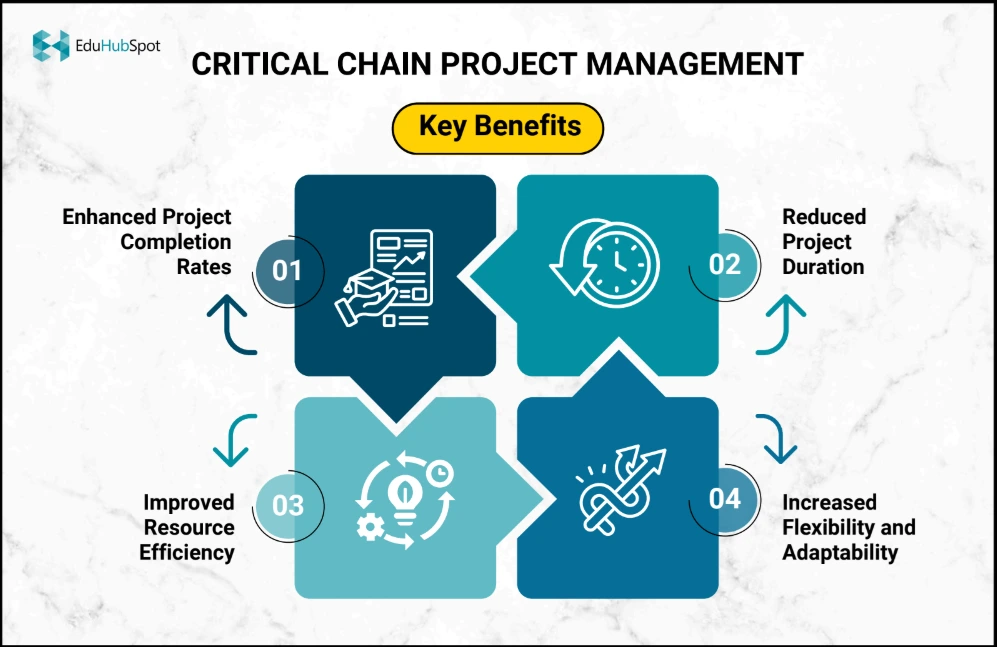
Employing Critical Chain Project Management can provide many advantages for companies that want to improve their project management methods.
1. Increased project throughput and efficiency
CCPM speeds up projects and makes them more efficient by eliminating unnecessary buffer times. It also pushes team members to work on tasks simultaneously and creates a sense of urgency among them.
2. Focus on deliverables over internal milestones
Pay attention to deliverables instead of internal milestones. While traditional methods stress meeting interim milestones, CCPM shifts the focus to delivering the project outcome on time, directing team efforts toward the end goal.
3. Fewer interruptions and better flow
Critical Chain Project Management doesn't allow interruptions or switching between tasks, which can lower output and quality. Instead, it tells team members to focus on one job at a time, which makes work go more smoothly and helps people concentrate better.
Example Cases of Critical Chain Project Management
Critical Chain Project Management has been shown to work in a number of different businesses and project settings. Some noteworthy examples are.
1. Manufacturing
Critical Chain Project Management has helped companies like Boeing, Lucent Technologies, and Ricoh. These simplify their production processes, reduce lead times, and better use their resources.
2. Construction
Many construction companies use CCPM to handle complicated building projects, making the best use of resources and reducing delays caused by insufficient resources.
3. IT and software development
Agile software development teams have used CCPM concepts to improve their delivery efficiency. They ensure that resources are available at the right time for the project and that people don't have to do too many things at once.
Critical Chain Project Management Future
Critical Chain Project Management is going to become a more common way for businesses to handle complicated projects. CCPM practices could be made even better with the help of new trends and methods.
For instance, advanced predictive analytics might make it easier to estimate tasks and predict resources more accurately. So, we don't have to rely on forecasts made by people as much.
Also, constant monitoring and fluid rescheduling could allow management to change buffer sizes and assignments on the fly, making it more responsive and flexible. Combining Critical Chain Project Management with other new approaches, such as Design Thinking and Lean Startup. These could also lead to new ways of promoting value and innovation.
CCPM's focus on managing constraints, design thinking's focus on the user, and lean startup's iterative cycles may make it easier to deliver projects that meet customer goals while making the best use of resources.
Conclusion
Project teams can produce amazing results by applying Critical Chain Project Management and embracing fresh approaches. CCPM keeps interconnected buffers and jobs to lower latency, unlike past approaches. By clearing obstacles, one can maximize resources and project speed.
With CCPM, businesses save time, control risk, and complete projects more quickly. CCPM and TOC provide a strategic edge in hectic corporate environments to help you finish projects responsibly and on schedule. Boost your career with the best PMP certification course and master Critical Chain Project Management for faster, more efficient project success.
Frequently Asked Questions (FAQs)
What distinguishes Critical Chain Project Management from traditional project management?
While CCPM stresses resource restrictions, buffer management, and eliminating multitasking, traditional approaches center on job deadlines.
Does Critical Chain Project Management benefit industries?
Fields, including manufacturing, building, IT, and healthcare, rely on CCPM to increase output and lower project delays.
How can buffer management increase CCPM project performance?
Buffers absorb uncertainty, stopping delays by ensuring resources are available and protecting important project tasks.
Is CCPM compatible with Agile or Lean?
Yes, CCPM can collaborate with Agile and Lean to improve resource use and reduce wasteful processes.
Explore Our Latest
Insights

Stay updated with our recent blog posts.
Explore Our
Course Gallery

Discover a diverse range of courses designed to elevate your skills and knowledge.

