How to Estimate Activity
Durations with Confidence

Estimating how long each task will take is one of the most critical and challenging parts of project planning.


Table of Contents
Share This Article

Introduction
Estimating activity duration is one of the most critical and challenging parts of project planning. Accurate estimation provides the foundation of a successful project. Get it right, and you can build realistic timelines, allocate resources efficiently, and keep stakeholders satisfied. Get it wrong, and you risk delays and missed deadlines.
Fortunately, with the right techniques and structured approaches, you can estimate with greater confidence and precision. This guide will cover proven strategies to master time estimation and improve project outcomes.
Why Activity Duration Estimation Matters
Every project, irrespective of size or field of work is built upon the basis of a set of tasks each having its own deadline. A precise activity duration estimation is crucial since the overall project timeline can be calculated by the total of the durations. When estimates are accurate, project managers can prepare realistic schedules and recognize risk early. They can allocate resources efficiently and work within delivery deadlines.
Inaccurate estimates result in delays in success, overrun costs and undermine stakeholder trust. They also affect project schedule estimation which causes teams to be under stress or sit idle for long. Time estimates that are reliable will not only help in planning better but also boost overall execution and the success of projects.
Techniques for Activity Duration Estimation
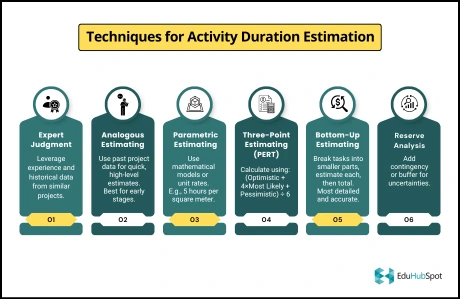
Expert Judgment
It is the process of consulting with experienced professionals and stakeholders for activity duration estimation based on prior project experiences and their knowledge. It is especially useful when there are no historical data or tasks that are unique. This method relies heavily on intuition, insight, and lessons learned.
Benefits:
- Quick to implement
- Leverages experience
- Works well for complex or new tasks
- Adaptable to changing circumstances
Analogous Estimating
This estimation technique uses the actual durations of previous projects like that to estimate current tasks. Known as top-down estimation, this method is great for the early project phases when there are few details. It gives a rough but quick estimate for scheduling.
The benefits include:
- Fast and cost-effective
- Requires minimal data
- Ideal for high-level planning
- Useful for feasibility assessment
Parametric Estimating
The statistical relationship between project variables and historical data can help in parametric estimation. For example - one unit of work requires X hours and multiplying the quantity by X gives you a total duration. It is very precise when the data and model are accurate
Benefits:
- High accuracy with good data
- Scalable and repeatable
- Ideal for repetitive tasks
- Supports quantitative decision-making
Project Planning Tools for Accurate Estimation
Critical Path Method (CPM)
CPM is a scheduling technique that identifies the longest sequence of dependent activities (the critical path) to determine the project's minimum completion time. Project managers can improve the timeline by focusing on tasks with no slack.
CPM allows project managers to visualize task dependencies and manage resource allocation. It helps identify bottlenecks that could delay the project. CPM is especially useful for projects that have well-defined tasks with fixed timelines. It is a valuable tool for accurate estimation of activity duration and for overall project scheduling.
PERT Chart (Program Evaluation Review Technique)
It can estimate the timeline of a project when activity durations remain uncertain. The chart uses three estimates of time for each task - optimistic, most probable, and pessimistic. The weighted-average formula can combine these estimates and calculate the expected duration. This method accounts for the variability and risks in complex projects.
PERT charts can help managers and project team members plan better and anticipate delays. It can improve the accuracy of activity length estimation by incorporating probabilistic estimates. This is especially true for research, development and innovative projects, where it can be difficult to predict exact durations.
Three-Point Estimation
When there's uncertainty in estimating how long a task might take, three-point estimation provides a structured and more realistic approach. It incorporates a range of possible outcomes instead of relying on a single guess, which helps account for variability and risk.
Three-point estimation involves gathering three values for each task:
- Optimistic (O): The best-case scenario where everything goes smoothly
- Most Likely (M): The most probable duration under normal conditions
- Pessimistic (P): The worst-case scenario with delays or issues
This method can be applied using different techniques like Analogous Estimating and PERT Estimating.
Analogous Estimating (Three-Point)
Analogous estimating is a top-down method that uses historical data from similar projects. When used with three-point estimation, it provides rough, experience-based duration ranges.
PERT Estimating (Program Evaluation and Review Technique)
PERT is a more formalized version of three-point estimation used primarily for complex, uncertain, or research-heavy projects. It improves accuracy by factoring in probability-weighted durations.
Tips to Improve Activity Duration Estimation
Break Down Tasks with Work Breakdown Structure (WBS)
Using WBS can help break down complex and large deliverables into manageable, and simple tasks. These tasks can be easy to understand and evaluate and estimate. It improves accuracy in activity duration estimation and reveals any dependencies or missing components. A complete WBS helps improve team accountability and clarifies the scope by creating a solid base for project success.
Include Resource Availability
An estimation of activity duration must consider the amount of effort required and availability of resources and its allocation. The task could take more time if the staff are on a part-time basis or have shared across projects. Making allowances for work calendars, holidays, and other simultaneous tasks ensures realistic timeframes and helps avoid delays. You must always confirm the commitments of resources during the planning stage to ensure that expectations align with delivery timeframes.
Adjust for Risk and Uncertainty
The estimation is not complete without understanding the unexpected challenges that can affect timeframes. This is the reason it is important to include buffers for contingencies or use estimation models like PERT. For high-risk tasks, you should consider the worst-case scenario and use the risk-adjusted duration estimation. You must ensure to document assumptions in a clear manner and use historical data when possible. This proactive way to manage risk can help to ensure excellent activity duration estimation even with uncertainty.
Validate with Team Feedback
Your team members usually have the most precise insights on how long tasks require. Engaging participants in estimation boosts participation and can help uncover unnoticed issues. It decreases the tendency to be optimistic and facilitates open discussion. You must look over past performance and then compare estimations. This approach of team collaboration strengthens alignment and improves estimation credibility. It increases reliability of activity duration estimation throughout different project phases.
Monitor and Adjust
Duration estimation does not end when the date is set. You must always monitor progress against estimates to find gaps early. Make use of this information to refine the future estimation of the duration of activities and also update timelines for remaining activities. Monitoring task performance regularly can help to identify deviations, monitor changes in scope, and ensure that the project is on course. Effective monitoring and swift adjustments help to improve the process and boost the reliability of schedules over time.
Common Pitfalls to Avoid
Over-optimism:
Assuming best-case scenarios without accounting for risks or delays can lead to unrealistic timelines, missed deadlines, and increased pressure on the team during project execution.
Ignoring historical data:
Failing to use past project data overlooks valuable insights and patterns, resulting in repeated mistakes and less accurate activity duration estimation, especially for recurring or similar project tasks.
Lack of documentation:
Not recording assumptions, sources, or estimation methods reduces transparency and makes it difficult to justify decisions, troubleshoot issues, or improve future project schedule estimation efforts.
Skipping dependencies:
Neglecting task relationships and sequencing can cause scheduling conflicts, resource misallocations, and unintended delays that ripple through the entire project timeline.
Following a Balanced Approach
No single method guarantees perfect estimates. Instead, a structured combination of expert insights, historical data, and analytical tools yields the most reliable activity duration estimates.
To streamline the estimation process, follow a logical sequence:
Estimation Process Flow:
Work Breakdown Structure (WBS) → Identify Resource Availability → Choose Estimation Method → Apply Risk Buffers → Validate with Team → Update Schedule
This step-by-step approach ensures that estimates are both realistic and adaptable. Here's how various methods can fit into your strategy:
For Example:
- Start with analogous estimation for early timelines
- Use expert judgment to validate high-risk tasks
- Apply parametric estimation for standardized tasks
- Use PERT and CPM for schedule optimization and risk modeling
By blending these techniques and following a structured workflow, project managers can improve accuracy, accountability, and scheduling confidence throughout the project lifecycle.
Conclusion
Accurate activity duration estimation is vital for successful project planning and execution. Project managers can create reliable schedules and mitigate risks by combining expert insights and proven techniques like CPM and PERT. Avoiding common pitfalls and continuously refining your approach ensures better outcomes and stronger team performance. With the right methods and tools empowers you to plan confidently and deliver projects on time and within scope.
Frequently Asked Questions (FAQs)
Why should I involve my team in estimating durations?
Team members add to your practical understanding of the task, relying on experience to provide you with good estimates and help to mitigate estimation bias.
How does risk management influence duration estimation?
Identifying risks early helps include contingency buffers or alternative task sequencing, improving estimation accuracy.
What strategies can I implement to improve accuracy in estimating time over the long run?
Keep track of your actual performance for activity duration estimation and make data-based adjustments. You can update your estimating process and base your estimates on what you have learned historically and any feedback received.
What does the Critical Path Method give a project manager with regards to estimating time?
CPM identifies the longest sequence of dependent tasks, allowing the project manager to focus on the tasks that will impact the project schedule directly.
Explore Our Latest
Insights

Stay updated with our recent blog posts.
Explore Our
Course Gallery

Discover a diverse range of courses designed to elevate your skills and knowledge.

