OKRs Vs. KPIs.: How They Help in
Performance Management

Learn how OKRs and KPIs help in performance management. Discover the key differences between OKRs and KPIs, when to use each, and how they drive better results for your business.


Did you ever feel like your team is working hard but not moving in the right direction? Or maybe you regularly track the performance, but they don't drive meaningful results? Well, here comes the role of OKRs. Vs. KPIs. Performance management isn't only about numbers; it's also about setting the right goals, tracking performance, and ensuring the efforts are going in the right direction. This further helps the business to succeed. Companies like Google, Intel, and Spotify use OKRs (Objectives and Key Results) to drive ambitious growth. On the other hand, some companies utilize KPIs (Key Performance Indicators) to monitor and sustain performance.
This blog will help you understand the difference between OKRs and KPIs, their role in performance management and how to use them effectively.
Understanding OKRs: Goal Setting for Ambition and Growth
Setting the right goals is essential for any business to succeed. But have you ever thought about how high-end companies consistently achieve ambitious milestones?
The answer lies in their OKRs (Objectives and Key Results), a goal-setting framework that helps businesses focus, align and measure outcomes. OKRs is a methodology that allows the team and organizations to focus and set clear goals, which will further help progress and quantifiable results. Andy Grove originally developed this concept at Intel in the 1970s. Subsequently, it became popular when John Doerr introduced it to Google in 1999. Since then, many companies have adopted OKRs to drive growth.
Unlike traditional goal-setting methods, OKRs help the teams to go beyond their comfort zones. Here's how they are structured:
Objective
The objective needs to be clearly defined as what you want to achieve. This must be a motivating, deadline-driven, and inspiring challenge.
Key results
Another aspect is the key results that you are expecting to achieve. These are the measurable outcomes that indicate whether the objective is achieved. Key results must be specific, numeric, and time-bound to ensure accountability.
Consider the below example, which highlights the OKR for a project management team: The objective will be to improve project delivery efficiency and team collaboration.
The key results that can be expected to achieve may include:
- Complete 95% of projects on time and within budget.
- Reduce project bottlenecks by 30% through improved workflow management.
- Increase stakeholder satisfaction score from 80% to 90%.
This OKR will ensure that the project managers focus on timely delivery, efficiency and stakeholder management, which is crucial for successful project execution.
What are the Five C's of Effective Communication in Project Management
OKRs are about tracking performance and acting as a performance accelerator. Here are some of the advantages of OKRs:
- Alignment across teams: OKRs ensures that everyone in the team, whether its leaders or employees, is working in the same direction.
- Agility and adaptability: OKRs allow the leaders to pivot and adjust as needed, as OKRs are reviewed quarterly.
- Data-driven decision making: Organizations can track real progress and make informed adjustments.
- Increased accountability: OKRs are transparent and shared which ensures that teams stay focused and motivated to achieve their goals.
Understanding KPIs: Measuring Success with Data
Tracking the proper metrics is one of the key components of performance management. This can further help in measuring progress, identifying gaps and making data-driven decisions. OKRs, on the one hand, assist in setting ambitious goals, while KPIs, on the other hand, help to provide a clear and measurable way to track ongoing progress.
KPIs (Key Performance Indicators) are quantifiable metrics that measure how effectively an individual or a team in an organization is performing to achieve business success. KPIs assist in monitoring performance to ensure stability and efficiency over time.
According to a study, it has been identified that nearly half, i.e., 49% of small and medium-sized business owners, have failed to identify any KPIs.
For example, if a project management's team objective (OKR) is to improve project delivery efficiency, then a KPI must be to track and monitor the project's performance. This will ensure that 95% of the projects are completed on time within the budget.
Likewise, if a project manager with project management professional certification sets an OKR to enhance stakeholder management, a relevant KPI could be to monitor the stakeholder engagement score. This can thus be measured through feedback surveys and achieving a 90% positive rating.
PMP beyond the certificate: Lifelong skills you'll gain from PMP training
Also, not all KPIs are treated equally and provide the same kind of insight. KPIs can be divided into two main types:
Leading KPIs
These KPIs predict future performance and identify upcoming trends. For example, the number of leads generated can be expected to determine the approximate future sales.
Lagging KPIs
These KPIs help measure past performance and further help evaluate success and failure—for example, customer churn rates reflecting past retention efforts.
Apart from these two main types, KPIs are divided across business functions. They are listed as follows:
- Financial KPIs
- Operational KPIs
- Customer KPIs
- Sales and Marketing KPIs
- Project Management KPIs
KPIs are the performance management benchmark, ensuring that every effort pays off. This can lead to growth, efficiency and business success. While tracking customer satisfaction, revenue or project completion rates, the right KPIs help businesses stay on track, make informed decisions and achieve sustainable success.
Futureproof your Career by Doing PMP certification.
OKRs Vs. KPIs: Key Differences and When to Use Each
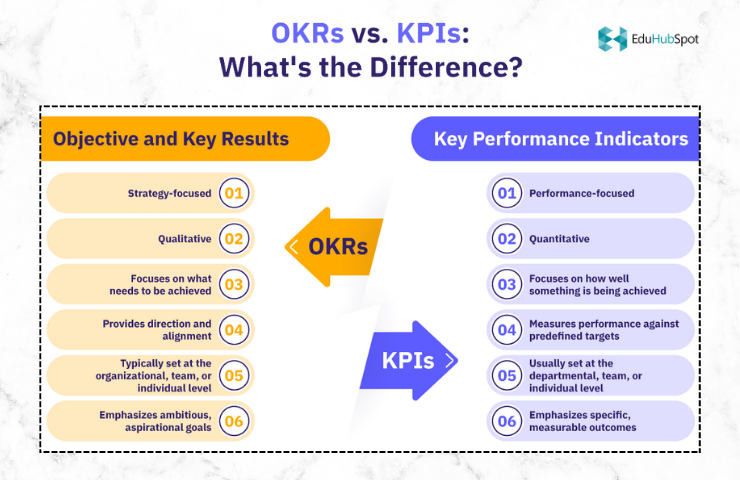
If you want your business to thrive, then you must track the progress in the right way. But here's the big question – OKRs. Vs. KPIs – what do you need to focus on? Although both – OKRs and KPIs play an integral role in performance management, they both serve different purposes.
OKRs are like your big, bold goals, which help you to aim high and push your boundaries by coming out of your comfort zone. Conversely, KPIs are like your performance checkpoints – they help you measure ongoing progress and ensure everything is on track.
We'll break down the key differences in OKRs. Vs. KPIs, which will help you understand both the terms in a much more straightforward way.
| Aspect | OKRs | KPIs |
|---|---|---|
| Purpose | Set ambitious high-impact goals for growth. | Measure and track ongoing performance and operational success. |
| Focus | Big picture objective and strategic growth. | Specific metrics tied to efficiency and results. |
| Timeframe | Often set for a specific period – maybe quarterly. | It can be both short-term and long-term. |
| Flexibility | Supports agile and adaptable goal setting. | Provides a strong basis for data-driven decisions. |
| Measurement | Results may be subjective and open to interpretation and discussion. | Results are concrete and objective. |
| Risk Level | Encourages us to stretch goals; hence, achieving 70% - 80% is typical. | Targets are expected to be met consistently. |
| Function | It helps define priorities and focus areas. | It helps to track progress and performance. |
| Usage | When you need innovation, transformation and growth. | When you need to monitor stability, efficiency and success. |
| Benefits | Helps in alignment, clarity, accountability, continuous improvement, employee engagement and transparency. | Helps in performance measurement, goal alignment, accountability, continuous improvement, resource optimization, employee development and communication and transparency. |
Now that you have understood the differences in OKRs Vs. KPIs, you must be thinking about when to use each. Well, the usage of OKRs and KPIs depends on your business goals.
You can use OKRs when you want growth or drive change by pushing your boundaries. For example, your objective is to improve project delivery efficiency.
However, if you want to measure ongoing performance and keep a note of the progress, then KPIs are best suited. For example, you may want to reduce project budget variance to less than 5%. However, it is suggested to keep a sweet balance of OKRs and KPIs to have an approach with dual benefits.
For example, a project management team wants to enhance project efficiency and success rates. Here, the OKR will improve the overall effectiveness of project delivery.
Key results can include:
- Implement a new project risk assessment.
- Conduct PMP boot camps and training sessions for all project managers.
- Improve stakeholder management and engagement through a structured communication plan in project management.
KPI can be to increase the on-time project completion rate from 85% to 95% to ensure that all the efforts are paid off.
Project Management Made Easy: PMP Boot Camp for Busy Professionals
Common Mistakes and Best Practices in Using OKRs. Vs. KPIs.
Setting goals isn't difficult; however, making them work is undoubtedly challenging. Many organizations dive into OKRs vs. KPIs without having a clear strategy. This makes them misaligned and unaccountable, and they struggle to track meaningful progress. Just setting numbers and targets isn't enough; you need a solid framework that drives meaningful results.
So you must be thinking – how to avoid these common pitfalls? And most importantly, how do you make OKRs Vs. KPIs work for your business?
Let's have a look at some of the common mistakes you must avoid:
1. Setting vague or unrealistic OKRs and KPIs
A common mistake most people make is to make too broad, unrealistic or lacking measurable outcomes. Without proper clarity, teams won't know exactly what to do.
An example of a bad OKR can be: 'improve project delivery' – this doesn't give clarity to anybody. However, this can be improved by mentioning an OKR with a clear idea – 'improve project delivery efficiency by implementing a strong and new risk assessment framework and increasing on-time project completion from 85% to 95%.
Likewise, an example of a bad KPI is 'improve stakeholder engagement'. This can further be improved by 'increasing stakeholder satisfaction score from 80% to 90% by the project review cycle.'
To effectively practice this, ensure that all OKRs and KPIs in project management follow the SMART (Specific, Measurable, Achievable, Relevant and Time-bound) criteria for setting goals.
2. Confusing OKRs with KPIs
To successfully define OKRs and KPIs, ensure clarity on using both terms. Most individuals treat OKRs and KPIs as one thing.
3. Setting too many OKRs and KPIs
Another mistake people make is setting too many OKRs and KPIs, which burdens the individuals, leading to burnout.
For example, a project management team sets more than 10 OKRs per quarter. This can then lead to confusion, lack of focus and ineffective execution.
However, the best practice is to focus on 3-5 significant high-impact OKRs that align with the project goals and priorities. This ensures that each objective has 2-4 measurable key results. You can prioritize only the most critical goals that drive high impact, such as on-time delivery, risk mitigation and stakeholder management.
Conclusion
OKRs and KPIs are some of the most impactful performance management tools, but only if used correctly. By avoiding common mistakes and following best practices, OKRs vs. KPIs can help businesses drive success, growth and innovation. Instead of choosing OKRs vs. KPIs, it's best advisable that the organizations choose to utilize both. This thereby creates a balanced approach. Take the next step in mastering performance-driven project management!
Whether you are preparing for PMP certification or looking to refine your project management skills, implementing the right OKRs and KPIs can help drive success.
Frequently Asked Questions (FAQs)
What is the difference between OKRs and KPIs?
OKRs refer to Objectives and Key Results, which help the organizations define goals they expect to achieve, which can further lead to growth and innovation. KPIs refer to Key Performance Indicators that help track and monitor progress effectively.
Can OKRs and KPIs be used together?
Yes, the best way is to use OKRs and KPIs together to have a balanced approach.
How many OKRs and KPIs a team should have?
A team should have 3-4 OKRs per quarter, while teams should track 5-10 critical KPIs.
Who are the key stakeholders involved during the initiating phase?
Key stakeholders include project sponsors, clients, senior management, subject matter experts, and end-users. Involving them early ensures that the project is aligned with organizational goals and user expectations.
What happens if you skip the Initiating Process Group?
Projects without proper initiation often suffer from vague objectives, misaligned stakeholder expectations, unclear authority, and higher risk of failure.
When is a project officially authorized to begin?
When the project charter is formally approved by the sponsor, and the project manager is assigned.
Table of Contents
Share This Article
Explore Our Latest
Insights

Stay updated with our recent blog posts.
Explore Our
Course Gallery

Discover a diverse range of courses designed to elevate your skills and knowledge.

