How Story Mapping Transforms
Complex Projects into Actionable Steps

Complex project management resembles maze navigation because teams encounter difficulties when they fail to coordinate their goals and tasks for the project. Story mapping provides a visual framework that simplifies development activities.


Table of Contents
Share This Article
Complex project management resembles maze navigation because teams encounter difficulties when they fail to coordinate their goals and tasks for the project. Story maps for your project, or simply put, story mapping provides a visual framework that simplifies development activities. It helps break down complex tasks, simplifying user journeys, allowing teams to track progress while identifying bottlenecks and setting proper priorities.
Facts: Jeff Patton developed story mapping as a tool that enables teams to concentrate on user requirements while ensuring each project stage adds genuine value to the result.
This blog examines how story mapping transforms complicated projects into concise steps, which leads to project success and improved collaboration and produces user-focused products.
Whether you're launching a new product or refining an existing one, story mapping is a tool for turning vision into reality.
What is Story Mapping?
Story maps for your project are a visual approach that enables teams to understand and organize their product's customer experience. Story mapping transforms product assessment by directing teams to see things from a user-centric viewpoint, which ensures that development activities match genuine user requirements.
Example: Teams express user needs through documented objectives using user stories that follow this standard structure: "As a [persona], I want to [action] so I can [benefit]".
Teams use this approach to jointly discover and arrange work that provides maximum value to users. Traditional documentation is complemented by story mapping in Agile environments. This approach is essential for adaptive project management, where constant changes require flexibility and responsiveness.
How To Build Story Maps for Your Project?
Story mapping began as a manual process that used whiteboards with sticky notes for teams to create visual story structures that they could easily adjust. Remote work has necessitated project management tools such as Miro, Trello, and Jira, which allow distributed teams to work together effortlessly while developing and enhancing their user story mapping. This is particularly useful when managing project complexity, where teams must track many moving parts.
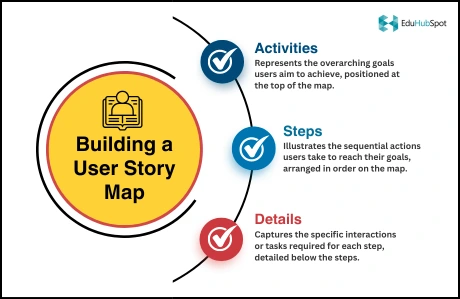
User story mapping contain three hierarchical levels that guide their structure.
- Activities: Users want to accomplish these goals, which constitute the activity level. The highest level of the map contains these elements, which should appear at the top.
- Steps: Users perform defined actions to achieve their goals through a sequential arrangement on the map.
- Details: Each step requires details, which are listed below as the granular interactions or tasks needed for completion.
Why Use Story Mapping for Your Project?
1. A Clear, Shared Understanding
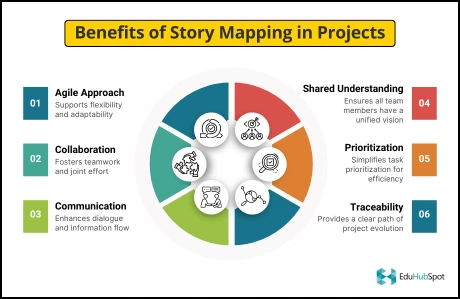
The main difficulty in any project stems from achieving alignment among all team members, from developers to designers to stakeholders. Story Mapping for Your Project acts as a visual reference, ensuring that everyone understands the product’s features, user journey, and priorities. Project design from a user-focused perspective results in better understanding between teams while minimizing confusion to enhance collaboration.
2. Prioritization Made Simple
Not all features are equally important, and this is where Story Mapping for Your Project helps. Through story mapping, teams can easily detect the essential user stories that bring maximum value to the project. The approach helps teams distinguish essential features from optional ones, which allows them to allocate resources effectively while speeding up product delivery.
3. Enhanced Traceability
Keeping track of project requirements and deliverables can be challenging, but Story Mapping for Your Project creates a seamless link between user needs and the final product. The ability to track development steps directly from user needs produces better progress tracking and quality control results. This is crucial when striving to meet strategic goals, as outlined in PMI's Approach to Implementing Benefits Realization.
4. Improved Communication & Collaboration
Story mapping functions as a communication pathway that serves more than tool functionalities. Story Mapping for Your Project breaks down barriers between different teams, ensuring that discussions are productive and feedback is actionable. A shared roadmap improves decision-making by providing better information, resulting in products that meet genuine user requirements.
5. Agile-Friendly Approach
Agile setups require absolute flexibility from their teams. Story Mapping for Your Project supports iterative and incremental development, making it easier for teams to pivot when needed. The story map can be modified as the product develops to integrate user feedback, which leads to continuous product refinement based on market feedback. Story mapping ensures that each step is focused on delivering user value, a critical aspect of project portfolio management.
6. A Proven, User-Centric Strategy
Jeff Patton introduced story mapping as part of Agile software development in 2005. The combination of User Experience design principles with Agile methods enabled him to maintain the team's focus on delivering meaningful value to users. Over the years, businesses beyond software development have embraced Story Mapping for Your Project, applying it in marketing, product management, and various other fields.
Want to excel as a project manager and learn story mapping? Check out this video to understand why a PMP certification can help you master the art of creating story maps for your project and excel in your organization.
Step-by-Step Guide to Story Mapping
This blueprint provides an effective method to structure your customer journey mapping process. We'll guide you through each step with a practical example to demonstrate how Story Mapping for Your Project streamlines development and enhances user experience.
1. Define the User's Activities
The first step in creating Story Mapping for Your Project is identifying the user's primary goal. This goal serves two purposes: it keeps the project focused on user needs and organizes a list of necessary functionalities.
Example:
Consider a banking app. The user must return the money to the person who transferred $100 to them the previous week. The functionality of returning wire transfers is defined as “Return Wire Transfer." This goal sets the foundation for structuring the Story Mapping for Your Project.
2. Define a User Persona
Creating a detailed user persona helps make the customer journey more relatable and ensures that the Story Mapping for Your Project caters to the right audience.
A banking application targets personal account users instead of business clients. By creating this persona, we achieve better results in our approach while identifying our specific target audience.
3. Break Down the Steps
We establish the user's goal and identity before we analyze the necessary steps to achieve it. Story Mapping for Your Project requires a step-by-step approach to ensure no essential detail is overlooked.
The primary actions for our banking application consist of:
- Log in
- Find the sender’s account number
- Create a new transaction
- Transfer funds
These form the pillars of our Story Mapping for Your Project, ensuring that every stage of the user journey is well-structured.
4. A Clear, Shared Understanding
The process requires listing all user interactions that exist within each activity. Story Mapping for Your Project should be comprehensive and include existing and planned details.
The log-in process breakdown consists of:
- Entering the username and password
- Clicking the login button
- Completing two-factor authentication (if enabled)
The breakdown process should be applied to each step so that developers can better understand the user journey. The method reveals necessary adjustments, including the implementation of a simple "Return Funds" button to simplify transactions.
5. Prioritize the Work
The next step in the process requires users to prioritize all mapped user stories. Story Mapping for Your Project should focus on ranking stories based on importance, ensuring critical features are developed first.
Example User Story:
The mobile personal account user requires an option to generate new transactions by copying recipient information from received transfers for speedier payments to specific users.
When working with Jira or comparable systems, product owners or business analysts usually consolidate user stories into epics based on business value or theme in alignment with the customer /user.
6. Consider Potential Problems
Each new feature's implementation has the potential to modify the current operational capabilities. Story Mapping for Your Project should proactively identify and mitigate potential risks, bottlenecks, and dependencies.
Example Considerations:
- The "Return Funds" button poses no potential security threats to the system.
- The system requires a mechanism to identify which transaction should be used for automatic data pre-filling.
- The deployment timeline may be affected by any dependencies between different features.
By addressing these concerns early, Story Mapping for Your Project ensures smoother implementation and a better user experience.
Conclusion
Implementing Story Mapping for Your Project helps teams stay organized, prioritize effectively, and create user-centric products. The six-step approach enables development efficiency while reducing errors to deliver exceptional user experiences. Join a valuable course to dive deeper into mastering story mapping and enhance your project management skills. Start using Story Mapping for Your Project today and transform your workflow!
Explore Our Latest
Insights

Stay updated with our recent blog posts.
Explore Our
Course Gallery

Discover a diverse range of courses designed to elevate your skills and knowledge.

