Project Schedule:
The Secret Weapon for a Seamless Project Delivery

Learn about project scheduling in project management. Discover scheduling benefits, methods, tools, and how to create effective project schedules for seamless project delivery.


Table of Contents
Share This Article
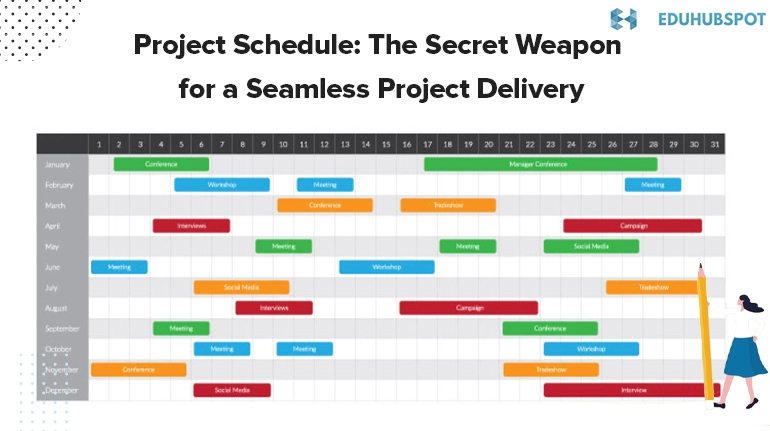
Imagine you're a project manager for a construction company and you've been assigned to build a new office building. To ensure the project is completed on time and within budget, you need to create a schedule and a project charter for the formal foundation for the project.
First, you'll gather information about each task that needs to be completed, such as laying the foundation, building walls, installing electrical wiring, etc. Next, you'll determine the dependencies between these tasks, such as whether one task needs to be completed before another can begin.
With this information, you'll create a timeline that shows the start and end dates for each task and the duration of each one. You'll also identify the critical path, which is the sequence of tasks that must be completed on time for the entire project to be completed on schedule.
As the project progresses, you'll need to monitor the schedule and make adjustments as needed to keep the project on track. This may involve rescheduling tasks, adding new tasks, or removing tasks that are no longer necessary.
By effectively scheduling the tasks in your project, you can ensure that your team can complete the project on time and within budget.
To enhance your scheduling skills, consider enrolling in MS Project training. This course focuses on the use of Microsoft Project, a key tool for any project manager. Through MS Project training, you will learn how to efficiently create, manage, and adjust project schedules using the software. This includes setting up task dependencies, managing resources, and tracking project progress, which are crucial for maintaining control over complex projects such as construction of a new office building. This specialized training will not only improve your proficiency with project management software but also equip you with the advanced skills necessary to handle project challenges more effectively.
What is scheduling?

Scheduling in project management refers to the process of creating a plan for the project timeline and allocating resources to specific tasks within that timeline. The goal of scheduling is to ensure that the project is completed on time, within budget, and to the desired level of quality.
A well-designed project schedule is an essential tool for successful project management. It provides a clear and comprehensive overview of the project timeline, enabling project managers and team members to understand the interdependence of tasks and the impact of changes on the overall project. Scheduling also helps identify potential risks and allows project managers to take proactive measures to mitigate them
Here are the key steps in the scheduling process:
- Define the project scope: The first step in creating a project schedule is to clearly define the project scope. This involves identifying the project deliverables, determining the project timeline, and defining the project constraints.
- Break down the project into tasks: The next step is to break down the project into smaller, more manageable tasks. This allows project managers to better understand the interdependence of tasks and to allocate resources more effectively.
- Establish task dependencies: Once the project is broken down into tasks, it is important to identify the dependencies between tasks. This includes identifying which tasks must be completed before others can begin and which tasks can be done simultaneously.
- Establish task duration: Establishing task duration involves determining how long each task is likely to take to complete. This is typically done by considering the resources required, the complexity of the task, and any constraints that may affect the duration.
- Allocate resources: After the task duration has been established, it is time to allocate resources to the tasks. This involves assigning specific team members to each task and determining the resources required to complete the task, such as equipment, materials, and supplies.
- Create a project network diagram: A project network diagram is a visual representation of the project schedule, showing the interdependence of tasks and the critical path. This diagram is essential for understanding the impact of changes on the overall project timeline.
- Develop a project schedule: Using the information gathered in the previous steps, it is possible to develop a comprehensive project schedule. This schedule should include all tasks, their duration, and the resources allocated to each task. It should also include the critical path and any potential risks that have been identified.
- Monitor and update the schedule: The final step in the scheduling process is to monitor and update the schedule regularly. This involves tracking the progress of tasks and making adjustments as necessary. It is important to regularly review the schedule to ensure that the project remains on track and to take corrective action if necessary.
Scheduling is an iterative process, and it is important to continuously monitor and update the schedule as the project progresses. The schedule should be a living document that is updated regularly to reflect changes in the project timeline, resource allocation, and task dependencies.
Benefits of scheduling in project management

Scheduling in project management provides several benefits, including:
- Better time management: Scheduling helps project managers allocate the right amount of time to each task, ensuring that deadlines are met and projects are completed on time.
- Improved resource utilization: Scheduling allows project managers to effectively allocate resources such as personnel, materials, and equipment to ensure that they are used efficiently.
- Enhanced collaboration: Scheduling enables project team members to coordinate their work effectively and work together towards the common goal of delivering the project on time.
- Increased visibility: Scheduling provides project managers and stakeholders with a clear view of the project timeline, enabling them to track progress and identify potential roadblocks early on.
- Reduced risk: Scheduling helps project managers identify potential risks and plan for contingencies, reducing the risk of project delays or failures.
- Increased accountability: Scheduling helps project managers hold team members accountable for their tasks, as well as hold themselves accountable for meeting project goals and deadlines.
Effective project scheduling methods
A Gantt chart is the most used type of project schedule. A Gantt chart can be used to produce both a milestone schedule and a thorough project schedule. Look for project scheduling solutions that let you build various views from the same schedule when selecting scheduling software.
Make sure that a thorough project schedule with milestones that you develop as a Gantt Chart may be condensed to that level for a clearer perspective that can be easily shared with your team or stakeholders. This enables you to present the same schedule in many ways, depending on the desired amount of detail and the intended audience.
Depending on the requirements of the project, your team can select from a variety of additional project management scheduling strategies than using a Gantt chart. The programme evaluation and review technique and the critical path method (CPM) are two additional well-liked project management scheduling methods (PERT).
Often employed in construction project management, the critical path method based the project schedule on the project's critical path, or the quantity of tasks required for completion as well as the order in which they must be done. The sequence of tasks that are crucial to the project's success is known as the critical path.
Other tasks may also be incorporated in a project, however they are referred to as float tasks if they are not on the critical path.
The total project timeline is planned using a PERT chart, a visual mapping tool, as part of the programme evaluation and review technique (PERT). The PERT chart of a project has several boxes, each of which represents a project activity or task. Each box has seven components, each of which refers to a distinct aspect of the activity, such as its duration, slack, and the time at which it may begin or end.
Conclusion
Scheduling is an essential aspect of project management that involves creating a timeline for project tasks and determining the resources needed to complete them. Effective scheduling helps ensure that a project is completed on time, within budget, and to the desired level of quality.
It is a continuous process that requires regular monitoring, updating, and adjusting to accommodate changes in project scope, timeline, and resources. With the right tools, techniques, and experience, project managers can effectively schedule projects to achieve their desired goals and outcomes.
Frequently Asked Questions (FAQs)
Why is scheduling important in project management?
Scheduling is important in project management because it helps ensure that a project is completed on time, within budget, and to the desired level of quality. Effective scheduling helps project managers plan, organize, and coordinate resources to achieve project goals and objectives.
What are the different types of schedules in project management?
The most common types of schedules in project management include Gantt charts, critical path method (CPM) schedules, and network diagrams. Other types of schedules include bar charts, milestones, and project calendars.
What is the difference between a Project Schedule and a Gantt chart?
A Project Schedule is a comprehensive document that outlines the timeline, tasks, and resources of a project. A Gantt chart is a visual representation of a Project Schedule, showing the timeline and progress of the project tasks in a graphical format.
How Does Project Management Use the PMBOK?
The project management industry accepts the PMBOK, or Project Management Body of Knowledge, as the complete set of procedures, best practices, terminologies, and recommendations. Companies value PMBOK because it enables them to standardize procedures across diverse divisions, modify procedures to meet particular requirements, and avoid project failures.
The body of knowledge must be frequently updated and communicated since it is continually expanding as practitioners learn new techniques or best practises. The Project Management Institute (PMI), a nonprofit member association of project management experts, is in charge of overseeing this endeavour.
Explore Our Latest
Insights

Stay updated with our recent blog posts.
Explore Our
Course Gallery

Discover a diverse range of courses designed to elevate your skills and knowledge.

